Impact of Cyclone Dip Tube Geometry on Process Efficiency and Operational Stability
Table of Contents
Introduction
In the intricate world of modern cement manufacturing, the preheater system stands as a cornerstone for efficiency, directly influencing kiln productivity, fuel economy and overall operational stability. Within this complex tower of cyclones, riser ducts and calciner systems, a seemingly small component, the Cyclone Dip Tube, wields a surprisingly significant impact. Often underestimated, its design and condition are paramount to achieving optimal preheater performance.
This article delves into the critical functions of the cyclone dip tube, exploring its aerodynamic principles, common problems and the profound economic implications of its proper functioning. We will also examine a real-life case study demonstrating how optimizing this vital component can lead to substantial improvements in efficiency and cost savings.
Understanding the Cyclone Dip Tube
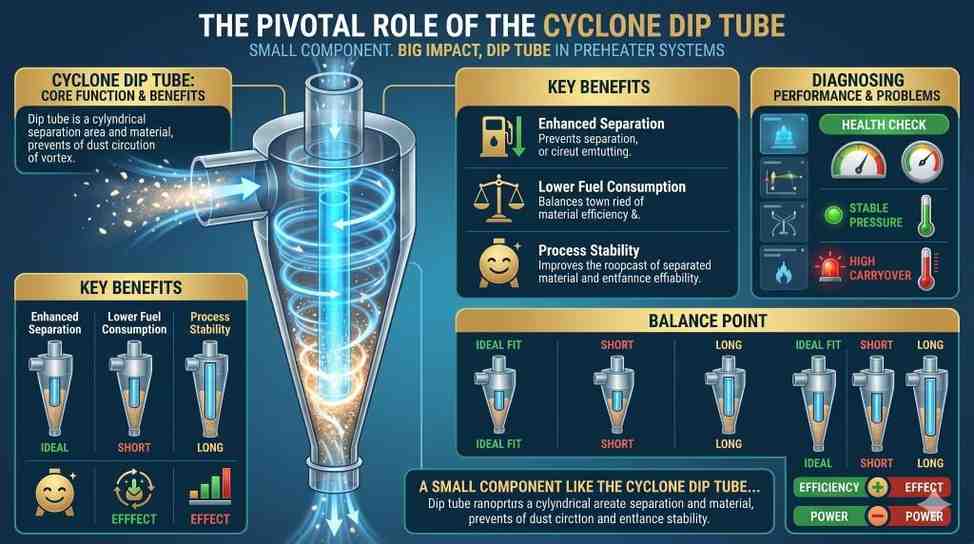
The cyclone dip tube, also known as a vortex finder, is a cylindrical component strategically placed within the upper section of a cyclone separator. It extends downwards from the gas outlet into the main body of the cyclone. Its fundamental role is to guide the cleaned gases out of the cyclone while ensuring the efficient separation of raw meal particles from the gas stream.
In a suspension preheater system, hot gases and raw meal enter the cyclone tangentially, creating a powerful rotating vortex. The centrifugal force drives heavier particles towards the cyclone wall, causing them to descend into the discharge cone. Concurrently, the cleaned gases reverse direction, forming an inner upward vortex, and exit through the dip tube. Thus, the dip tube acts as a controlled gas extraction channel, crucial for stabilizing the internal vortex structure and preventing particle bypass.

Core Functions of the Cyclone Dip Tube
The dip tube performs several critical process functions simultaneously, all contributing to the overall efficiency of the preheater system:
1. Gas and Material Separation
The most vital role of the dip tube is to prevent direct short-circuiting of dusty gases to the outlet. Without a properly designed and positioned dip tube, dust particles can bypass the separation zone, leading to a drastic reduction in cyclone efficiency. A correctly installed dip tube ensures:
- Maximum raw meal separation
- Reduced dust carryover to subsequent stages
- Improved gas-solid residence time for heat transfer
- Better heat transfer efficiency
2. Stabilization of the Internal Vortex
Stable vortex formation is essential for effective cyclone operation. The dip tube creates a defined central vortex structure, facilitating controlled upward gas flow, reducing turbulence, and maintaining stable centrifugal separation forces. Instability in the vortex can lead to a sharp drop in separation efficiency and increased pressure fluctuations throughout the preheater system.

3. Pressure Drop Control
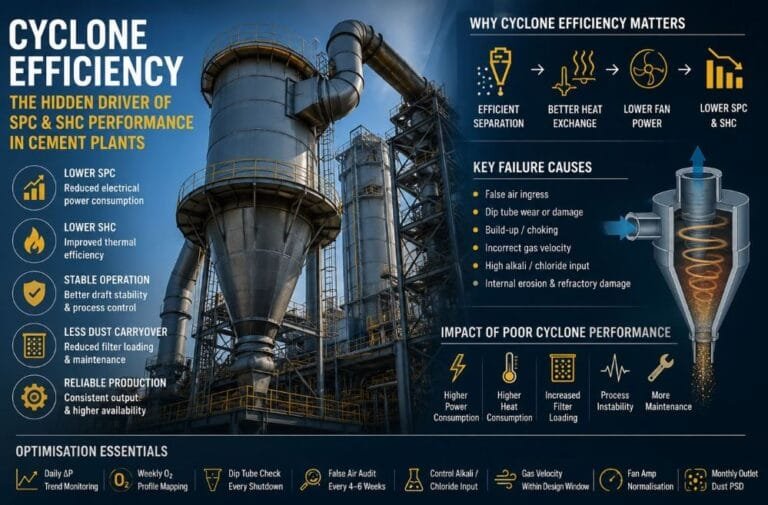
Every cyclone inherently creates resistance to gas flow, known as pressure drop. The dip tube significantly influences the gas velocity profile, turbulence intensity, flow resistance, and cyclone draft stability. An optimized dip tube minimizes unnecessary turbulence while maintaining adequate separation efficiency. This balance is crucial because excessive pressure drop directly increases ID fan power consumption, specific electrical energy usage, and overall operating costs.
Why the Dip Tube is Critical for Preheater Efficiency
The impact of the cyclone dip tube extends to several key performance indicators of a cement plant’s preheater system:
A. Improvement in Cyclone Separation Efficiency
The dip tube directly affects how efficiently raw meal is separated from process gases. A properly designed dip tube facilitates a stable double vortex inside the cyclone: an outer downward spiral carrying material and an inner upward spiral carrying cleaned gases. This structured flow pattern significantly increases centrifugal separation efficiency .
Efficient separation leads to a reduction in dust carryover, which means less dust moves to the next cyclone stage or returns to the kiln inlet. This results in improved heat exchange, reduced kiln inlet dust circulation, better calcination stability and lower thermal losses. Ultimately, improved separation translates to fuel consumption reduction, as more raw meal remains in effective contact with hot gases, and less hot dust escapes the system. This directly lowers specific heat consumption, coal or alternative fuel requirements, and mitigates thermal instability.
B. Pressure Stability and Fan Performance
Preheater draft stability is heavily dependent on cyclone pressure behavior. A properly engineered dip tube reduces chaotic internal flow patterns and stabilizes gas exit conditions, helping to maintain smooth gas extraction, stable cyclone differential pressure, and predictable airflow patterns .
Unstable cyclone flow creates fluctuating resistance, forcing the Induced Draft (ID) fan to continuously compensate. A healthy dip tube helps maintain consistent preheater fan load, better draft control, reduced fan stress, and lower electrical power consumption. In large kiln systems, even minor improvements in pressure stability can lead to significant annual energy savings.
C. Control of Gas Short-Circuiting
Gas short-circuiting occurs when gases bypass the intended separation path and move directly to the outlet. A correct dip tube prevents premature gas escape, extends the effective separation path length, and maintains cyclone residence time. This improves material retention, heat transfer effectiveness, and calcination consistency.
Aerodynamic Principles Behind Dip Tube Performance
Cyclone efficiency is fundamentally governed by fluid dynamics. The dip tube influences tangential gas velocity, axial velocity profile, swirl intensity, and residence time distribution. A well-designed dip tube enhances centrifugal force generation while minimizing energy losses caused by turbulence.
Key aerodynamic parameters influenced by the dip tube include:
- Dip tube diameter: Affects gas velocity and pressure drop.
- Immersion depth: Critical for preventing short-circuiting and stabilizing the vortex.
- Vortex finder geometry: Influences the shape and stability of the inner vortex.
- Clearance from cyclone roof: Impacts gas flow patterns at the inlet.
- Gas velocity distribution: Determines the effectiveness of centrifugal separation.
- Small geometric deviations in the dip tube can significantly affect cyclone efficiency and pressure drop .

Common Dip Tube Problems and Their Operational Impact
Over time, dip tubes are subjected to severe thermal and abrasive conditions, leading to various problems, each with distinct operational consequences:
1. Short Dip Tube
A dip tube that is too short cannot properly isolate the outlet vortex from the incoming dusty gas stream. This leads to:
- Poor separation efficiency
- High dust carryover
- Increased kiln inlet circulation load
- Elevated top-stage outlet temperatures
- Reduced thermal efficiency
The cyclone essentially loses its ability to effectively separate fine particles.
2. Excessively Long Dip Tube
While longer dip tubes can initially improve separation efficiency, excessive immersion creates major drawbacks:
- High pressure drop
- Increased ID fan load
- Severe material build-up risk
- Increased probability of cyclone choking
- Restricted gas flow
An overly long dip tube can eventually destabilize the entire preheater system.
3. Damaged or Worn Dip Tube
Erosion and thermal stress gradually deform the dip tube geometry, resulting in:
- Vortex instability
- Unpredictable pressure fluctuations
- Higher preheater fan power consumption
- Reduced heat exchange efficiency
- Increased operational instability
In severe cases, portions of the dip tube may collapse or detach, causing major cyclone blockage and potentially leading to costly downtime.
The Critical Balance: Separation Efficiency vs. Pressure Drop
Optimizing cyclone performance is always a compromise between maximizing material separation and minimizing pressure loss. This is a fundamental principle in preheater process engineering.
| Dip Tube Condition | Advantages | Disadvantages |
| Too Long | Higher separation efficiency, Lower dust carryover | Higher resistance, Greater pressure drop, Increased fan power, Build-up tendency |
| Too Short | Lower pressure drop, Reduced flow resistance | Poor separation, High dust recirculation, Thermal losses, Reduced efficiency |
The engineering objective is to achieve an ideal dip tube design that provides maximum particle separation, stable vortex formation, minimum turbulence, and the lowest practical pressure drop. This optimum balance is the foundation of efficient cyclone operation.
Operational Indicators of Dip Tube Problems
Experienced kiln operators can often identify dip tube issues through process trends before physical inspection. Key indicators include:
- Sudden Drop in Cyclone Efficiency: A reduction in material separation may indicate dip tube erosion, misalignment or structural damage.
- Increased Preheater Fan Power Consumption: Higher resistance or unstable flow patterns force the ID fan to draw more power, serving as an early warning sign.
- Increased Kiln Inlet Dust Loading: Poor cyclone separation increases internal dust circulation, affecting kiln inlet stability, calciner performance, and coating formation.
- Unstable Cyclone Differential Pressure: Erratic pressure fluctuations often indicate vortex instability, gas short-circuiting, internal obstruction or dip tube deformation.
- Elevated Top Stage Temperatures: Poor heat exchange allows more thermal energy to escape from upper cyclone stages, increasing stack losses, fuel consumption and overall heat inefficiency.
- Frequent Build-Up Formation: Incorrect gas flow patterns promote coating accumulation inside cyclone cones, dip tubes and riser ducts. Recurring blockages frequently trace back to dip tube design or condition issues.
Maintenance and Inspection Best Practices
Given the severe operating conditions, regular inspection and proactive maintenance of the cyclone dip tube are essential:
Routine Internal Inspection
During planned shutdowns, thoroughly check for erosion thickness loss, warping, cracks, misalignment, and build-up deposits.
Dimensional Verification
Measure the dip tube’s immersion depth, diameter consistency, and concentric alignment to ensure it meets design specifications.
Refractory and Surface Condition Monitoring
Damaged refractory lining or exposed metal accelerates erosion and thermal deformation. Ensure the protective lining is intact.
Process Trend Monitoring
Continuously track operational parameters such as cyclone pressure drop, fan load, top-stage temperatures and kiln inlet dust loading. Operational trends often reveal problems earlier than physical inspections during shutdowns.
Modern Design Improvements in Dip Tubes
Advanced cyclone systems leverage computational fluid dynamics (CFD) to optimize dip tube designs. Modern improvements focus on enhancing efficiency and durability:
- Anti-vortex geometries: Designed to improve flow patterns and reduce turbulence.
- Wear-resistant liners: Extend the lifespan of the dip tube in abrasive environments.
- Aerodynamic edge shaping: Minimizes pressure drop and improves flow characteristics.
- Low-pressure-drop configurations: Reduce energy consumption of the ID fan.
- Ceramic protection systems: Provide superior resistance to high temperatures and abrasion.
These developments collectively improve separation efficiency, equipment life, and energy performance.
Economic Impact of Proper Dip Tube Performance
Despite its size, the cyclone dip tube significantly influences several major cost drivers in a cement plant:
- Fuel Savings: Improved heat exchange directly reduces specific heat consumption.
- Electrical Savings: Lower pressure drop decreases ID fan power demand.
- Production Stability: Stable cyclones improve kiln consistency and reduce upset conditions, minimizing costly downtime.
- Maintenance Reduction: Proper flow distribution minimizes coating and blockage frequency, leading to fewer repairs and extended equipment life.
In large cement plants, even minor improvements in cyclone efficiency due to optimized dip tube performance can yield substantial annual savings.
Case Study: Kerman Cement Plant Optimization
One of the most documented and successful implementations of Cyclone Dip Tube optimization occurred at the Kerman Cement Plant in Iran. This case study is widely cited in process engineering for its use of advanced computational modeling to solve real-world efficiency bottlenecks.
1. The Challenge
The plant operated a Hurriclon cyclone system in its preheater tower. After undergoing structural modifications intended to increase capacity, the plant noticed a significant decrease in separation efficiency. The raw meal was not being separated effectively from the gas stream, leading to high dust carryover and increased thermal losses.
2. The Solution: Technical Optimization
Process engineers conducted a study using Computational Fluid Dynamics (CFD) and Design of Experiment (DOE) to pinpoint the exact geometric cause of the inefficiency. They focused on three critical dimensions of the first-stage cyclones:
- Vortex-Finder (Dip Tube) Length: Adjusting how deep the tube extended into the cyclone body.
- Cylinder Height: Modifying the main body volume.
- Cone Tip Diameter: Optimizing the material discharge point.

3. Implementation and Results
By redesigning the Cyclone Dip Tube to an optimized length and diameter based on the CFD results, the plant achieved the following measurable improvements:
| Performance Metric | Before Optimization | After Optimization | Net Improvement |
|---|---|---|---|
| Separation Efficiency | ~85% (Estimated) | ~98.4% | +13.4% Increase |
| Pressure Drop | High resistance | Reduced turbulence | -2.2% Decrease |
| Dust Carryover | Excessive | Minimal | Significant Reduction |
4. Key Takeaway
The Kerman case study proves that the Cyclone Dip Tube is not just a “static pipe” but a precision instrument. By increasing the efficiency by over 13%, the plant was able to significantly lower its fuel consumption per ton of clinker, as more preheated material stayed in the system rather than escaping with the exhaust gases.
This cases demonstrate that investing in high-quality dip tube maintenance and design is one of the fastest ways to achieve a high Return on Investment (ROI) in cement manufacturing.
Conclusion
The cyclone dip tube is an often-underestimated yet operationally significant component within a cement plant preheater system. Its influence extends far beyond simple gas routing, directly governing cyclone efficiency, vortex stability, pressure behavior, heat exchange effectiveness, and overall kiln stability. A properly designed and maintained Cyclone Dip Tube is instrumental in achieving efficient material separation, stable preheater operation, lower fuel consumption, reduced electrical power usage, and enhanced kiln reliability.
Conversely, a damaged or improperly sized dip tube can create severe process instability, escalate operating costs, and diminish overall plant efficiency. For process engineers and plant operators, meticulous attention to dip tube condition, geometry, and aerodynamic performance remains one of the most cost-effective methods for optimizing preheater performance and improving overall kiln economics.


3 thoughts on “Cyclone Dip Tube Effect on Separation Efficiency”