Driving Efficiency, Quality, and Sustainability in Modern Cement Production
A comprehensive technical analysis of Cement Mill Separator Optimization and their impact on grinding circuit performance.
Table of Contents
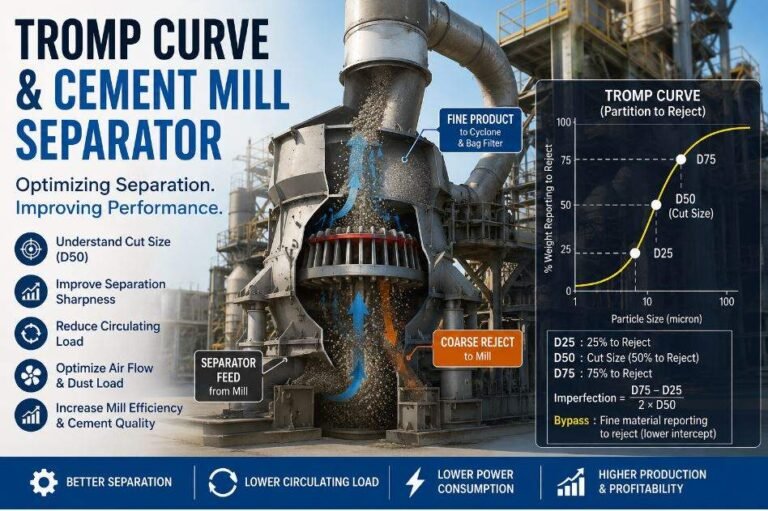
In the cement manufacturing industry, the grinding process represents one of the most energy-intensive and operationally critical stages of production. At the heart of optimizing this process lies the cement mill separator – a sophisticated component that classifies ground materials with precision, ensuring that only properly sized particles advance to the final product stream while oversized material is recycled back for further grinding.
Over the past five decades, separator technology has undergone a dramatic transformation. The evolution from rigid, static setups to highly dynamic, intelligent systems has enabled modern cement plants to achieve unprecedented reductions in energy consumption while simultaneously maximizing product quality and operational consistency. This technical article examines the three distinct generations of separator technology, their operational principles, performance characteristics, and the transformative impact they deliver across the entire grinding circuit.
Key Performance Metrics
| Metric | Value | Impact |
| Energy Efficiency Gain | 50-60% | Reduction from 1st to 3rd generation |
| Separator Efficiency (3rd Gen) | 65-75% | High-efficiency systems |
| Production Improvement | 30%+ | Output increase with modern separators |
| Specific Energy Consumption (3rd Gen) | 0.8-1.2 kWh/ton | Lowest power consumption |
| Circulating Load Reduction | 30-50% | Less material recycled to mill |
| Blaine Consistency (3rd Gen) | ±50 cm²/g | Superior fineness control |
The Three Generations of Cement Mill Separators
1st Generation: Static Separator
The earliest separator designs relied entirely on fundamental physics principles without any moving components. These static separators represent the foundational technology upon which all subsequent innovations have been built.

Operating Mechanism
Separation is achieved exclusively through internal airflow patterns and gravitational forces. Material enters the separator cone, where the velocity of ascending air is carefully controlled. Coarse particles, unable to remain suspended in the air stream, settle by gravity to the bottom of the cone and are discharged as rejects back to the grinding mill. Fine particles, conversely, are carried upward by the air stream and exit as finished product.
Key Characteristics
- No moving parts: Mechanical simplicity reduces maintenance requirements and initial capital costs
- High circulating load: Excessive fine material is unnecessarily returned to the mill, reducing overall efficiency
- Limited fineness control: Inconsistent product fineness and poor control over particle size distribution
- Separator efficiency: 40-50%, requiring higher specific energy consumption (2.0-2.5 kWh/ton)
- Blaine consistency: ±100-150 cm²/g, indicating significant variability
Ideal Application
Older cement plants with basic production requirements and limited capital for upgrades. Still operational in many developing markets and legacy facilities where simplicity and low maintenance are prioritized over efficiency.
2nd Generation: Dynamic Separator
To address the inefficiencies inherent in static designs, the second generation introduced rotating mechanical elements that harness centrifugal force to dramatically improve particle classification accuracy and consistency.

Operating Mechanism
Dynamic separators integrate a rotating distributor plate and dynamic vanes that spin at controlled speeds, typically 100-150 rpm. As material enters the separator, the rotating distributor disperses it radially outward. The centrifugal force generated by this rotation, combined with the upward air stream, creates a more precise classification zone. Heavier, coarser particles are thrown outward by centrifugal action and fall to the reject chamber, while lighter, finer particles are drawn inward and upward toward the product outlet.
Key Characteristics
- Reduced overgrinding: More precise classification minimizes unnecessary regrinding, saving time and energy
- Improved fineness control: Better control over product Blaine and particle size distribution
- Enhanced production stability: More consistent product quality and reduced process variability
- Separator efficiency: 50-60%, with specific energy consumption of 1.5-2.0 kWh/ton
- Blaine consistency: ±75-100 cm²/g, representing significant improvement over 1st generation
Ideal Application
Existing cement plants seeking to upgrade from static systems to achieve quick performance improvements. Particularly valuable for brownfield retrofits where capital constraints limit complete system replacement.
3rd Generation: High-Efficiency Separator
Introduced in the mid-1980s, the third generation represents the pinnacle of separator technology, engineered to meet the most stringent environmental and quality standards while delivering unprecedented energy efficiency and operational performance.

Operating Mechanism
High-efficiency separators employ a sophisticated rotor cage design consisting of multiple stages of rotating and stationary elements. The rotor cage, typically operating at higher speeds (200-300 rpm), creates a complex flow field that optimizes particle classification. Material enters the separator and is distributed into the rotor cage, where multiple stages of centrifugal classification occur. The multi-stage design allows for exceptionally precise particle size cutoff, with minimal bypass of coarse particles and minimal loss of fine particles to the reject stream. External ventilation systems provide additional control over the classification environment.
Key Characteristics
- Lowest specific power consumption: Reduced kWh per ton of cement, directly lowering electricity costs
- Superior Blaine control: Exceptional fineness consistency with lower residue variation across all mesh sizes
- Maximum mill output: Optimized classification increases grinding mill throughput by 15-30%
- Separator efficiency: 65-75%, with specific energy consumption as low as 0.8-1.2 kWh/ton
- Blaine consistency: ±50 cm²/g, representing exceptional precision
Ideal Application
Modern cement plants prioritizing peak performance, energy efficiency, and premium product standards. Essential for facilities targeting net-zero emissions or competing in premium cement markets where product consistency is paramount.
Separator Technology Comparison
Visual Comparison of Three Generations
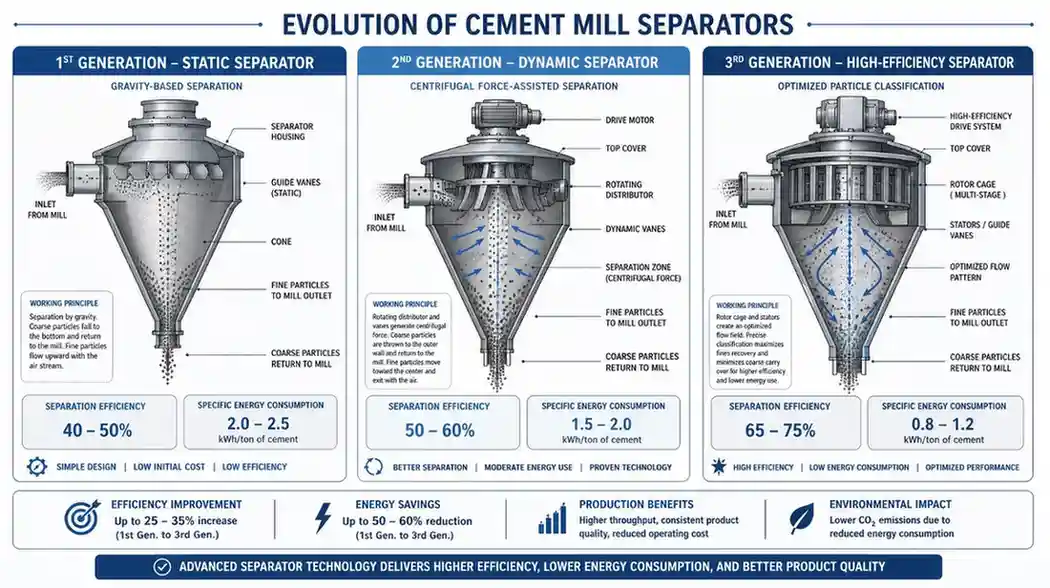
The following diagram illustrates the evolution from static to dynamic to high-efficiency rotor cage separator designs:

Figure 1: Technical schematic showing the evolution from static to dynamic to high-efficiency rotor cage separator designs, with key performance metrics for each generation.
Comparative Performance Summary
| Parameter | 1st Generation | 2nd Generation | 3rd Generation |
| Separation Mechanism | Gravity-based | Centrifugal force | Multi-stage rotor cage |
| Separator Efficiency | 40-50% | 50-60% | 65-75% |
| Specific Energy (kWh/ton) | 2.0-2.5 | 1.5-2.0 | 0.8-1.2 |
| Circulating Load | High (35-50%) | Moderate (20-35%) | Low (10-20%) |
| Blaine Consistency | ±100-150 cm²/g | ±75-100 cm²/g | ±50 cm²/g |
| Production Increase | Baseline | +10-15% | +15-30% |
| Moving Parts | None | Rotating elements | Multi-stage rotor cage |
| Maintenance Complexity | Low | Medium | Medium-High |
| Capital Cost (relative) | 1.0x | 1.2-1.4x | 1.3-1.6x |
Why Separator Performance Matters
Impact on Grinding Circuit Efficiency
An optimized separator does not impact merely one component of the grinding circuit- it fundamentally transforms the efficiency of the entire system. The separator acts as the critical control point that determines what material returns to the mill for further grinding and what exits as finished product. This classification function directly influences energy consumption, production rate, product quality, and maintenance requirements across the entire operation.
Six Key Operational Benefits
| Performance Metric | Impact on Grinding Circuit | Quantified Benefit |
| Higher Production | Increased mill output and vastly improved circuit throughput | 15-30% increase in production capacity |
| Lower Power Consumption | Reduced kWh needed per ton of cement, directly lowering electricity bills | 6-10 kWh/t savings per ton |
| Better Fineness Control | Achieves stable Blaine and optimized particle size distribution for stronger cement | ±50 cm²/g Blaine consistency |
| Lower Circulating Load | Less material returns to the mill, ensuring more efficient grinding cycles | 30-50% reduction in recirculation |
| Improved Efficiency | Better overall grinding efficiency with minimal overgrinding | 25-35% overall circuit efficiency gain |
| Consistent Quality | Uniform final product quality, leading to better customer satisfaction | Reduced product variability by 40-60% |
The Grinding Circuit Ecosystem
Complete Process Flow
The grinding circuit functions as an integrated ecosystem where each component influences the performance of all others:
Raw Material Input → Grinding Mill → Efficient Separator → Quality Cement Output
↓ Reject Stream (Return to Mill)
Raw material enters the grinding mill, where it is progressively reduced in size through mechanical action. The ground material, suspended in an air stream, is then transported to the separator for classification. The separator’s efficiency in distinguishing fine particles from coarse particles directly determines the energy efficiency of the entire circuit.
Grinding Circuit Flow Diagram

Figure 2: Complete grinding circuit flowchart showing material flow from raw input through grinding mill, efficient separator, to quality cement output, with energy consumption and performance metrics at each stage.
Macroeconomic Advantages of Optimized Separation
- Higher Availability: Less mechanical wear and tear on grinding media and mill internals, meaning fewer maintenance shutdowns and increased uptime
- Lower Maintenance Costs: Smooth, optimized operations reduce the frequency of part replacements and emergency repairs
- Better Return on Investment (ROI): Energy savings and higher output quickly offset the capital cost of upgrading to high-efficiency separators
- More Competitive Operation: Lower production costs allow plants to price their products more competitively in the market
- Environmental Compliance: Reduced energy consumption translates to lower CO₂ emissions and improved sustainability metrics
Quantified Performance Improvements
Efficiency Metrics Across Generations
The following visualization demonstrates the measurable improvements in separator efficiency, energy consumption, circulating load reduction, and production output:

Figure 3: Comparative analysis of separator efficiency, specific power consumption, circulating load reduction, and production output improvement across three generations of separator technology.
Key Performance Improvements
- Separator Efficiency: 40-50% (1st Gen) → 65-75% (3rd Gen) = 40% improvement
- Specific Power Consumption: 5.0 kWh/t (1st Gen) → 2.5 kWh/t (3rd Gen) = 50% reduction
- Circulating Load: 35% (1st Gen) → 15% (3rd Gen) = 57% reduction
- Production Output: Baseline (1st Gen) → +30% (3rd Gen) = 30% increase
Technical Specifications and Operating Parameters
1st Generation Static Separator
| Parameter | Specification |
| Separator Efficiency | 40-50% |
| Specific Energy Consumption | 2.0-2.5 kWh/ton |
| Circulating Load | High (35-50%) |
| Blaine Consistency | ±100-150 cm²/g |
| Cut Point (d₅₀) | 40-50 μm |
| Pressure Drop | 2.5-3.5 kPa |
| Rotor Speed | N/A (static) |
| Maintenance Interval | 6-12 months |
| Component Life | 4-6 years |
2nd Generation Dynamic Separator
| Parameter | Specification |
| Separator Efficiency | 50-60% |
| Specific Energy Consumption | 1.5-2.0 kWh/ton |
| Circulating Load | Moderate (20-35%) |
| Blaine Consistency | ±75-100 cm²/g |
| Cut Point (d₅₀) | 30-40 μm |
| Pressure Drop | 1.8-2.5 kPa |
| Rotor Speed | 100-150 rpm |
| Maintenance Interval | 3-6 months |
| Component Life | 3-5 years |
3rd Generation High-Efficiency Separator
| Parameter | Specification |
| Separator Efficiency | 65-75% |
| Specific Energy Consumption | 0.8-1.2 kWh/ton |
| Circulating Load | Low (10-20%) |
| Blaine Consistency | ±50 cm²/g |
| Cut Point (d₅₀) | 20-30 μm |
| Pressure Drop | 1.2-1.8 kPa |
| Rotor Speed | 200-300 rpm |
| Maintenance Interval | 12 months |
| Component Life | 5-7 years |
Maintenance Considerations and Equipment Longevity
1st Generation Static Separators
Maintenance Profile: Minimal moving parts reduce mechanical failures, but wear on internal cones and vanes requires replacement every 4-6 years. Inspection and maintenance are straightforward but frequent.
- Typical Maintenance Interval: 6-12 months for inspections; major overhaul every 4-6 years
- Common Wear Items: Internal cones, inlet vanes, thimble assembly
- Maintenance Cost: Low (primarily labor and simple parts)
- Downtime per Service: 2-4 days
2nd Generation Dynamic Separators
Maintenance Profile: Rotating elements introduce additional wear mechanisms, requiring more frequent bearing inspections and lubrication schedules. Rotor blade wear necessitates replacement every 3-5 years depending on material abrasiveness.
- Typical Maintenance Interval: 3-6 months for bearing checks; rotor blade replacement every 3-5 years
- Common Wear Items: Bearings, rotor blades, seals, lubrication systems
- Maintenance Cost: Moderate (bearing replacement and specialized labor)
- Downtime per Service: 3-5 days
3rd Generation High-Efficiency Separators
Maintenance Profile: Advanced bearing designs and optimized flow patterns reduce wear significantly. Predictive maintenance programs can extend component life to 5-7 years. The reduced circulating load minimizes wear on mill internals, providing indirect maintenance benefits across the grinding circuit.
- Typical Maintenance Interval: 12-month bearing inspections; rotor cage replacement every 5-7 years
- Common Wear Items: Rotor cage blades, bearings, seals
- Maintenance Cost: Moderate-High (advanced components, but longer intervals)
- Downtime per Service: 4-6 days (less frequent)
Indirect Maintenance Benefits
The reduced circulating load from high-efficiency separators provides significant indirect maintenance benefits:
- Mill Liner Wear: Reduced by 20-30% due to lower recirculating load
- Grinding Media Consumption: Reduced by 15-25% due to optimized grinding conditions
- Mill Bearing Life: Extended by 10-15% due to reduced stress
- Overall Mill Availability: Increased by 5-10% due to fewer maintenance interventions
Return on Investment Analysis
Financial Impact for a 1.5 MTPA Facility
For a typical 1.5 million tonne per annum (MTPA) cement plant, upgrading from a 1st generation static separator to a 3rd generation high-efficiency separator delivers compelling financial returns.
Annual Financial Benefits
| Benefit Category | Annual Value | Basis |
| Energy Savings | $400,000 – $600,000 | 6-10 kWh/t reduction at $0.08/kWh |
| Production Increase | $200,000 – $300,000 | 15-30% throughput improvement at $40/ton |
| Maintenance Cost Reduction | $100,000 – $150,000 | Fewer shutdowns and reduced wear parts |
| Quality Premium | $50,000 – $100,000 | Consistent product commands premium pricing |
| Total Annual Benefit | $750,000 – $1,150,000 | Cumulative operational advantages |
Investment and Payback Analysis
| Metric | Value |
| Estimated Capital Cost | $2,000,000 – $3,500,000 |
| Annual Operating Benefit | $750,000 – $1,150,000 |
| Simple Payback Period | 2.5 – 4.5 years |
| Equipment Lifespan | 15-20 years |
| Additional Benefit Period | 10-17 years after payback |
| Net Present Value (10 year horizon) | $3,500,000 – $5,200,000 |
| Internal Rate of Return (IRR) | 25-35% |
Sensitivity Analysis
The payback period varies based on key assumptions:
- If electricity cost is $0.10/kWh: Payback period reduces to 2.0-3.5 years
- If electricity cost is $0.06/kWh: Payback period extends to 3.5-5.5 years
- If production increase is 40% (vs. 20%): Payback period reduces by 0.5-1.0 years
- If capital cost is 20% lower: Payback period reduces by 0.5 years
Conclusion: The Strategic Imperative for Separator Optimization
The evolution of cement mill separator technology represents one of the most significant advances in cement manufacturing efficiency over the past five decades. The progression from static gravity-based designs through dynamic centrifugal systems to sophisticated high-efficiency rotor cage separators demonstrates the industry’s commitment to continuous improvement in energy efficiency, product quality, and operational sustainability.
Key Takeaways
- Energy Efficiency: Modern high-efficiency separators reduce specific energy consumption by 50-60% compared to 1st generation systems, translating to $400,000-$600,000 in annual electricity savings for a typical 1.5 MTPA facility.
- Production Performance: 3rd generation separators increase mill throughput by 15-30% through superior classification and reduced circulating load, enabling plants to produce more cement with the same installed capacity.
- Product Quality: Exceptional Blaine consistency (±50 cm²/g) and precise particle size control enable cement plants to produce premium products that command market premiums and satisfy the most demanding specifications.
- Financial Returns: Upgrading to high-efficiency separators delivers a 2.5-4.5 year payback period with internal rates of return of 25-35%, making separator upgrades one of the highest-ROI investments in cement plant modernization.
- Environmental Impact: Reduced energy consumption translates directly to lower CO₂ emissions, supporting cement plants’ sustainability goals and compliance with increasingly stringent environmental regulations.