Impact of Cyclone Efficiency on Heat and Power Consumption: Critical Impacts Every Cement Engineer Must Know
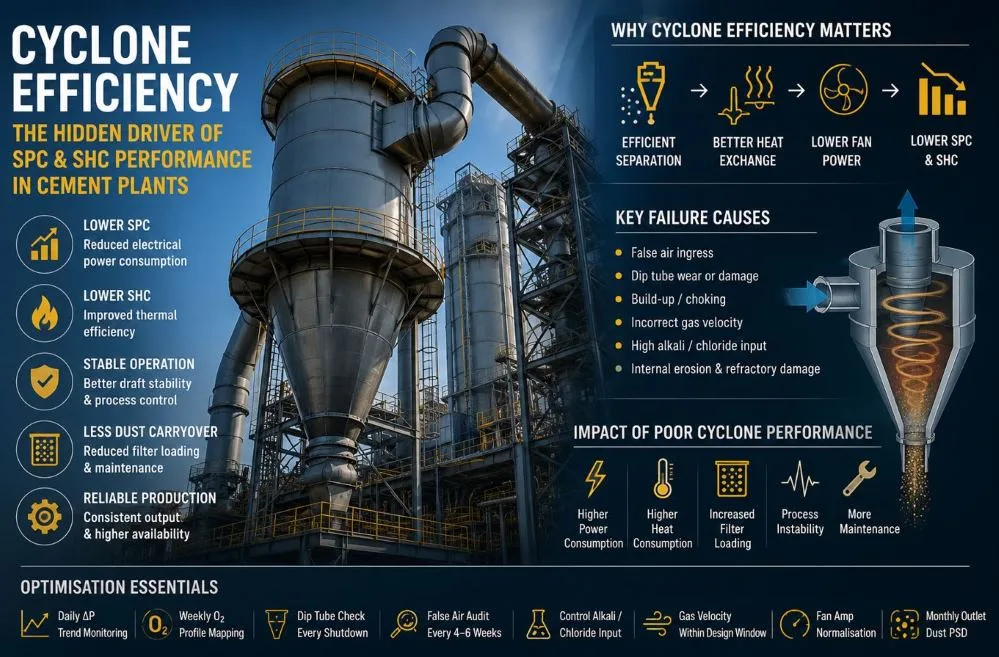
Impact of Cyclone efficiency on heat and power consumption is one of the most underestimated relationships in cement plant operation – yet it silently controls SPC, SHC, fan load and pyroprocess stability every single day.
Table of Contents
In most cement plants, operators usually focus more on parameters like kiln feed rate, residue or free lime because these values are directly visible in daily operation. But one area that quietly affects the entire pyro system is cyclone performance.
Now the question is – why are cyclones so important if they are not even considered a major rotating equipment?
The reason is that a cyclone is not just a dust separator. Inside the preheater system, it plays a critical role in heat exchange between hot gases and raw meal. If cyclone efficiency starts dropping, the effect does not remain limited to material separation only. It slowly starts affecting fan power consumption, bag filter loading, calcination stability, kiln heat consumption and overall process balance.
For example, when separation efficiency becomes poor, more fine material escapes with the gas stream instead of returning properly through the dip tube. This increases gas loading in the downstream system. As a result, ID fans may require higher power to maintain draft, pressure drops become unstable and heat transfer efficiency inside the preheater starts reducing.
At the same time, poor cyclone performance can disturb material circulation inside the tower. Once that happens, calcination also becomes inconsistent because the raw meal is no longer getting the same heat exposure inside every stage. Eventually, the kiln has to compensate with higher fuel input, which directly increases Specific Heat Consumption (SHC).
This is why cyclone efficiency should not be treated as only a maintenance topic. It is directly connected with process stability and energy performance.
In this article, we will understand how cyclone efficiency actually affects SPC and SHC, what are the most common operational and mechanical reasons behind cyclone performance deterioration, and what practical optimization methods can be applied in real plant conditions to improve overall system efficiency.
1. Cyclone Separation Mechanics
Most people in cement plants treat a cyclone like a simple dust collector. But if we look at how the preheater actually works, the cyclone is doing much more than just separating dust from gas. It is simultaneously working as a heat exchanger, a material separator, a gas-flow stabilizer and indirectly an energy-saving device. That is why even a small reduction in cyclone efficiency can slowly disturb the entire pyroprocess system.
Now the question is – how can one equipment affect so many process areas at the same time?
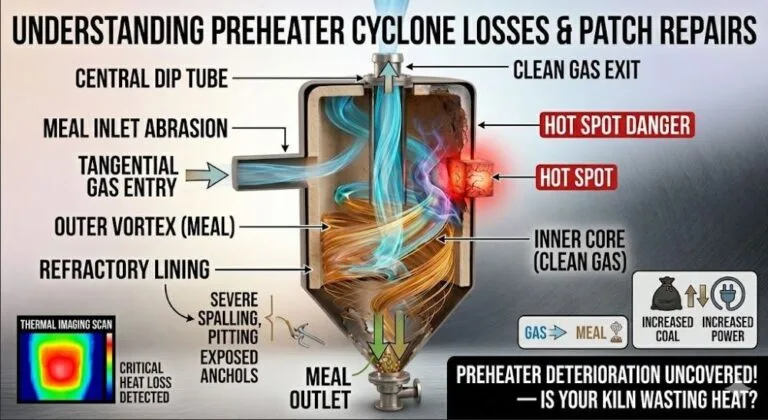
The answer lies in the vortex flow mechanism inside the cyclone. When hot dust-laden gas enters the cyclone, it does not enter straight. It enters tangentially at high velocity. Because of this tangential entry, the gas immediately starts rotating inside the cyclone body and forms a strong double-vortex structure.
The first vortex is the outer downward vortex.
This vortex moves downward along the cyclone wall at high speed. Due to centrifugal force, heavier raw meal particles are pushed outward toward the wall. Once the particles lose momentum, gravity pulls them downward into the discharge cone.
At the same time, another vortex forms in the center of the cyclone. This is called the inner upward vortex. Near the lower section of the cyclone, the gas reverses direction and starts moving upward through the vortex finder, carrying relatively clean gas to the next stage.
So basically:
- outer vortex → separates material
- inner vortex → carries cleaned gas upward
Now here comes the important part. Cyclone efficiency completely depends on how stable these vortices remain during operation. If the vortex becomes unstable because of false air, dip tube wear, coating formation, uneven gas distribution, or incorrect gas velocity, then separation efficiency immediately starts dropping.
Instead of falling into the cone, fine particles start escaping with the gas stream and travel downstream toward the bag filter and fan system. This separation performance is generally explained using something called particle cut size or d₅₀. In simple language, d₅₀ means the particle size at which the cyclone can separate nearly 50% of the particles successfully. A smaller d₅₀ value usually indicates better cyclone efficiency because the cyclone is able to capture even finer particles from the gas stream. But achieving this is not only about increasing gas velocity.
A cyclone always works between two opposite forces centrifugal force trying to throw particles toward the wall and drag force from the gas stream trying to carry particles upward.
When centrifugal force dominates, separation improves. But if drag force becomes stronger because of unstable gas flow, turbulence, or false air dilution, fine particles start bypassing the cyclone.This is why cyclone operation is extremely sensitive to operating conditions. Even small disturbances inside the preheater can weaken vortex stability and reduce overall separation efficiency.

Figure 1. shows this dual-vortex mechanism inside a cyclone. The outer downward vortex pushes particles toward the wall and cone section, while the inner upward vortex carries cleaned gas through the vortex finder. Any disturbance in this vortex pair directly affects separation performance, heat exchange efficiency, and downstream system stability.
2. Impact on Specific Power Consumption (SPC)
Most plants notice rising SPC only after the fan load or bag filter differential pressure starts increasing. But by that stage, cyclone efficiency may already have been deteriorating for weeks or even months. Now the important thing to understand is that cyclone efficiency does not increase SPC through only one mechanism. It affects SPC through multiple parallel paths that slowly compound together.
2.1 ID Fan Loading
This is usually the first measurable effect of poor cyclone performance. when separation efficiency drops, more fine material escapes with the gas stream instead of properly separating inside the cyclone.
So where does this material go?
It moves downstream toward the bag filter. Now the bag filter suddenly has to handle much higher dust loading than normal. As dust cake accumulates between pulse cleaning cycles, differential pressure across the filter starts increasing. once system resistance increases, the ID fan has only one option – it must work harder to maintain the required draft. That means higher fan amps, higher motor load and ultimately higher SPC.
Many plants see increasing ID fan current even though kiln production remains constant. Operators often suspect fan problems or filter issues first. But in many cases, the real root cause is upstream cyclone degradation.
2.2 Raw Mill Destabilization
In VRM systems, cyclone performance becomes even more critical because the cyclone is continuously separating fine product from the gas stream after grinding and classification.
When the cyclone is operating properly, fine product gets recovered efficiently and sent to the silo. But when separation efficiency drops, a larger amount of fine material bypasses the cyclone and travels with the gas toward the bag filter.
Now this creates another problem. part of this dust-laden gas is often recirculated back into the VRM circuit through the gas recirculation loop. so instead of leaving the system as finished product, fine particles continue circulating inside the circuit again and again.
This unstable gas-solid circulation creates several problems simultaneously:
- Separator efficiency starts reducing,
- Mill bed stability becomes inconsistent,
- Circulation load increases,
- Fan resistance gradually rises.
Over time, both the mill fan and ID fan require more power just to maintain the same gas flow and production level. So even though the grinding system itself may look mechanically healthy, cyclone inefficiency silently increases total grinding circuit power consumption.
2.3 Compressed Air and Filter Cleaning Demand
This is the hidden SPC penalty that many plants underestimate. Once downstream dust loading increases, the bag filter has to clean itself more frequently through pulse-jet cleaning.
More pulse cleaning means higher compressed air demand, increased compressor running hours and faster filter bag deterioration. And once filter bags start deteriorating, pressure drop increases even further, which again increases fan power demand.
So one cyclone problem slowly turns into a complete energy-loss chain across multiple systems.That is why poor cyclone efficiency should never be viewed as only a separation problem. It directly affects fan power, compressor power, filter performance and total circuit stability.
In most cement plants, the largest contribution usually comes from downstream filter overburden and rising fan resistance.

Figure 2. Indicative distribution of incremental SPC attributable to poor cyclone efficiency, across three primary mechanisms. Proportions vary by plant configuration; the dominant path in most plants is ID fan overloading due to downstream filter overburden.
Recommended Reading: For practical insights into kiln optimization, heat balance calculation, thermal efficiency improvement, and reducing heat losses in cement plants, read this detailed guide on Amazon Kindle.
3. Impact on Specific Heat Consumption (SHC)
Most plants can easily notice electrical losses because fan amps, motor load and SPC trends are directly visible in the control room. But thermal losses from poor cyclone performance are much more dangerous because they usually develop slowly and remain hidden for a long time.
In many cases, rising SHC is blamed on fuel quality, kiln coating behavior, raw mix chemistry or calciner combustion issues, while the actual root cause is deteriorating cyclone efficiency.
The reason this happens is simple: A cyclone is not only separating material. It is also responsible for proper heat exchange between hot gases and raw meal.
Once cyclone performance becomes unstable, the entire heat transfer process inside the preheater starts weakening.
3.1 Degraded Meal-Gas Heat Transfer
To understand this properly, first we need to understand what the preheater is actually doing. The preheater works like a countercurrent heat exchanger.
- Hot exhaust gases from the kiln move upward.
- Raw meal moves downward from stage to stage.
During this opposite-direction movement, heat from the hot gas transfers into the raw meal before the material enters the kiln. This is extremely important because the more heat the meal absorbs inside the preheater, the less fuel the kiln needs later for calcination.
Now here is the critical point: Efficient heat transfer only happens when gas and raw meal remain evenly distributed and properly mixed inside the cyclone system.
When cyclone efficiency starts dropping:
- Meal distribution becomes uneven,
- Gas bypassing starts increasing,
- Vortex stability weakens,
- Effective contact between gas and material reduces.
So even though hot gas is still available, the heat transfer itself becomes inefficient. As a result, the raw meal enters the kiln at a lower effective thermal condition. and once that happens, the kiln has only one option – it must burn additional fuel to complete the same calcination process. That extra fuel directly increases Specific Heat Consumption (SHC).
So poor cyclone efficiency is not only a separation loss. It is actually a hidden heat recovery loss inside the preheater.
3.2 False Air as a Dual Penalty
False air is one of the most damaging problems in cyclone systems because it creates two different losses simultaneously. This is why false air should never be treated as only an air leakage issue.
Now the question is – why is false air so harmful?
Because when external cold air enters the system through flap valves, rotary valve seals, expansion joints, inspection doors or cone cracks, it immediately disturbs the designed gas-flow pattern inside the cyclone. The vortex loses stability, separation efficiency drops and more fine particles start bypassing downstream.
But that is only the first penalty. The second penalty is thermal. This incoming cold air has no process value, but the kiln still has to heat it up to process temperature. So now fuel is being consumed just to heat unnecessary air mass.
That means false air simultaneously causes:
- Poorer separation efficiency,
- Weaker heat exchange,
- Higher fuel consumption.
This is why even a small leakage can create measurable SHC increase. In a typical six-stage preheater system, one damaged rotary valve alone can increase SHC noticeably if the leakage continues for a long period.
That is why plants sometimes observe continuously rising SHC even though kiln operation appears normal on the surface.
False air is self-amplifying: it degrades cyclone performance, which increases dust carryover which raises gas temperature at the preheater exit, which increases false air suction pressure differential – a feedback loop that accelerates SHC deterioration unless proactively managed.
3.3 Draft and Calciner Instability
Another major thermal impact of poor cyclone efficiency comes through gas-flow instability. Inside the pyroprocess, stable combustion completely depends on stable gas flow but when cyclone separation becomes unstable:
- Gas velocity fluctuations increase,
- Draft behavior starts oscillating,
- Pressure balance inside the preheater becomes inconsistent.
These disturbances eventually reach the kiln inlet, calciner combustion zone and tertiary air system.
Now instead of having a smooth and predictable combustion environment, the system starts behaving irregularly. this creates several operational problems:
- Fluctuating temperature profiles,
- Unstable calciner combustion,
- Uneven meal feeding into the kiln,
- Inconsistent tertiary air flow,
- Unstable kiln draft conditions.
And once combustion stability is lost, maintaining low SHC becomes extremely difficult because efficient fuel burning always depends on stable airflow, stable temperature profile and predictable gas movement.
If the upstream gas circuit itself becomes turbulent and unstable, the kiln continuously keeps compensating with additional fuel input. So even though operators may focus mainly on burner settings or fuel mix, the actual instability may be originating much earlier – inside the cyclone system itself.

Figure 3. Poor cyclone efficiency creates parallel thermal and electrical losses at the same time. False air and poor heat exchange mainly increase SHC, while dust carryover and fan overloading mainly increase SPC. But in actual plant operation, both effects usually occur together rather than separately.
4. Failure Modes and Diagnostic Indicators
One of the biggest mistakes in cement plants is waiting for a major alarm before checking cyclone condition. The problem is that cyclone efficiency usually does not fail suddenly. In most cases, degradation happens slowly over weeks or months. During this period, the plant only sees indirect symptoms like:
- Rising SPC,
- Increasing SHC,
- Unstable draft,
- Higher fan amps,
- Fluctuating kiln operation.
And because these symptoms appear gradually, the actual cyclone problem often remains unnoticed. That is why engineers who rely only on alarms usually detect the issue very late. The better approach is to understand the failure signatures early because every cyclone problem leaves behind a different operational pattern.
| Failure mode | Primary mechanism | Key indicator | SPC/SHC impact |
|---|---|---|---|
| False air leakage | Vortex destabilisation & cold air dilution | Rising O₂ downstream of cyclone | Both ↑↑ |
| Dip tube wear | Gas short-circuit & particle bypass | Low ΔP & coarse outlet dust | SPC ↑↑ |
| Internal build-up | Geometry distortion & flow blockage | Rising ΔP & kiln draft fluctuation | Both ↑ |
| Incorrect gas velocity | Weak centrifuge (low) or re-entrainment (high) | Efficiency curve shift | SPC ↑ |
| Uneven gas distribution | Asymmetric vortex & localised bypass | Uneven wear patterns on inspection | Both ↑ |
| Refractory damage | Geometry change & wall roughness increase | Hot spots & thermal imaging | SHC ↑ |
4.1 Common Cyclone Failure Modes and Their Process Effects
False Air Ingress Signature
False air is one of the most common and most damaging cyclone problems in cement plants. Air leakage can enter through rotary valves, flap valves, expansion joints, inspection doors or cracks in cone sections.
Now the important question is -why does this create such a large process impact?
Because the cyclone is designed for a specific gas-flow pattern and pressure condition. Once cold external air enters the system, the gas balance inside the cyclone immediately changes. This creates two major effects simultaneously – vortex stability weakens and cold air dilution increases.
As a result separation efficiency drops, downstream dust loading increases, fan load rises and SHC starts increasing because the kiln must heat additional cold air mass. Typical signs of false air problems include:
- Rising O₂ after cyclone stages,
- Unstable kiln draft,
- Increasing ID fan amps,
- Inconsistent gas temperature profile,
- Localized cold spots during thermal inspection,
- Increasing filter loading downstream.
In many plants, process instability becomes visible much earlier than any actual cyclone alarm.
Dip Tube (Vortex Finder) Failure Signature
The dip tube is one of the most critical internal parts of the cyclone because it controls the inner upward vortex. Its main job is to prevent gas from directly short-circuiting from inlet to outlet. Now imagine what happens if the dip tube becomes worn, shortened, cracked or deformed.
The inner vortex immediately loses stability. Instead of following the designed vortex path, gas starts bypassing directly upward and carries raw meal particles along with it. That means separation efficiency collapses very quickly.
Typical process symptoms include:
- Sudden rise in outlet dust,
- Coarse particles in ducts or filters,
- Low or continuously falling cyclone ΔP,
- Unstable vortex formation,
- Rapid wear of downstream fans and filter bags,
- Increased gas bypassing.
This problem becomes especially severe in high-abrasion areas like kiln-preheater circuits and VRM systems. Because once the dip tube wears excessively, efficiency loss accelerates rapidly instead of gradually.
Cyclone Build-Up or Choking Signature
Build-up problems are dangerous because they slowly change the internal geometry of the cyclone and cyclone efficiency is highly dependent on geometry. When material starts depositing inside the cyclone:
- Gas flow path changes,
- Vortex formation becomes unstable due to resistance in path,
- Pressure distribution becomes uneven.
This is commonly seen in systems with high alkali, chloride, sulfur or moisture circulation. Now the problem is that build-up usually develops progressively. So initially operators may only notice:
- Slowly rising ΔP,
- Occasional draft fluctuation,
- Unstable calciner behavior.
But as deposits continue increasing, the cyclone eventually starts choking internally. Typical signs include:
- Increasing cyclone pressure drop,
- Oscillating kiln inlet draft,
- Uneven material distribution,
- Combustion instability,
- Flushing events,
- Restricted gas flow zones.
And because the change happens slowly, plants often underestimate the severity until major process instability appears.
Gas Velocity Mistuning Signature
Many people assume higher gas velocity automatically means better cyclone efficiency but that is not true. Cyclone efficiency actually follows an optimum velocity range. If gas velocity becomes too low, centrifugal force weakens and once centrifugal force weakens:
- Fine particles stop separating properly,
- Carryover increases,
- Vortex stability reduces.
Low gas velocity typically causes weak separation, higher downstream dust loading, poor collection efficiency and unstable internal flow behavior.
But excessively high velocity is also harmful. At very high gas speeds:
- Turbulence increases,
- Particle re-entrainment starts,
- Cyclone internals wear faster,
- Pressure drop rises sharply,
- Fan power consumption increases.
So even though gas speed becomes higher, actual separation efficiency may still reduce. That is why cyclone operation always requires balanced gas velocity, not simply maximum velocity. In many plants, velocity-related problems are not caused by a single equipment failure. They usually originate from imbalance between airflow, material loading, system resistance and fan operation across the entire circuit.
So unless the complete gas circuit is evaluated together, operators may keep adjusting fans repeatedly without solving the real root cause.
5. Systematic Troubleshooting Protocol
One of the biggest reasons cyclone problems remain unresolved in many cement plants is that troubleshooting is often done randomly.
For example: First fan is checked, then bag filter, then kiln draft, then separator and finally the cyclone.
By that time, the actual root cause may already have become much worse. Effective cyclone troubleshooting should always follow a logical sequence. The idea is simple:
First analyze operating trends during running condition, then confirm the actual condition during shutdown inspection because if shutdown inspection is done without understanding the operating symptoms first, many important clues get missed.
1. Pressure Drop (ΔP) Trend Analysis
Cyclone pressure drop is one of the best indicators of internal cyclone condition. But the important thing is this: A single ΔP reading usually tells very little. The trend behavior is what matters most.
Now the question is – why is ΔP so important?
Because cyclone pressure drop directly reflects how gas is flowing inside the cyclone. any disturbance in vortex formation, internal geometry, gas bypassing or material loading will immediately affects ΔP behavior.
Falling ΔP Usually Indicates – false air leakage, dip tube wear, gas short-circuiting or internal bypassing.
This happens because gas starts finding an easier path through the cyclone instead of following the designed vortex pattern. So resistance reduces abnormally.
Rising ΔP Usually Indicates – internal build-up, cyclone choking, excessive dust loading or restricted gas passage.
In this case, gas has to work harder to move through the cyclone, so pressure resistance increases.
Now here is the important operational point: A continuous ΔP drift over 48–72 hours is often more valuable than any alarm because cyclone degradation usually starts gradually before becoming severe enough to trigger alarms. So trend monitoring is often the earliest warning system available to process engineers.
2. Oxygen (O₂) Profile Mapping
O₂ trend analysis is one of the most effective ways to identify false air entry points inside the preheater system. The logic is simple that If no leakage exists, oxygen concentration between adjacent cyclone stages should remain relatively stable according to process conditions. But when cold external air enters the system locally, O₂ suddenly increases after that location. So by comparing stage-wise O₂ readings, engineers can identify where false air is entering.
Common leakage locations include flap valves, rotary valves, inspection doors, expansion joints and cone cracks. Now many operators underestimate even small O₂ increases. But in reality, even around 0.5% localized O₂ rise can significantly affect vortex stability, gas temperature profile, heat exchange efficiency and overall SHC.
That is why O₂ mapping should not be treated only as a combustion parameter. It is also a cyclone diagnostic tool.
3. Fan Amperage Monitoring
Fan amperage trends often reveal cyclone problems much earlier than mechanical inspection. Now think about the process chain carefully. When cyclone efficiency drops:
- More dust bypasses downstream,
- Bag filter loading increases,
- Filter differential pressure rises,
- Total system resistance becomes higher.
Once resistance increases, the fan must consume more power to maintain the same gas flow that have dust also in air. That is why rising normalized fan amps without production increase is a very important warning sign. This usually appears as increasing ID fan load, rising bag filter ΔP and gradual SPC increase.
The important point is that fan amperage should never be judged alone. It must always be compared with production rate, gas flow and overall operating conditions.
For example, if kiln throughput increases, fan amps will naturally increase because the system is handling more gas and material. That does not automatically mean cyclone efficiency has become poor. But if fan amperage keeps rising while production, gas flow and operating conditions remain almost stable, then it usually indicates increasing system resistance caused by problems like poor cyclone separation, higher dust carryover or rising bag filter loading.
So the real focus should be on abnormal fan load increase relative to process conditions, not on fan amps alone.
4. Cyclone Outlet Dust Analysis
Under normal operating conditions, most coarse particles separate easily inside the cyclone because their higher mass allows centrifugal force to push them toward the cyclone wall more effectively. After losing momentum, these particles fall into the cone section and discharge from the bottom of the cyclone.
However, cyclone separation is never perfectly 100% efficient. A limited amount of fine dust and occasionally some coarse particles may still escape with the gas stream under normal conditions.
The problem becomes serious when coarse particle carryover starts increasing abnormally.nThis usually indicates that the internal gas flow pattern has become disturbed due to problems such as:
- Dip tube damage,
- Gas short-circuiting,
- Severe vortex instability,
- Excessive false air ingress.
In these conditions, gas no longer follows the proper vortex path inside the cyclone. Instead, part of the gas bypasses directly from inlet toward the outlet, carrying particles upward before proper separation can occur. As a result, even larger particles that would normally separate successfully begin escaping with the gas stream. On the other hand, excessively fine dust carryover usually indicates weak vortex formation, low gas velocity, false air dilution or reduced centrifugal separation efficiency inside the cyclone.
Dust analysis becomes much more useful when current outlet dust samples are compared with historical baseline data from stable operating conditions. Because cyclone deterioration usually develops gradually, small changes in particle size distribution or dust loading are often difficult to notice in a single inspection. Trend comparison over time helps engineers identify efficiency loss much earlier before major operational instability develops.
5. Shutdown Internal Inspection
Operating trends can indicate that cyclone efficiency is deteriorating, but the actual root cause is usually confirmed only during shutdown inspection. That is why shutdown inspection should never be treated as a routine visual activity.
It should be done systematically because small internal changes inside the cyclone can create large process instability later.
During shutdown, the main focus should be on checking components that directly affect vortex stability, gas flow pattern and separation efficiency.
Dip Tube Wear and Length
The dip tube controls the inner upward vortex inside the cyclone. Its length and geometry are extremely important for proper separation. If the dip tube becomes worn, shortened, cracked or deformed, gas can start bypassing directly from inlet to outlet instead of following the designed vortex path. As a result:
- separation efficiency drops,
- dust carryover increases,
- downstream fan and filter loading rise.
That is why dip tube condition should never be judged only visually. Actual wear and extension length should always be measured and compared with previous shutdown records.
Cone Erosion Pattern
The cyclone cone continuously faces wear because material keeps moving downward along the inner wall at high speed. But during shutdown inspection, engineers do not check only how much the cone has worn out. They also observe where the wear is happening.
The reason is that the wear pattern can give clues about how gas and material were flowing inside the cyclone during operation. If gas flow and vortex movement inside the cyclone are stable, material usually moves more evenly around the wall. In that case, wear also appears more uniform.
But if one side of the cone is wearing much more than the other side, it usually means the internal flow was not balanced properly. For example: gas velocity may have been higher in one area, vortex movement may have become unstable or material may have been hitting one section repeatedly.
So uneven wear often indicates disturbed gas flow or unstable vortex behavior inside the cyclone that is why cone erosion is not only a maintenance issue. It also helps engineers understand whether the cyclone was operating with stable or disturbed internal flow conditions.
Refractory Condition
Cyclone refractory is not only used for heat protection. It also helps maintain the correct internal shape and smooth flow path inside the cyclone. Now the important point is this: Cyclone efficiency depends heavily on stable gas flow and vortex formation. So if the refractory gets damaged, the internal flow condition also starts changing.
For example, when refractory lining becomes cracked, uneven, broken or excessively rough, the gas can no longer move smoothly inside the cyclone. As a result:
- gas flow becomes disturbed,
- vortex stability weakens,
- and separation efficiency may start reducing.
In severe cases, damaged refractory can even change the internal geometry of the cyclone. That means gas velocity may become uneven in different areas inside the cyclone, which further disturbs proper separation behavior.
During thermal inspection, these refractory problems often appear as localized hot spots on the cyclone shell. That is why hot spots are important because they can indicate early refractory deterioration before major internal damage or process instability develops.
Rotary Valve Clearance and Flap Valve Sealing
Rotary valves and flap valves are critical because they prevent false air from entering the system while still allowing material discharge. If rotary valve clearance becomes excessive, flap valves fail to seat properly or sealing surfaces wear out, cold external air starts entering the cyclone system.
This false air disturbs the vortex structure, increases O₂ levels and reduces overall separation and heat exchange efficiency. So during shutdown, valve sealing condition should always be checked carefully instead of only verifying mechanical movement.
Importance of Wear Pattern Comparison
One of the biggest mistakes during shutdown inspection is observing the present condition without comparing it to historical data. Cyclone deterioration is usually gradual so small changes may not look serious during a single shutdown inspection.
But when current inspection records, photographs and wear measurements are compared with previous shutdown data, progressive deterioration becomes much easier to identify.
For example: slowly reducing dip tube length, gradually increasing cone erosion or repeated localized wear patterns often reveal long-term gas flow imbalance or vortex instability that may not be obvious from one inspection alone.
That is why the most effective plants maintain detailed shutdown history records instead of relying only on visual judgement during each maintenance stop.

Figure 4. Cyclone ΔP trend interpretation. A stable trend (left) indicates healthy operation. A sustained downward drift (centre, red border) signals false air entry or dip tube wear and requires immediate leakage investigation. A sustained upward drift (right, amber border) indicates build-up progression and requires inspection of alkali/chloride cycles and operating temperatures.
6. Practical Optimization Strategies
One common misconception in many cement plants is that poor cyclone performance is mainly a design problem but in actual operation, most cyclone efficiency losses are usually caused by false air leakage, poor maintenance practices, delayed inspections, worn internals or unstable operating discipline.
In many cases, plants invest heavily in fans, filters or system modifications while the real issue is simply uncontrolled leakage or deteriorated cyclone internals. The important thing is that some of the highest-return improvements in cyclone performance do not require major capital investment.
Simple actions like systematic inspection, timely seal replacement, regular trend monitoring and proper shutdown checking can significantly improve both SPC and SHC.
6.1 False Air Reduction Programme
False air should never be treated as a one-time maintenance issue because even if leakage is repaired once, new leakage paths can gradually develop again during operation due to wear, thermal movement and mechanical damage. That is why false air control should be treated as a continuous monitoring programme.
Now the question is – where should plants focus first?
The most critical areas usually include:
- rotary valve clearances,
- flap valve sealing condition,
- inspection door gaskets,
- and expansion joints.
For example, if rotary valve blade-to-casing clearance becomes excessive, cold external air can continuously enter the system. Similarly poorly seated flap valves, damaged gaskets or cracked expansion joints can disturb cyclone vortex stability and increase heat loss.
That is why these components should be inspected regularly during planned shutdowns and thermal cycling conditions. Many plants only check whether the valve is rotating properly. But sealing condition is equally important because even small leakage can affect cyclone efficiency and SHC.
A structured leakage audit every few weeks using O₂ or CO₂ measurements helps identify developing leakage zones before they create major process instability. The objective is to keep false air under control continuously not only after major efficiency loss becomes visible.
6.2 Dip Tube Replacement Scheduling
Dip tube wear is one of the most underestimated reasons for sudden cyclone efficiency deterioration. The problem is that dip tube damage usually develops gradually, so operators often do not notice the efficiency loss until downstream problems become severe.
Now here is the critical point: Even moderate dip tube erosion can significantly disturb vortex behavior. If the dip tube loses a noticeable portion of its designed extension length, gas short-circuiting tendency increases and separation efficiency can drop sharply.
That is why every planned kiln shutdown should include:
- dip tube length measurement,
- wear mapping,
- and internal condition inspection at all cyclone stages.
Another important thing is this: Dip tube replacement should not depend only on visual judgement from inspection ports because the most important erosion often happens on internal surfaces that are difficult to see directly during routine inspection.
So replacement decisions should be based on measured wear rate, comparison with baseline dimensions and historical inspection records. otherwise plants may continue operating with severely deteriorated dip tubes without realizing how much cyclone efficiency has already been lost.
6.3 Velocity Optimisation
Many people assume that increasing gas velocity always improves cyclone efficiency but cyclone behavior is not that simple. Cyclones actually operate within an optimum velocity range. Initially, increasing gas velocity improves centrifugal separation force and helps particle separation but after a certain point, further velocity increase creates excessive turbulence and once turbulence becomes too high:
- particle re-entrainment increases,
- vortex stability weakens,
- pressure drop rises,
- and wear rate accelerates.
So beyond the optimum range, cyclone efficiency can actually start decreasing instead of improving. In most preheater systems, cyclones are designed to operate within a specific inlet velocity range for balanced separation and acceptable wear conditions.
If operation moves too far outside this range either because of excessive fan throttling, unstable gas flow or overspeeding to compensate for other problems, the plant may simultaneously lose:
- separation efficiency,
- energy efficiency,
- and equipment life.
That is why cyclone optimization should focus on balanced gas velocity not maximum velocity.
6.4 Build-up Prevention and Control
Build-up formation inside cyclones is usually linked with volatile circulation inside the preheater system. During clinker formation, alkalis, chlorides and sulfur compounds can vaporize at high temperature and later condense in cooler zones inside the preheater. Over time, these sticky materials start accumulating on cyclone walls and gas passages.
This problem is especially common in lower preheater stages where temperature conditions favor condensation. Now the important thing is this build-up is not only a cleaning issue. It is actually connected with overall process chemistry and thermal balance.
Long-term build-up control usually requires:
- proper raw mix chemistry management,
- alkali and chloride monitoring,
- stable gas temperature profile,
- and controlled volatile circulation.
But during running operation, short-term control also becomes important. Many plants use air cannons to remove deposits. however, one common mistake is using fixed timer-based air cannon operation without understanding the actual build-up mechanism because different types of deposits behave differently. Some deposits require targeted impact during specific operating conditions, while others are linked with temperature cycling or local gas-flow behavior.
So effective build-up control requires process-based operation not simply repeated air cannon firing at fixed intervals.
Common misdiagnosis
Plants routinely invest in new fans, separator upgrades and bag filter expansions while leaving deteriorated cyclone internals in service. Because cyclone degradation is gradual and its effects distribute across multiple KPIs, it rarely generates a single alarming signal – only a persistent, multifactorial drift in SPC, SHC and production stability that is attributed elsewhere.
7. Impact on SPC and SHC
Poor cyclone efficiency does not affect only one process parameter. Its impact spreads across both electrical and thermal performance of the plant at the same time. That is why plants often observe rising fan power, increasing SHC, unstable draft, higher filter loading and fluctuating process conditions together.
The important thing is that these losses usually develop gradually and support each other, making the overall efficiency deterioration much larger over time.
7.1 SPC – three compounding mechanisms
The most visible electrical impact of poor cyclone efficiency is usually rising ID fan load. when cyclone separation becomes weak, more fine material bypasses downstream and reaches the bag filter system. as dust loading increases:
- bag filter differential pressure rises,
- system resistance becomes higher,
- and the ID fan requires more power to maintain gas flow.
This is usually the first measurable SPC penalty noticed in operation but the important point is that fan overloading is not the only mechanism increasing SPC. Two additional mechanisms also develop in parallel.
VRM Circuit Destabilization
In VRM systems, cyclone efficiency directly affects grinding circuit stability. Normally, the cyclone should recover fine product efficiently and send it out of the system but when cyclone separation becomes poor, more fine material bypasses with the gas stream and re-enters the grinding circuit again through gas recirculation.
Now instead of leaving the system as finished product, these fine particles continue circulating repeatedly inside the VRM loop. This creates several problems:
- circulation load increases,
- material bed stability becomes inconsistent due to fine material increases,
- separator performance weakens,
- and grinding pressure often increases to maintain output.
As grinding pressure and circulation load increase, the mill starts consuming more electrical power for the same production level. So cyclone inefficiency indirectly raises specific mill power consumption as well.
Increased Compressed Air Demand
At the same time, higher dust loading at the bag filter increases pulse-jet cleaning frequency. That means:
- compressed air consumption increases,
- compressors operate for longer duration,
- and filter bags experience faster wear.
This creates another hidden SPC penalty that many plants underestimate because compressor power is often not directly linked mentally with cyclone efficiency. So in reality, poor cyclone performance usually increases SPC through three simultaneous mechanisms:
- higher ID fan load,
- VRM circuit destabilization,
- and increased compressed air demand.
And because all three happen together, total electrical loss becomes much larger than operators initially expect.
7.2 SHC – thermal efficiency and false air as a dual penalty
The thermal impact of poor cyclone efficiency is often even more serious than the electrical impact because heat losses develop slowly and are harder to identify early. One of the biggest contributors here is false air. Now the important thing is this false air creates two different thermal penalties at the same time.
First Penalty – Separation and Heat Transfer Loss
When false air enters the cyclone system vortex stability weakens, gas flow pattern becomes disturbed and separation efficiency starts reducing. Once vortex behavior becomes unstable, contact between hot gas and raw meal also becomes less effective.
That means heat transfer efficiency inside the preheater drops so even though hot gas is still available, the raw meal absorbs less useful heat before entering the kiln. As a result, the kiln must burn additional fuel to achieve the same level of calcination.
Second Penalty – Heating Unnecessary Cold Air
False air also introduces cold external air into the pyroprocess. Now this incoming air contributes nothing to clinker formation but the kiln still has to heat this additional air mass to process temperature. That means fuel is being consumed without creating any productive thermal benefit.
So false air simultaneously causes weaker heat exchange, lower separation efficiency and higher fuel consumption.
Self-Reinforcing Effect of False Air
The dangerous part is that false air problems often become self-amplifying. The sequence usually develops like this:
- false air weakens cyclone efficiency,
- poor separation increases dust carryover,
- exit gas temperature rises,
- suction imbalance becomes stronger,
- and even more false air starts entering the system.
So once leakage begins increasing, SHC deterioration can accelerate gradually unless the root cause is corrected early.
Heat Transfer Loss Even Without Measurable False Air
Another important point many plants overlook is that SHC can increase even when measurable false air is not very high because poor cyclone performance alone can reduce meal-gas contact efficiency. If vortex formation becomes unstable:
- gas distribution becomes uneven,
- bypass flows develop,
- and effective heat transfer surface inside the preheater reduces.
That means the raw meal enters the kiln less efficiently heated, forcing additional fuel consumption for the same calcination requirement. so even without major leakage, unstable cyclone flow behavior itself can increase SHC.
Draft Instability and Calciner Combustion
Finally, these thermal disturbances propagate downstream into the calciner and kiln combustion zone. Once draft becomes unstable:
- tertiary air flow fluctuates,
- combustion becomes inconsistent,
- temperature profile starts oscillating,
- and calciner stability reduces.
And stable combustion is one of the most important conditions for maintaining low SHC. So when upstream cyclone flow becomes unstable, thermal inefficiency spreads across the entire pyroprocess system rather than remaining limited only to the cyclone itself.

Figure 5. Indicative energy impact ranges for common cyclone failure modes, expressed in standard plant KPIs. Amber bars represent SHC impact (kcal/kg clinker); teal bars represent SPC impact (kWh/tonne clinker). Values are order-of-magnitude estimates for a 3,000–5,000 tpd clinker line; actual impacts depend on stage count, system design, and operating conditions. False air is measured as incremental O₂ increase per preheater stage.
Technical note. Energy impact figures in Figure 5 represent indicative ranges derived from published process engineering references and plant benchmarking data. Actual values will vary with preheater stage count, cyclone diameter, operating throughput and feed chemistry. All diagnostic protocols should be validated against site-specific baseline measurements. SPC expressed as kWh per tonne of clinker equivalent; SHC expressed as kcal per kg clinker.
Conclusion
Cyclone efficiency is much more important than most plants initially realize because it is not just a simple dust collection parameter. In a cement plant, cyclone performance directly affects the thermal and electrical efficiency of the entire pyroprocess system. When a cyclone operates properly, gas-solid separation remains stable, heat exchange becomes more effective, dust circulation stays controlled and downstream loading on fans and bag filters remains lower. But when cyclone performance starts deteriorating, the impact gradually spreads across the entire process in the form of rising SPC, increasing SHC, unstable kiln or preheater draft, higher fan amperage, excessive bag filter loading and reduced operational stability.
Unlike sudden mechanical breakdowns, cyclone efficiency loss usually develops slowly over time. In most cases, the deterioration is caused by false air ingress, dip tube wear, internal build-up, refractory damage, uneven gas distribution or improper gas velocity conditions. Because these problems develop progressively, many plants initially observe only the symptoms such as unstable draft, rising power consumption, poor combustion stability or increasing bag filter differential pressure while the actual root cause inside the cyclone remains unnoticed. As a result, cyclone inefficiency is often underestimated even though it can strongly influence process stability, energy consumption and overall plant performance.
Another important point is that the most reliable plants are not always the ones with the newest equipment or the most expensive modifications. In many cases, they are the plants that consistently follow disciplined monitoring and preventive maintenance practices. Effective cyclone optimisation usually comes from strong operational control rather than major capital investment. Regular ΔP trend monitoring, stage-wise O₂ analysis, systematic false air audits, dip tube inspection during shutdowns, gas velocity verification, fan load trend analysis and routine outlet dust monitoring often provide much greater long-term benefits than operators initially expect. Small corrections in these areas can prevent much larger future losses in SPC, SHC, equipment life and production stability.
Ultimately, the objective is not to chase maximum cyclone efficiency at any cost, but to maintain stable and energy-efficient operation with reliable gas-solid separation, controlled pressure drop, efficient heat transfer and acceptable wear conditions. In practical cement plant operation, engineers who identify small changes in airflow behavior, pressure trends and internal wear patterns early are usually the ones who prevent the largest hidden energy and maintenance losses across the system.


One thought on “Impact of Cyclone Efficiency on Heat And Power Consumption”