Working Principle, Differences, Advantages & Which One Is Better?
Table of Contents
Baghouses are one of the most critical pieces of equipment in a cement plant. While their primary purpose is to capture dust before process gases are released into the atmosphere, they also play a major role in maintaining stable airflow, reducing fan power consumption, extending filter bag life and ensuring reliable plant operation.
Among the various baghouse designs, Pulse Jet Baghouses and Reverse Air Baghouses are the two most widely recognized technologies. Although both systems perform the same fundamental function – separating dust particles from process gases, they use completely different cleaning methods. These differences affect everything from filtration efficiency and maintenance requirements to energy consumption and plant reliability.
Many engineers assume that one system is always better than the other. In reality, both technologies have their own strengths and limitations. The right choice depends on factors such as plant capacity, operating conditions, available space, maintenance practices and production requirements.
This article explains how both baghouse systems work, their similarities and differences, and the situations where each technology performs best.

Related Reading: This article is Part 3 of our Baghouse Optimization Series. If you haven’t already, we recommend reading Part 1, which explains the fundamentals of baghouse operation, filtration principles, and optimization techniques, followed by Part 2, which covers the major Pulse Jet Baghouse components and their functions in detail.
What is a Pulse Jet Baghouse?
A Pulse Jet Baghouse is a continuous dust collection system that cleans its filter bags using short bursts of compressed air. Unlike older baghouse designs, filtration and cleaning occur simultaneously, allowing the baghouse to remain in operation without interrupting the gas flow. Today, Pulse Jet Baghouses are the most common type of baghouse used in modern cement plants because they provide high filtration efficiency, compact design and excellent performance under continuous operation.
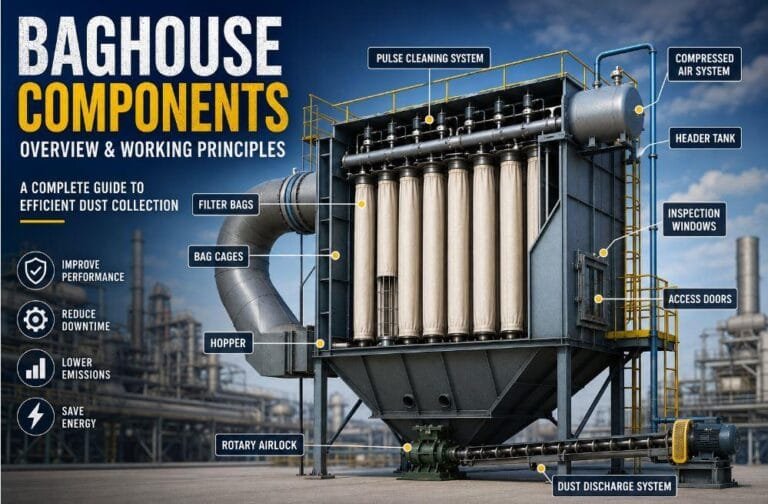
Main Components
A typical Pulse Jet Baghouse consists of:
- Filter Bags
- Filter Cages
- Venturi
- Blow Tube
- Solenoid Valve
- Diaphragm (Pulse) Valve
- Compressed Air Header Tank
- Hopper
- Rotary Airlock
- Dust Discharge System
- Differential Pressure (DP) Transmitter
- PLC Control System
Each component works together to ensure efficient filtration and automatic cleaning.
What is a Reverse Air Baghouse?
A Reverse Air Baghouse is a dust collection system that cleans filter bags by passing clean air in the opposite direction of normal filtration. Instead of using compressed air pulses, the system isolates one compartment at a time and gently reverses the airflow to remove the accumulated dust cake.
Before Pulse Jet technology became popular, Reverse Air Baghouses were widely used in cement plants, steel plants and power stations because of their simple cleaning method and long filter bag life. Although many older plants still operate Reverse Air Baghouses, new cement plants rarely install them due to their larger size and lower filtration capacity.
Main Components
A Reverse Air Baghouse generally includes:
- Filter Bags
- Filter Cages (or support rings, depending on design)
- Reverse Air Fan
- Reverse Air Duct
- Compartment Isolation Damper / Poppet Valve (design dependent)
- Hopper
- Rotary Airlock
- Dust Discharge System
- Differential Pressure Monitoring System
Unlike a Pulse Jet Baghouse, it does not require a compressed air system, blow tubes, venturis, or diaphragm valves.
Related Reading: If you would like to learn more about mill stability, read our article on Common Causes of Vibration in Vertical Roller Mills (VRM) and Their Troubleshooting, where the most common process- and mechanical-related vibration issues are explained with practical troubleshooting tips.
Similarities Between Pulse Jet and Reverse Air Baghouse
Although their cleaning methods are completely different, both systems are designed to perform the same basic function – efficient dust collection. Both baghouses:
- Remove dust from process gases.
- Use filter bags as the primary filtration media.
- Collect dust in a hopper.
- Discharge dust through a rotary airlock and conveying system.
- Help maintain process ventilation.
- Reduce particulate emissions.
- Improve environmental compliance.
- Require regular inspection and preventive maintenance.
- Use Differential Pressure (DP) as an important performance indicator.
Regardless of the cleaning technology, both systems rely on proper airflow distribution, healthy filter bags, and efficient dust discharge to maintain stable operation.
Working Principle of a Pulse Jet Baghouse
- Dust-laden process gas enters the baghouse and passes through the filter bags, where dust particles are captured on the outer surface while clean gas exits through the clean air chamber.
- As dust accumulates on the filter bags, the Differential Pressure (DP) gradually increases. When the preset DP limit is reached, the PLC initiates the pulse cleaning cycle.
- The solenoid valve energizes and opens the diaphragm valve, releasing compressed air from the header tank into the blow tube.
- The compressed air passes through the venturi, creating a powerful cleaning pulse that rapidly expands the filter bag and dislodges the accumulated dust cake.
- The removed dust falls into the hopper under gravity and is discharged through the dust handling system, while filtration continues without interrupting the process.

In a Vertical Roller Mill (VRM), harder clinker often requires increased fan airflow to transport the additional internal recirculation and maintain efficient material separation. Understanding and accurately measuring actual fan flow is therefore essential for stable mill operation and energy optimization. For a detailed explanation, read Fan Flow Measurement in Cement Plants: Methods, Calculations & Optimization.
Working Principle of a Reverse Air Baghouse
- Dust-laden process gas enters the baghouse and passes through the filter bags, where dust particles are captured on the bag surface while clean gas exits through the clean air chamber.
- As dust accumulates on the filter bags, the Differential Pressure (DP) gradually increases. When the preset DP limit is reached, the compartment requiring cleaning is isolated from the main process gas stream.
- A reverse air fan blows clean air through the filter bags in the opposite direction of normal filtration.
- The reverse airflow gently flexes and slightly collapses the filter bags, loosening the accumulated dust cake from their surface.
- The dislodged dust falls into the hopper under gravity and is discharged through the dust handling system. Once cleaning is complete, the compartment returns to normal filtration, and the next compartment enters the cleaning cycle.

Recommended Reading: Since clinker quality is closely linked to kiln operation, understanding burning conditions, heat balance, and thermal efficiency is essential for improving cement mill performance. For a detailed explanation of these topics, check out this comprehensive guide on Amazon Kindle.
How Reverse Air Cleaning Differs
Unlike the rapid cleaning action of a Pulse Jet Baghouse, Reverse Air cleaning is slow and gentle. This reduces mechanical stress on the filter bags and can significantly increase bag life. However, because one compartment must be taken offline during cleaning, the system requires a larger filtration area to maintain the same gas handling capacity.
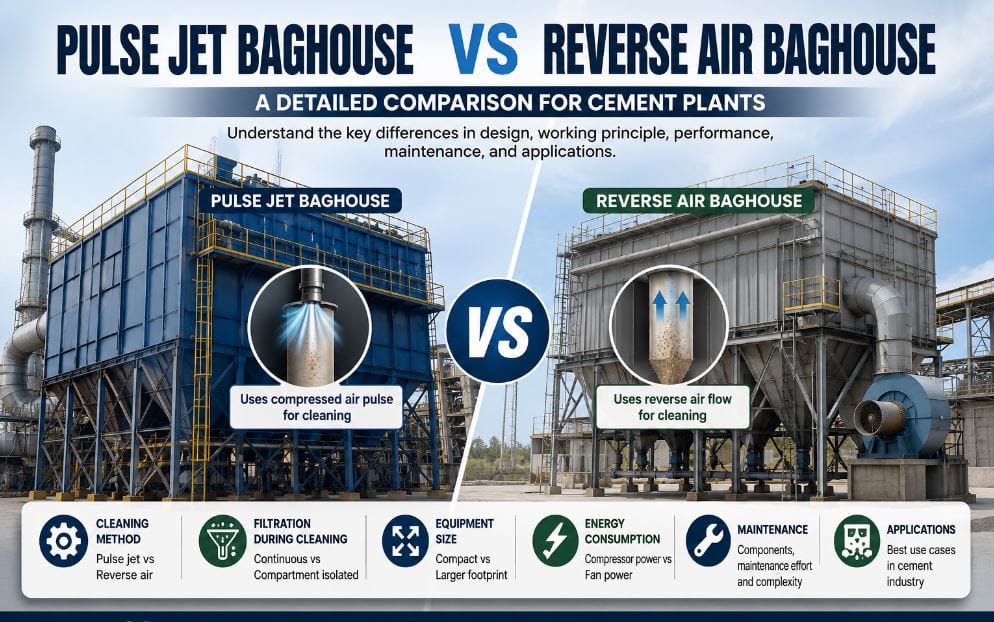
Pulse Jet Baghouse vs Reverse Air Baghouse: A Detailed Comparison
Although both systems perform the same function, their design, cleaning mechanism, operating philosophy, and maintenance requirements are significantly different. Understanding these differences helps engineers choose the right baghouse for a particular application and troubleshoot existing systems more effectively.
| Feature | Pulse Jet Baghouse | Reverse Air Baghouse |
|---|---|---|
| Cleaning Method | Uses short bursts of compressed air to clean the filter bags. | Uses low-pressure clean air flowing in the opposite direction of filtration. |
| Cleaning During Filtration | Cleaning takes place while filtration continues, so production is not interrupted. | The compartment being cleaned is isolated, while the remaining compartments continue operating. |
| Equipment Size | Operates at a higher Air-to-Cloth (A/C) Ratio, resulting in a more compact design. | Requires a lower A/C Ratio and therefore a larger filtration area and bigger baghouse. |
| Compressed Air Requirement | Requires clean, dry compressed air along with a header tank, pulse valves and solenoid valves. | Does not require compressed air and uses a reverse air fan for cleaning. |
| Filter Bag Life | Rapid pulse cleaning creates higher mechanical stress on the filter bags. | Gentle reverse airflow reduces stress and can provide longer bag life. |
| Maintenance Requirements | Requires maintenance of pulse valves, solenoid valves, venturis, blow tubes, and compressed air systems. | Requires maintenance of reverse air fans, dampers, ducting and compartment isolation mechanisms. |
| Energy Consumption | Consumes compressor power for pulse cleaning but generally offers better overall energy efficiency in modern plants. | Eliminates compressor power but requires larger fans and a larger filtration area. |
| Dust Collection Efficiency | Provides excellent filtration efficiency and easily meets modern emission standards. | Also offers high filtration efficiency but performance may decline as equipment ages. |
| Typical Applications | Widely used in modern cement plants, raw mills, cement mills, coal mills, kiln baghouses, clinker coolers, steel plants, and mineral processing industries. | Commonly found in older cement plants, power plants, steel plants, and other legacy industrial installations. |
Both technologies are capable of delivering excellent filtration performance. However, the cement industry has largely shifted toward Pulse Jet Baghouses because they offer continuous filtration, a compact design, easier automation, and higher gas-handling capacity. These advantages make them well suited for the high production rates and stringent emission standards of modern cement plants.
Recommended Reading: Since baghouse performance is closely influenced by raw mill gas flow, temperature, moisture, and process stability, understanding Raw Mill operation and optimization can help improve overall baghouse efficiency. For a detailed guide on raw mill operation, troubleshooting, and process optimization, check out this comprehensive book on Amazon Kindle.
Which Baghouse Is Better?
This is one of the most common questions asked by engineers and plant operators. However, there is no single answer that applies to every application. The better baghouse depends on the process requirements, plant capacity, operating conditions, maintenance practices and environmental regulations.
For modern cement plants, the Pulse Jet Baghouse has become the industry standard because it offers continuous filtration, higher gas handling capacity, a compact design and easy automation. These features make it well suited for large production units where maximum equipment availability and low emissions are essential.
On the other hand, Reverse Air Baghouses are still reliable systems and continue to operate successfully in many older cement plants. Their gentle cleaning method places less mechanical stress on the filter bags, which can result in longer bag life under suitable operating conditions.
Rather than asking which system is universally better, the more practical question is which baghouse is better for a specific application.
When Should You Choose a Pulse Jet Baghouse?
A Pulse Jet Baghouse is generally the preferred choice when:
- High production capacity is required.
- Continuous filtration is essential.
- Installation space is limited.
- Strict emission standards must be achieved.
- Automatic operation with minimal operator intervention is desired.
- High Air-to-Cloth ratios are required.
- Modern PLC-based process control is available.
For these reasons, nearly all new cement plants installed today use Pulse Jet Baghouses.
When Should You Choose a Reverse Air Baghouse?
A Reverse Air Baghouse may be a suitable choice when:
- An existing Reverse Air system is already installed.
- Gentle cleaning is preferred to maximize filter bag life.
- Compressed air availability is limited.
- Plant production requirements are moderate.
- The additional installation space is not a major concern.
Although new installations are uncommon, upgrading and maintaining existing Reverse Air Baghouses can still provide reliable performance.
Real-Life Cement Plant Scenario
Imagine a cement plant operating a 6,000 TPD clinker production line. The kiln and raw mill generate a large volume of hot process gases that must be filtered continuously without interrupting production.
In this situation, a Pulse Jet Baghouse is usually the better option because it cleans the filter bags while filtration continues. This ensures stable airflow, consistent mill ventilation and low emissions without taking any compartment out of service.
Now consider an older cement plant commissioned several decades ago, where a Reverse Air Baghouse is already integrated into the process. Replacing the entire system with a Pulse Jet Baghouse may require major structural modifications, significant downtime and substantial capital investment. In such cases, maintaining and optimizing the existing Reverse Air Baghouse is often the more practical and economical solution. These examples show that the “best” baghouse is not determined solely by technology but also by the plant’s operating conditions and economic considerations.
Common Misconceptions
“Pulse Jet Baghouses always have lower operating costs.”
Not necessarily. While Pulse Jet systems are more compact and efficient, they require compressors, air dryers, diaphragm valves and solenoid valves. Poor compressed air quality can increase maintenance costs.
“Reverse Air Baghouses are outdated.”
Not entirely. Although they are rarely installed in new cement plants, many continue to operate reliably after decades of service when properly maintained.
“Longer filter bag life means better performance.”
Longer bag life is only one factor. Filtration efficiency, energy consumption, emissions, maintenance requirements, and production reliability are equally important when evaluating baghouse performance.
Final Comparison
| Criteria | Better Choice |
|---|---|
| Continuous Filtration | Pulse Jet Baghouse |
| Compact Design | Pulse Jet Baghouse |
| High Gas Handling Capacity | Pulse Jet Baghouse |
| Modern Automation | Pulse Jet Baghouse |
| Lower Space Requirement | Pulse Jet Baghouse |
| Gentle Bag Cleaning | Reverse Air Baghouse |
| Longer Filter Bag Life | Reverse Air Baghouse |
| No Compressed Air Requirement | Reverse Air Baghouse |
| New Cement Plants | Pulse Jet Baghouse |
| Existing Older Installations | Reverse Air Baghouse |
Conclusion
Both Pulse Jet and Reverse Air Baghouses are proven dust collection technologies capable of delivering excellent filtration performance when properly designed and maintained. Their primary difference lies in how the filter bags are cleaned, which influences equipment design, maintenance requirements, operating costs, and overall plant performance.
Today, Pulse Jet Baghouses are the preferred choice for most modern cement plants because they provide continuous filtration, a compact footprint, higher gas handling capacity, and easy integration with automated control systems. These advantages make them well suited for high-capacity plants operating under strict environmental regulations.
However, Reverse Air Baghouses should not be considered obsolete. They remain dependable systems for many existing installations, particularly where gentle bag cleaning, long filter bag life, and established plant infrastructure outweigh the benefits of a complete system replacement.
Ultimately, selecting the right baghouse is not about choosing the latest technology, it is about selecting the system that best matches the process requirements, maintenance capabilities, operating conditions, and long-term objectives of the plant.