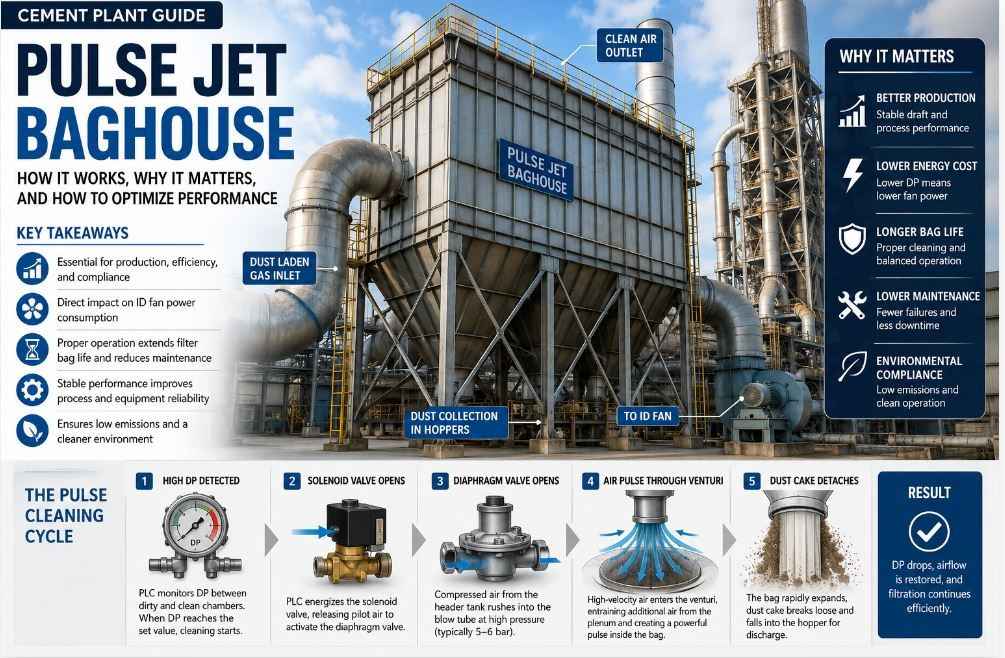
Introduction, Importance, Working Principle & Process Flow
Table of Contents
A cement plant is full of large equipment such as kilns, pre-heaters, grinding mills and high-capacity fans. Since these machines directly produce clinker and cement, they usually receive the most attention. However, one of the most important systems often works quietly in the background – “Baghouse“.
Many people think a baghouse is only used for dust collection and environmental compliance. In reality, it plays a vital role in the overall efficiency and reliability of the plant. A properly operating baghouse not only controls dust emissions but also helps maintain stable process conditions. A well-maintained baghouse provides several important benefits:
- Maintains stable airflow throughout the process
- Improves mill and kiln production
- Reduces fan power consumption
- Increases equipment reliability
- Extends filter bag life
- Lowers maintenance and operating costs
- Ensures compliance with environmental emission limits
On the other hand, a poorly performing baghouse creates several operational problems:
- Higher differential pressure (DP)
- Reduced airflow and draft
- Increased fan power consumption
- Lower production capacity
- Frequent bag failures and maintenance shutdowns
- Higher dust emissions
In simple words: A healthy baghouse allows the entire process to breathe efficiently, while a neglected baghouse slowly reduces the performance and efficiency of the entire cement plant.
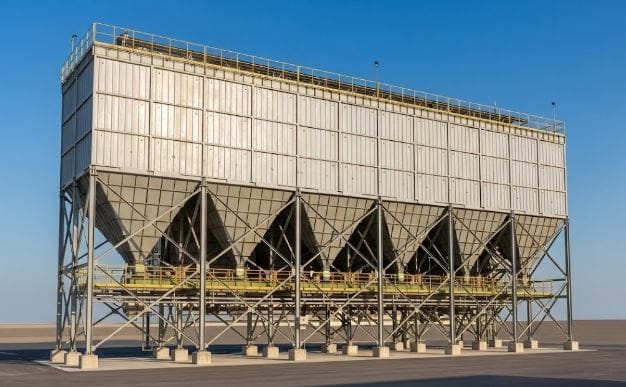
Why Baghouse Optimisation Should Be a Continuous Activity
Baghouse optimisation is not a one-time maintenance job performed only during annual shutdowns. It is a continuous process that requires regular monitoring, preventive maintenance, and proper operational practices. A well-optimized baghouse improves plant efficiency, while poor maintenance can gradually reduce overall performance. Effective baghouse optimisation involves:
- Process monitoring and control
- Mechanical inspection and maintenance
- Instrumentation accuracy
- Compressed air system performance
- Proper operating discipline
Every process engineer should monitor baghouse performance regularly because small issues often become costly problems if left unattended.
For example, a 20–30 mmWC increase in Differential Pressure (DP) may seem insignificant during daily operation, but it increases system resistance. As a result, the Induced Draft (ID) Fan has to work harder to maintain the required airflow. This leads to:
- Higher motor current
- Increased power consumption
- Reduced available draft
- Lower process airflow
- Reduced mill production
From practical plant experience, many plants ignore gradual DP increases until production starts falling or fan power rises significantly. By that time, the plant may have already lost a considerable amount of energy and production. Regular monitoring and timely corrective action can prevent these hidden losses.
Related Reading: If you would like to learn more about mill stability, read our article on Common Causes of Vibration in Vertical Roller Mills (VRM) and Their Troubleshooting, where the most common process and mechanical-related vibration issues are explained with practical troubleshooting tips.
Why Every Cement Plant Depends on Its Baghouse
1. Environmental Compliance
The primary function of a baghouse is to capture dust particles before process gases are released into the atmosphere. Modern cement plants must comply with strict environmental regulations, making efficient dust collection essential for both legal compliance and sustainable operation. Even a few damaged or leaking filter bags can significantly increase stack emissions, leading to regulatory issues, higher maintenance costs, and an increased risk of environmental penalties. In addition, visible dust emissions can negatively affect the company’s reputation and often result in complaints from nearby communities.
Key benefits of an efficient baghouse:
- Controls dust emissions within permissible limits
- Ensures compliance with environmental regulations
- Protects the surrounding environment
- Improves the company’s public image
- Reduces the risk of penalties and complaints
Remember: Every kilogram of dust escaping through the stack is not just pollution, it is also valuable product lost from the process.
2. Maximising Plant Production
A baghouse plays a crucial role in maintaining the airflow required for efficient plant operation. Every grinding system and kiln depends on adequate ventilation to transport heat, remove moisture, and carry fine particles through the process. When baghouse resistance increases due to high Differential Pressure (DP), airflow decreases, causing the entire process to become unstable.
The impact can be seen across different plant sections:
Raw Mill
The baghouse plays a critical role in maintaining proper ventilation in the raw mill. Adequate airflow is essential for drying raw materials, transporting fine particles and keeping the mill stable. When baghouse Differential Pressure (DP) increases, airflow decreases, directly affecting raw mill performance.
Common effects of poor baghouse performance:
- Reduced drying capacity, especially when raw material moisture is high
- Lower mill ventilation, resulting in poor material transport
- Reduced mill production because the required air volume cannot be maintained
- Increased ID fan power consumption as the fan works harder to overcome higher resistance
- Unstable mill operation and frequent process fluctuations
From practical plant experience:
A gradual increase in baghouse DP is often ignored until production starts dropping. Instead of increasing the ID fan speed, engineers should first identify the root cause such as clogged filter bags, poor pulse cleaning, or hopper dust accumulation to restore normal airflow and improve mill performance.
Cement Mill
In a cement mill, proper ventilation is essential for efficient material transport, grinding, and separation. When baghouse Differential Pressure (DP) increases, airflow through the mill decreases, reducing the system’s overall efficiency and production capacity.
Common effects of poor baghouse performance:
- Poor material transport inside the mill
- Higher separator reject due to inefficient classification
- Increased circulating load, putting additional stress on the grinding system
- Reduced mill throughput and overall production
- Increased fan power consumption as the ID fan works against higher resistance
From practical plant experience:
When mill production starts decreasing, operators often decrease separator speed or increase ID fan speed to recover output. However, if the real issue is high baghouse DP, these adjustments only increase power consumption without solving the root cause. Restoring proper baghouse performance improves airflow, stabilises mill operation and helps achieve higher production with lower energy consumption.
Coal Mill
A baghouse is especially critical in the coal mill because it not only controls dust but also maintains safe and stable ventilation. Proper airflow is essential for drying coal, transporting fine particles, and preventing the accumulation of combustible dust.
Common effects of poor baghouse performance:
- Reduced drying efficiency, especially when coal moisture is high
- Poor fineness control due to unstable airflow
- Lower mill performance and reduced coal drying capacity
- Increased explosion risk due to poor ventilation and dust accumulation
- Higher fan power consumption caused by increased baghouse resistance
From practical plant experience:
Coal mill baghouse DP should always be monitored closely. A gradual increase in DP reduces ventilation, making coal drying more difficult and creating unsafe operating conditions. Maintaining proper airflow not only improves mill performance but also enhances the overall safety of the coal grinding system.
Kiln Baghouse
The kiln baghouse is essential for maintaining stable kiln draft and smooth gas flow through the pre-heater and rotary kiln. Any increase in baghouse Differential Pressure (DP) restricts gas flow, affecting the entire pyro-processing system and reducing kiln efficiency.
Common effects of poor baghouse performance:
- Poor kiln draft, making process control difficult
- Unstable burning zone and fluctuating kiln operation
- Higher pre-heater pressure due to restricted gas flow
- Reduced kiln output and lower production
- Increased ID fan power consumption
- Higher risk of false air effects and process instability
From practical plant experience:
When kiln draft becomes unstable, operators often increase the kiln ID fan speed to maintain the required negative pressure. However, if the baghouse DP is high, this only increases power consumption while providing limited improvement. Cleaning clogged filter bags, repairing damaged bags, and maintaining an efficient pulse cleaning system restore proper gas flow, stabilise the burning zone, and improve kiln performance.
In a Vertical Roller Mill (VRM), harder clinker often requires increased fan airflow to transport the additional internal recirculation and maintain efficient material separation. Understanding and accurately measuring actual fan flow is therefore essential for stable mill operation and energy optimisation. For a detailed explanation, read Fan Flow Measurement in Cement Plants: Methods, Calculations & Optimisation.
3. Reducing Fan Power Consumption
The Induced Draft (ID) Fan is one of the largest power consumers in a cement plant. Its energy consumption mainly depends on gas flow, static pressure, fan efficiency and gas density. Among these, baghouse Differential Pressure (DP) is the factor that operators can monitor and control on a daily basis.
As baghouse DP increases, the fan must generate more pressure to maintain the required airflow. This forces the motor to work harder, increasing energy consumption and reducing overall system efficiency.
Common effects of high baghouse DP:
- Higher fan power consumption
- Increased motor current and temperature
- Greater load on fan bearings
- Higher fan vibration
- Increased operating and maintenance costs
Many plants focus on optimising the fan while overlooking the baghouse. In reality, even a small reduction in baghouse DP can significantly lower ID fan power consumption without affecting production. Maintaining clean filter bags, an efficient pulse cleaning system and proper hopper dust evacuation is one of the simplest and most cost-effective ways to improve plant energy efficiency.
4. Increasing Filter Bag Life
Filter bags are one of the most expensive consumable components in a baghouse. Replacing thousands of bags requires a planned shutdown, significant workforce and substantial maintenance costs. Therefore, extending filter bag life is essential for reducing operating expenses and improving plant reliability.
A complete bag replacement typically involves:
- Production shutdown
- Skilled workforce
- Cranes and lifting equipment
- Scaffolding
- Purchase of new filter bags
- Filter cage inspection or replacement
- Disposal of damaged bags
The service life of filter bags depends on several operating conditions:
- Gas temperature
- Pulse cleaning frequency and pressure
- Dust characteristics
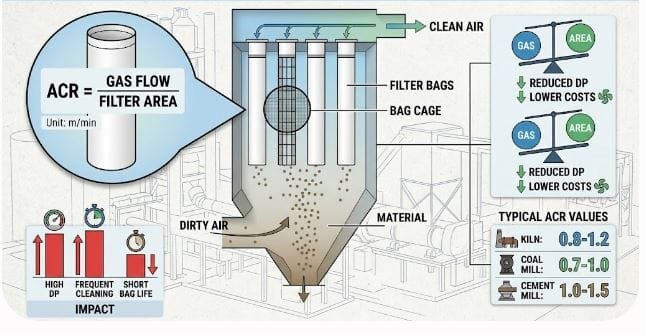
- Air-to-Cloth (A/C) Ratio
- Gas velocity
- Moisture content
- Chemical attack from acidic or corrosive gases
Many premature bag failures are not caused by poor bag quality but by improper operating conditions. High temperatures, excessive pulse cleaning, high Air-to-Cloth Ratio, moisture, or chemical attack can damage filter bags long before their expected service life. Maintaining the baghouse within recommended operating limits can extend bag life from a few months to several years, significantly reducing maintenance costs and unplanned shutdowns.
Recommended Reading: Since clinker quality is closely linked to kiln operation, understanding burning conditions, heat balance, and thermal efficiency is essential for improving cement mill performance. For a detailed explanation of these topics, check out this comprehensive guide on Amazon Kindle.
5. Lower Maintenance Cost
A poorly performing baghouse affects much more than dust collection. As its performance deteriorates, it creates a chain reaction that increases maintenance requirements across the entire system. By optimising baghouse operation, plants can reduce breakdowns, improve equipment reliability and lower overall maintenance costs.
Common maintenance issues caused by poor baghouse performance:
- Frequent pulse valve failures
- Compressed air compressor overloading
- Rotary airlock failures
- Hopper choking and dust build-up
- Conveyor overloading
- Increased fan vibration
- Expansion joint damage due to excessive pressure fluctuations
Many maintenance problems that appear unrelated are actually caused by poor baghouse operation. High DP, ineffective pulse cleaning or poor hopper evacuation puts extra stress on connected equipment, leading to repeated failures. A well-maintained baghouse minimises these secondary problems, allowing maintenance teams to focus on planned preventive maintenance instead of frequent emergency repairs.
Understanding the Pulse Jet Baghouse
Effective baghouse optimisation starts with a clear understanding of how the system works. A Pulse Jet Baghouse is designed to collect dust continuously while automatically cleaning the filter bags, allowing the process to operate without interruption. Unlike older shaker or reverse-air baghouses, a pulse jet baghouse performs filtration and cleaning at the same time, making it the preferred choice for modern cement plants where continuous operation and high production are essential.
The Pulse Jet Baghouse performs two main functions:
- Dust Filtration – Captures fine dust particles from the process gas before clean air is released.
- Automatic Cleaning – Uses short bursts of compressed air to remove accumulated dust from the filter bags while the baghouse remains in service.
A pulse jet baghouse can maintain low Differential Pressure (DP) and stable airflow only when the pulse cleaning system, compressed air supply, and hopper dust evacuation are functioning properly. Even if one of these systems underperforms, baghouse efficiency gradually decreases, affecting the entire process.
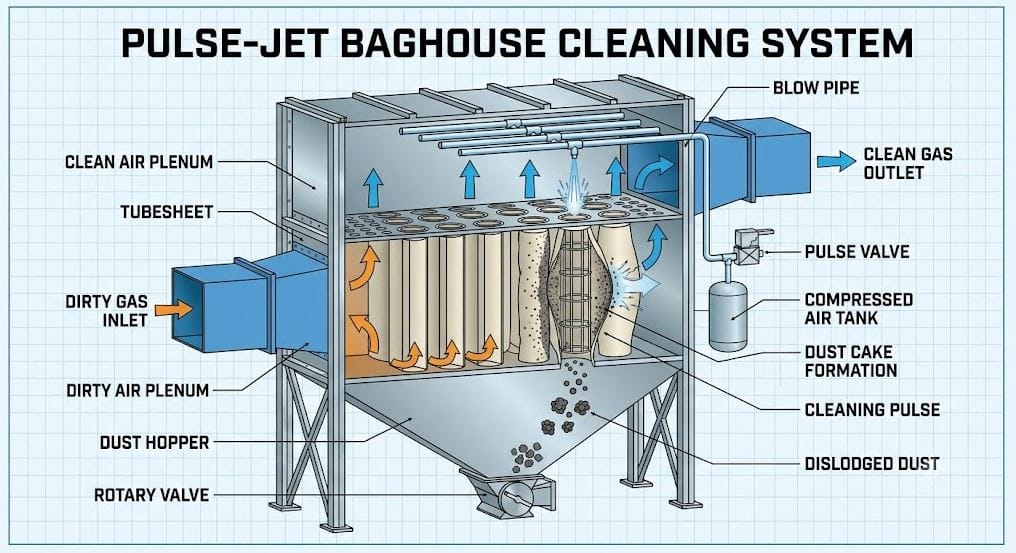
How a Pulse Jet Baghouse Works
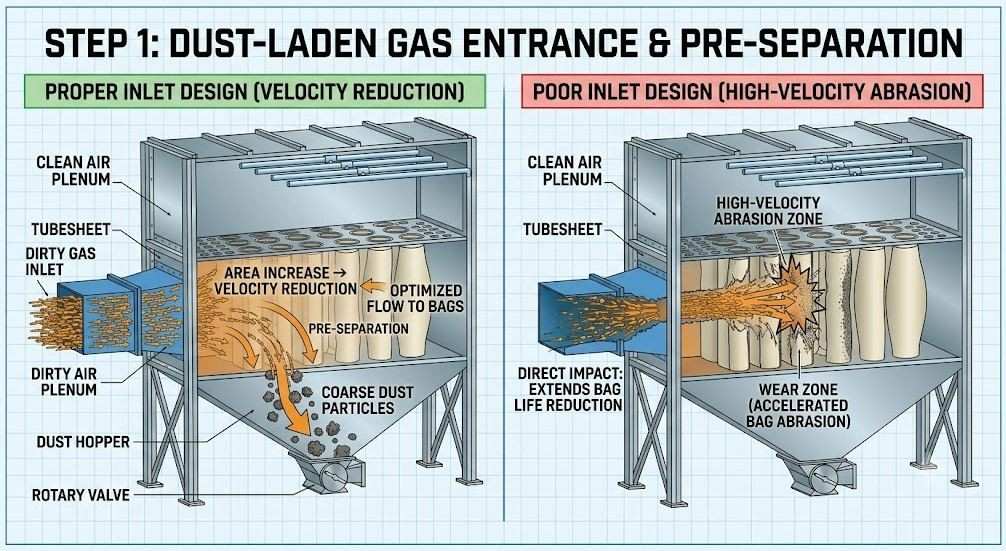
Step 1 – Dust-Laden Gas Enters the Baghouse
The process starts when dust-laden gas leaves equipment such as the Raw Mill, Cement Mill, Coal Mill, Kiln and enters the baghouse through the inlet duct. At this stage, the gas velocity is relatively high because it has travelled through process ducts. As the gas enters the baghouse, the cross-sectional area increases significantly, causing the gas velocity to decrease. This reduction in velocity is important because it allows larger and heavier dust particles to settle directly into the hopper under gravity before reaching the filter bags. This process is known as pre-separation.
Benefits of proper inlet design:
- Reduces gas velocity before filtration
- Allows coarse dust to settle into the hopper
- Minimises direct impact on filter bags
- Reduces bag abrasion and extends bag life
- Improves overall baghouse efficiency
A poorly designed or damaged inlet causes dust to hit a small group of filter bags at high velocity. These bags wear out much faster than the others, leading to frequent bag failures and higher maintenance costs.
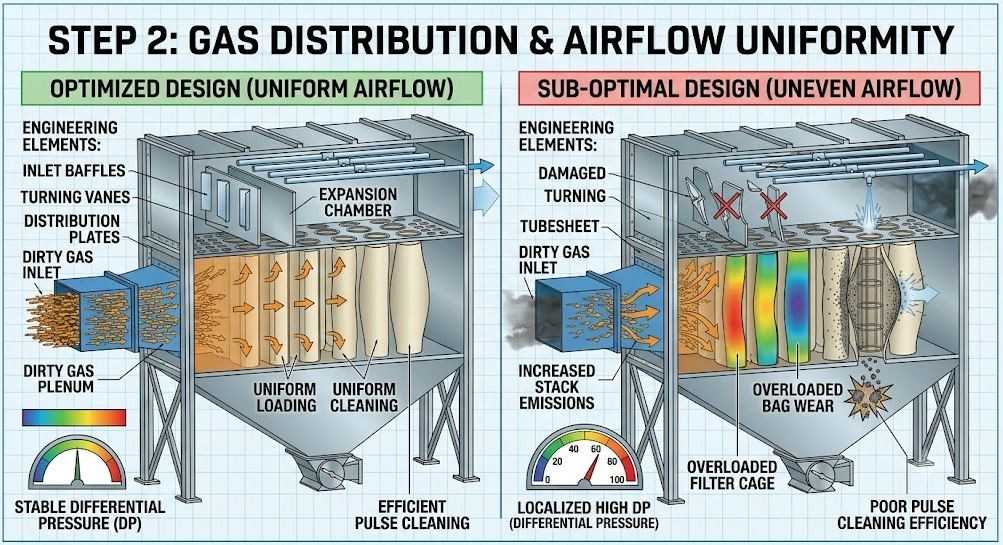
Step 2 – Gas Distribution Inside the Baghouse
After entering the hopper section, the gas is distributed evenly across all filter compartments. Uniform airflow ensures that every filter bag shares an equal filtration load, resulting in stable operation and efficient cleaning. If airflow is uneven, some bags become overloaded while others remain underutilised, reducing the overall efficiency of the baghouse.
Poor gas distribution can cause:
- Uneven bag loading
- Localised high Differential Pressure (DP)
- Premature filter bag wear
- Poor pulse cleaning efficiency
- Increased stack emissions
To achieve uniform airflow, engineers carefully design and inspect:
- Inlet baffles
- Turning vanes
- Distribution plates
- Expansion chambers
When one compartment consistently shows higher DP than the others, the problem is often poor gas distribution rather than defective filter bags. Correcting airflow distribution improves both performance and bag life.
Step 3 – Filtration Begins
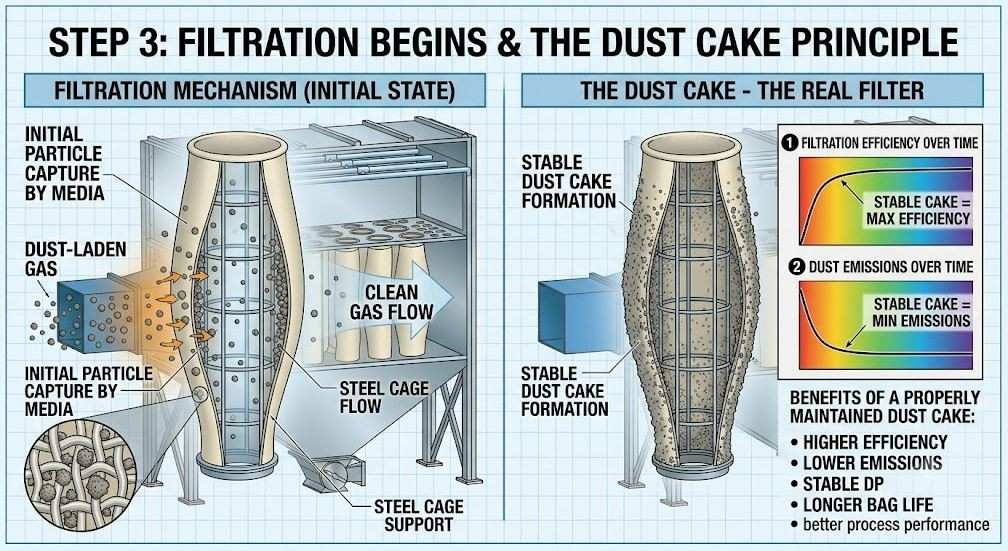
Each filter bag is supported by a steel cage, and the dusty gas flows from the outside of the bag to the inside. As the gas passes through the filter fabric, clean air enters the bag while dust particles remain on the outer surface. Initially, the filter media captures most of the dust. After a short period of operation, a thin layer of dust forms on the bag surface. This layer is known as the dust cake.
The Dust Cake -The Real Filter
Many engineers believe that perfectly clean filter bags provide the best filtration. In reality, the opposite is true. A thin and stable dust cake acts as the primary filtering layer, capturing much finer particles than the filter fabric alone. The objective of pulse cleaning is not to completely clean the bags. Instead, it should remove only the excess dust while leaving behind a thin residual dust cake for efficient filtration.
A properly maintained dust cake provides:
- Higher filtration efficiency
- Lower dust emissions
- Stable Differential Pressure (DP)
- Better process performance
- Longer filter bag life
Excessive pulse cleaning removes the protective dust cake, wastes compressed air, and increases bag wear. On the other hand, insufficient cleaning allows dust to accumulate excessively, causing DP to rise and restricting airflow. The best baghouse performance is achieved by maintaining the right balance between filtration and cleaning.
Step 4 – Clean Gas Leaves the Baghouse
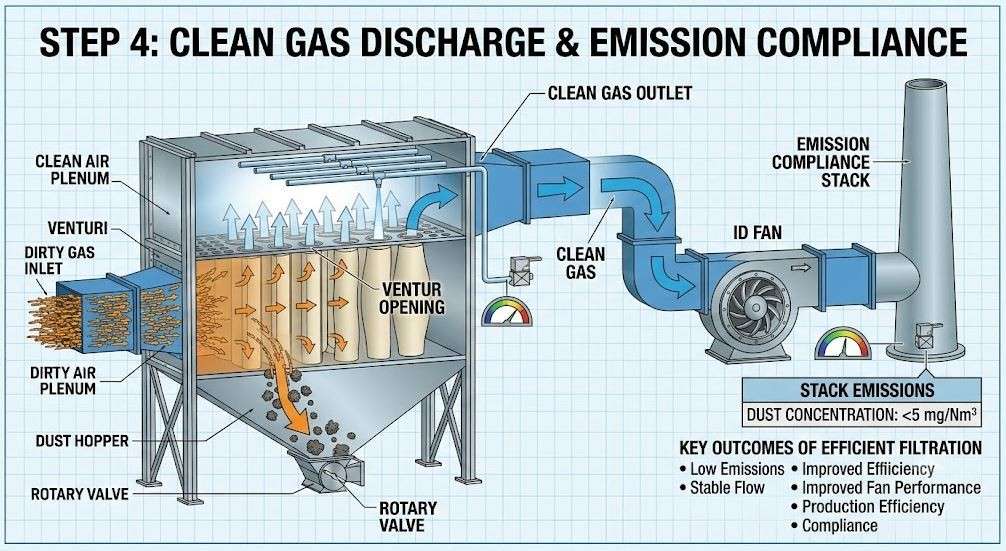
After passing through the filter bags, the clean gas flows into the venturi, enters the clean air plenum, passes through the outlet duct, and is then drawn by the ID Fan before being discharged through the stack. By this stage, almost all dust particles have been removed, allowing the plant to meet environmental emission limits while maintaining stable process airflow.
Key outcomes of efficient filtration:
- Very low dust emissions
- Stable process airflow
- Improved ID fan performance
- Better production efficiency
- Compliance with environmental regulations
A stable outlet DP, consistent airflow and low stack emissions indicate that the baghouse is operating efficiently. Regular monitoring of these parameters helps identify potential problems before they affect production or environmental compliance.
The Pulse Cleaning Cycle
As filtration continues, dust gradually accumulates on the outer surface of the filter bags, forming a dust cake. While this dust cake improves filtration efficiency, excessive build-up increases Differential Pressure (DP) and restricts airflow. To maintain stable operation, the baghouse automatically starts the pulse cleaning cycle when the preset DP limit is reached.
Step 1 – PLC Detects High Differential Pressure
A Differential Pressure (DP) transmitter continuously measures the pressure difference between the dirty gas chamber and the clean gas chamber. When the DP reaches the preset upper limit, the PLC (Programmable Logic Controller) automatically initiates the pulse cleaning sequence.
Key functions:
- Continuously monitors baghouse DP
- Compares actual DP with the setpoint
- Automatically starts pulse cleaning when required
- Maintains stable airflow and filtration performance
Step 2 – Solenoid Valve Opens
After receiving the signal from the PLC, the solenoid valve is energised. Although the solenoid handles only a small pilot airflow, its main purpose is to activate the diaphragm valve.
Role of the solenoid valve:
- Receives the PLC signal
- Releases pilot air pressure
- Triggers the diaphragm valve to open
Step 3 – Diaphragm Valve Opens
As soon as the pilot pressure is released, the diaphragm valve opens almost instantly. Compressed air stored in the air header is released into the blow tube at high pressure. Typical pulse pressure is 5–6 bar, although the exact value depends on the baghouse design and filter bag specifications.
This stage provides:
- High-pressure compressed air
- Fast and efficient pulse cleaning
- Uniform air distribution through the blow tube
Low compressed air pressure or leaking diaphragm valves often result in weak cleaning pulses, causing DP to increase gradually and reducing baghouse efficiency.
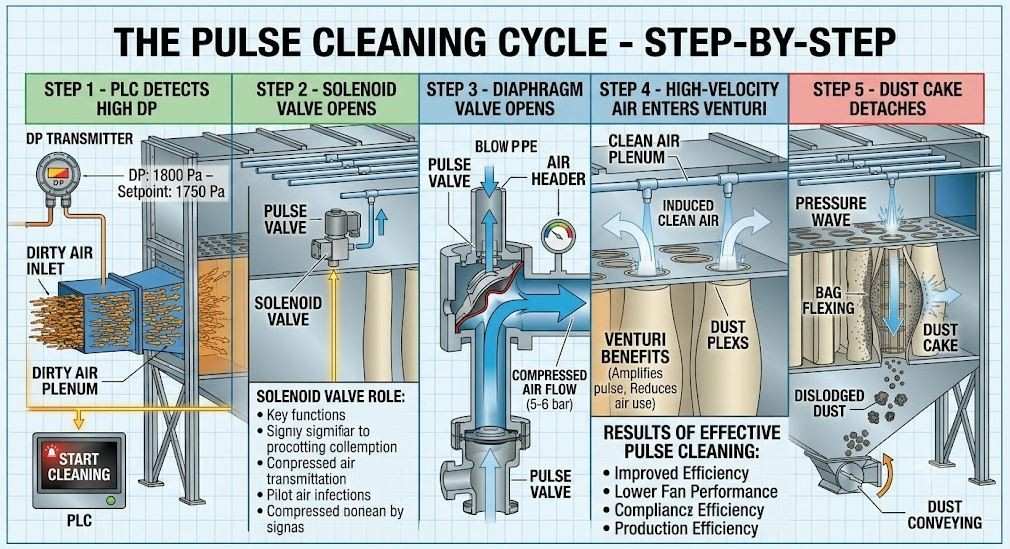
Step 4 – High-Velocity Air Enters the Venturi
The compressed air exits through nozzles positioned above each filter bag and enters the venturi. The venturi draws additional clean air from the clean air plenum, significantly increasing the total cleaning airflow. This creates a powerful pressure wave that travels down the inside of the filter bag, ensuring effective dust removal with a relatively small amount of compressed air.
Benefits of the venturi:
- Amplifies the cleaning pulse
- Improves pulse efficiency
- Reduces compressed air consumption
- Ensures uniform cleaning of the filter bag
Step 5 – Dust Cake Detaches
The pressure wave rapidly expands the filter bag, causing it to flex. This sudden movement breaks the bond between the dust cake and the filter fabric. The loosened dust falls into the hopper under gravity and is removed through the rotary airlock before being conveyed back to the process or disposal system.
Results of effective pulse cleaning:
- Removes excess dust from the bags
- Reduces Differential Pressure (DP)
- Restores normal airflow
- Maintains stable baghouse performance
- Extends filter bag life
A properly adjusted pulse cleaning system removes only the excess dust while leaving a thin dust cake on the filter surface. This balance keeps DP under control, minimises compressed air consumption, and extends the service life of the filter bags.
Complete Gas Flow Path
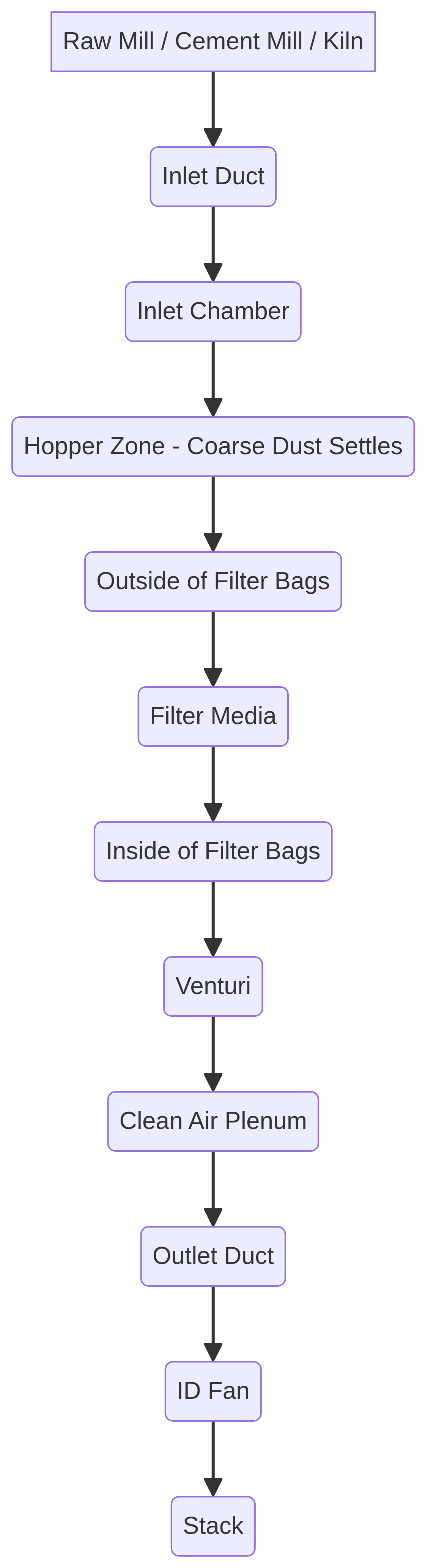
Complete Dust Flow Path
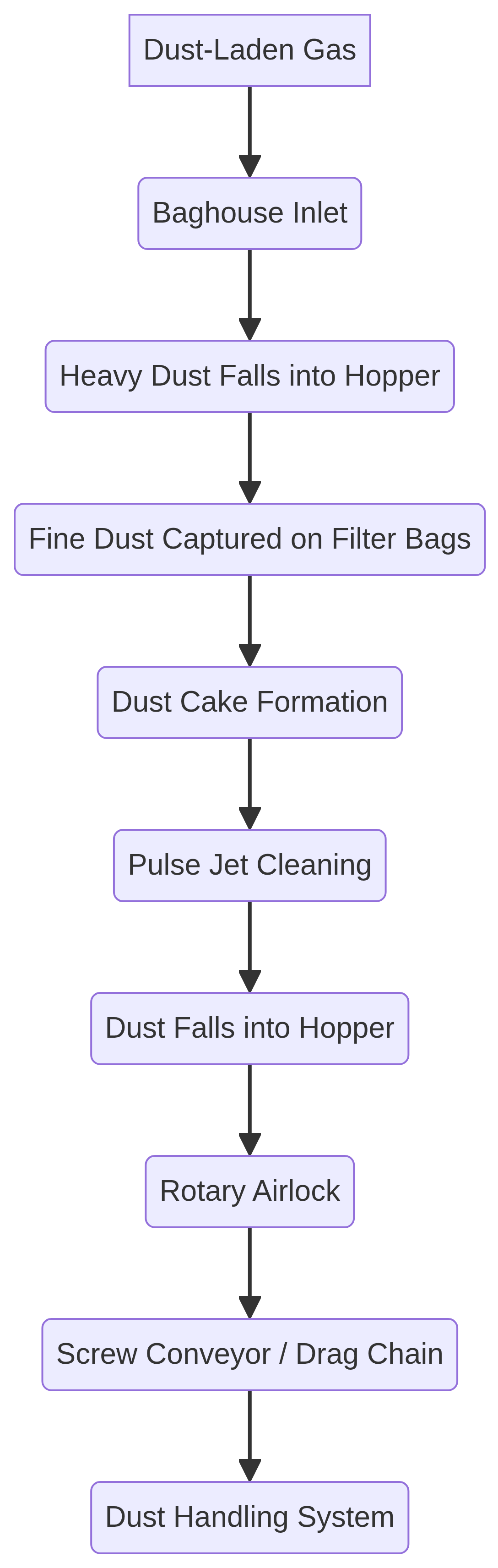
Filter Media Characteristics
| Filter Media | Max. Operating Temp (°C) | Key Characteristics | Common Applications |
| Polyester | 130 | Good all-around performance, cost-effective, can be treated for chemical resistance. | General cement dust, lower temperature applications. |
| Aramid (Nomex) | 200 | High temperature resistance, good abrasion resistance, cost-effective for high-temp filtration. | Kiln baghouses, clinker coolers, high-temperature areas. |
| Fibreglass | 260 | Excellent high-temperature resistance, good chemical resistance, often with PTFE coatings for durability. | Extreme high-temperature applications. |
| PTFE | 260 | Superior chemical resistance, non-stick surface, excellent for sticky dust and harsh chemicals. | Corrosive environments, sticky dust, high efficiency. |
Recommended Reading: Since baghouse performance is closely influenced by raw mill gas flow, temperature, moisture, and process stability, understanding Raw Mill operation and optimisation can help improve overall baghouse efficiency. For a detailed guide on raw mill operation, troubleshooting, and process optimisation, check out this comprehensive book on Amazon Kindle.
Key Takeaways
A baghouse is much more than a dust collection system, it is a vital part of the cement manufacturing process. Its performance directly affects production, energy consumption, equipment reliability, maintenance costs, and environmental compliance. A well-maintained baghouse ensures stable airflow, efficient filtration, and smooth plant operation.
To optimise baghouse performance, every process engineer should understand:
- How process gas flows through the baghouse
- How the dust cake improves filtration efficiency
- How the pulse cleaning system maintains stable Differential Pressure (DP)
- How poor baghouse performance impacts the entire process
Many production losses and high power consumption issues are traced back to baghouse problems such as high DP, ineffective pulse cleaning, damaged filter bags, or poor hopper dust evacuation. Regular monitoring and preventive maintenance help avoid these hidden losses and improve overall plant performance.
4 thoughts on “Baghouse Optimisation in Cement Plants (Part-1)”