Table of Contents
In the cement industry, gypsum is often referred to as a set retarder, but its contribution extends far beyond merely delaying the setting of cement. From a cement plant process engineer’s perspective, gypsum is one of the most critical components influencing cement quality, consistency and performance. Its role begins immediately when water is added to cement and continues throughout the early stages of hydration.
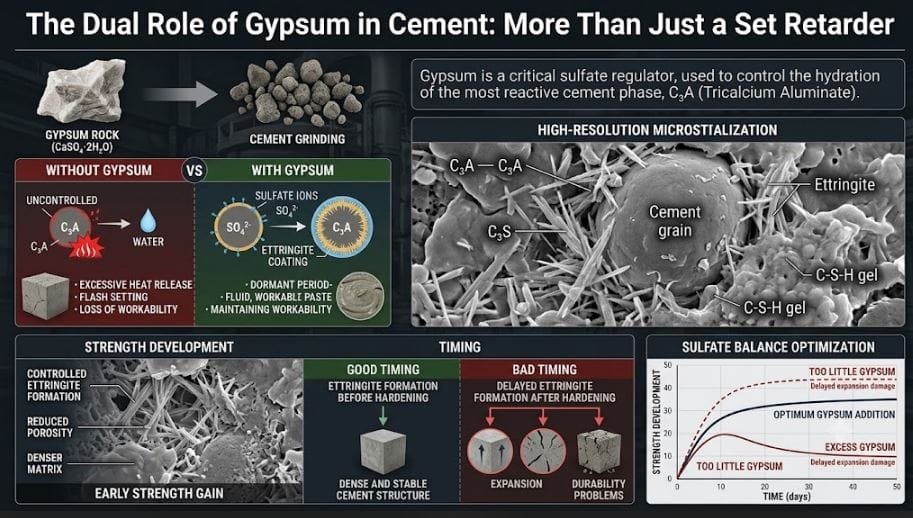
The primary function of gypsum is to regulate the highly reactive tricalcium aluminate (C₃A) phase present in clinker. Without adequate sulphate control, C₃A reacts rapidly with water, causing flash setting and making cement practically unworkable within minutes. By controlling this reaction, gypsum provides the necessary dormant period that allows concrete to remain plastic and workable during mixing, transportation, placement and finishing operations.
However, gypsum is much more than a setting time controller. During hydration, it reacts with C₃A to form ettringite, a beneficial crystalline compound that contributes to the development of a denser cement matrix and supports early-age strength gain when formed at the proper time. Maintaining the correct gypsum-to-clinker balance is therefore essential not only for achieving consistent setting characteristics but also for optimising cement strength and overall performance.
For cement manufacturers, understanding the dual role of gypsum is vital. Even small variations in gypsum addition, clinker mineralogy or sulphate balance can significantly influence setting time, strength development and customer satisfaction. Optimising gypsum is not merely a laboratory requirement, it is a key process parameter that directly impacts cement quality from the grinding mill to the construction site.
What Happens Without Gypsum?
Portland cement clinker contains four major mineral phases, among which tricalcium aluminate (C₃A) is the most reactive during the early stages of hydration. The moment water comes into contact with cement, C₃A begins reacting rapidly. In the absence of sufficient gypsum, this reaction proceeds almost uncontrollably, releasing a significant amount of heat within a very short period.
Gypsum acts as a sulphate regulator by controlling the hydration of C₃A and providing the dormant period necessary for normal cement setting. Without adequate gypsum addition, the hydration process becomes excessively rapid, leaving little time for proper handling and placement of concrete. Depending on the clinker mineralogy and the degree of sulphate deficiency, cement may exhibit flash setting or severe loss of workability shortly after mixing.
Without sufficient gypsum:
- C₃A reacts rapidly and uncontrollably with water.
- Cement may undergo flash setting or abnormal early stiffening.
- Workability is lost before proper placement and compaction.
- Hydration becomes difficult to control during the initial stages.
- Setting characteristics become inconsistent.
- Early strength development can be adversely affected due to improper sulphate balance.
- Concrete quality and field performance may be compromised.
In practical cement plant operations, even small deviations in gypsum addition can significantly influence cement behaviour. A cement that loses its workability prematurely becomes difficult to mix, transport, and place at the construction site, regardless of its compressive strength potential. This is why maintaining the optimum gypsum-to-clinker ratio is considered one of the most critical parameters in cement grinding.
Simply put, without adequate gypsum, cement loses the controlled hydration mechanism required for normal setting behaviour, making it unsuitable for most construction applications.
Related Reading: If you would like to learn more about mill stability, read our article on Common Causes of Vibration in Vertical Roller Mills (VRM) and Their Troubleshooting, where the most common process and mechanical-related vibration issues are explained with practical troubleshooting tips.
How Does Gypsum Control Setting?
Gypsum (CaSO₄·2H₂O) is typically added during cement grinding to regulate the hydration of tricalcium aluminate (C₃A), one of the most reactive phases present in clinker. Although gypsum addition generally ranges between 3–5%, the optimum dosage depends on factors such as clinker mineralogy, C₃A content, cement fineness, and the desired cement properties.
When water is added to cement, gypsum dissolves and releases sulphate ions that react with C₃A to form ettringite (Ca₆Al₂(SO₄)₃(OH)₁₂.26H₂O). Without gypsum, C₃A hydrates almost instantaneously, causing cement to stiffen rapidly. The formation of ettringite regulates this reaction and provides the dormant period necessary for normal cement setting and workability.
Instead of allowing uncontrolled hydration, gypsum:
- Controls the reaction rate of C₃A.
- Promotes the formation of ettringite during the early stages of hydration.
- Prevents rapid setting by maintaining proper sulphate balance.
- Provides the dormant period required for normal cement setting.
- Maintains concrete workability during transportation, placement, and finishing operations.
This dormant period is extremely important for construction activities because it provides sufficient time for:
- Mixing
- Pumping
- Transportation
- Placement
- Compaction
- Finishing operations
Without this controlled hydration mechanism, cement would lose its normal setting characteristics and become difficult to handle at the construction site. Proper gypsum addition ensures that cement remains workable for an adequate period while allowing hydration to continue in a controlled manner, ultimately contributing to consistent setting behaviour and early strength development.
It is important to note that gypsum requirement is not the same for every cement. The optimum sulphate level varies with clinker chemistry and the use of supplementary cementitious materials such as fly ash, slag, or limestone. For this reason, sulphate optimisation remains one of the most critical quality control parameters in cement manufacturing.

In a Vertical Roller Mill (VRM), harder clinker often requires increased fan airflow to transport the additional internal recirculation and maintain efficient material separation. Understanding and accurately measuring actual fan flow is therefore essential for stable mill operation and energy optimisation. For a detailed explanation, read Fan Flow Measurement in Cement Plants: Methods, Calculations & Optimisation.
The Hidden Role of Gypsum in Strength Development
Gypsum’s role in cement extends well beyond controlling the setting time. It also contributes significantly to early-age strength development by maintaining the proper sulphate balance during the initial stages of hydration. When water is added to cement, gypsum reacts with C₃A to form ettringite. As hydration progresses, these reactions continue in a controlled manner, allowing other clinker phases, particularly tricalcium silicate (C₃S), to hydrate and contribute to strength development. The timely formation of ettringite helps develop a denser and more uniform microstructure during the early stages of cement hydration.
This process provides several important benefits:
- Improved early-age strength development.
- Better densification of the cement matrix.
- Reduction in capillary porosity.
- Enhanced particle bonding within the hydrated paste.
- Improved cohesiveness and dimensional stability of the microstructure.
During the first few days of hydration, gypsum is progressively consumed as sulphate ions participate in ettringite formation. This period also coincides with rapid early strength development in cement-based materials. Maintaining the optimum sulphate balance during this stage is therefore essential for achieving consistent cement performance.
From a cement plant perspective, gypsum optimisation is closely linked not only to setting time but also to strength results. Insufficient gypsum can lead to rapid and uncontrolled hydration of C₃A, while excessive sulphate may adversely affect cement performance. For this reason, achieving the optimum gypsum-to-clinker ratio remains one of the most important quality control parameters in cement manufacturing.
Timing Matters: Good Ettringite vs Bad Ettringite
The benefits of ettringite depend largely on when and where it forms during the hydration process. When formed at the right time, ettringite contributes positively to cement performance. However, under certain conditions, its formation after concrete has hardened can become detrimental to long-term durability.
Good Timing (Before Hardening)
During the plastic and early hydration stages, ettringite formation is both normal and desirable. It helps regulate the hydration of C₃A while contributing to the development of a dense and stable microstructure. When ettringite forms during this stage, it:
- Improves the density of the cement matrix.
- Supports early-age strength development.
- Reduces capillary porosity.
- Enhances the cohesiveness of the hydrated paste.
- Contributes positively to the long-term performance of concrete.
This is the beneficial ettringite formation intentionally achieved through proper sulphate balance in Portland cement.
Bad Timing (After Hardening)
Problems arise when ettringite forms after the concrete has already hardened. Since hardened concrete has limited space to accommodate the growth of ettringite crystals, their formation can generate internal stresses within the microstructure. Under such conditions:
- Internal expansion may develop.
- Microcracks can begin to form.
- Concrete durability may be adversely affected.
- Long-term deterioration can occur in severe cases.
One of the most well-known examples is Delayed Ettringite Formation (DEF), which is generally associated with elevated curing temperatures during the early stages of concrete hydration and the subsequent reformation of ettringite at later ages. Improper sulphate balance can further influence these reactions under specific conditions. Therefore, gypsum optimisation is important not only for controlling setting time but also for ensuring the long-term performance of cement-based materials. Maintaining the correct sulphate balance helps achieve beneficial early ettringite formation while minimising the risk of undesirable expansion-related problems later in the service life of concrete.t for setting time but also for long-term concrete performance.
Recommended Reading: Since clinker quality is closely linked to kiln operation, understanding burning conditions, heat balance, and thermal efficiency is essential for improving cement mill performance. For a detailed explanation of these topics, check out this comprehensive guide on Amazon Kindle.
Why Optimum Gypsum Addition is Critical
Adding more gypsum is not always the solution to improve cement quality. Gypsum plays a critical role in controlling the hydration of C₃A and regulating setting time, but its quantity must be optimised according to clinker characteristics and grinding conditions.
Impact of Low Gypsum Addition
When gypsum is insufficient, the available sulphate is not enough to control the rapid reaction of C₃A. This can lead to:
- Flash setting, where cement loses workability quickly after water addition.
- Reduced workability, making concrete handling and placement difficult.
- Poor strength development, especially during early hydration stages.
- Uncontrolled C₃A hydration, causing rapid heat release and instability in setting behaviour.
Impact of Excessive Gypsum Addition
Adding gypsum beyond the optimum requirement can also create problems. Excess sulphate may result in:
- Higher false setting tendency, affecting cement handling and mixing behaviour.
- Sulphate imbalance, disturbing the hydration mechanism and clinker-sulfate interaction.
- Expansion risks, if excessive sulphate remains unreacted or contributes to delayed reactions.
- Negative impact on long-term performance due to improper hydration balance.
The optimum gypsum requirement is different for every clinker. A fixed gypsum percentage cannot be applied universally because sulphate demand depends on several factors, including:
- C₃A content and reactivity
- Alkali content in clinker
- Clinker mineral composition
- Cement fineness and particle size distribution
- Grinding system conditions
- Type and quantity of supplementary cementitious materials (SCMs) such as fly ash, slag, or pozzolana
Therefore, gypsum optimisation should be based on cement chemistry, setting behaviour, strength results, and plant trial observations rather than simply increasing or decreasing the gypsum percentage. The goal is to maintain the right sulphate balance that controls C₃A hydration and delivers consistent cement performance.
Operational Considerations for Cement Plants
In a cement plant, gypsum optimisation requires continuous monitoring of both process parameters and cement quality indicators. Simply maintaining a fixed gypsum percentage is not enough because changes in clinker chemistry, fineness, grinding conditions, and raw material variations can affect sulphate demand. Process engineers should regularly evaluate key parameters such as:
- Initial and final setting time to ensure proper control of C₃A hydration and maintain required workability.
- SO₃ percentage in cement to maintain the optimum sulphate balance.
- Gypsum quality and purity, as variations in gypsum source and impurities can influence cement performance.
- C₃A content and reactivity of clinker, which directly determine sulphate requirement.
- 1, 3, 7, and 28-day strength results to confirm that gypsum addition is supporting proper hydration and strength development.
- Cement temperature during grinding, as excessive temperature can affect gypsum dehydration and increase false setting risk.
- Customer feedback related to false setting or workability issues to identify any imbalance in sulphate control.
- Sulphate optimisation trials and studies to continuously improve cement consistency.
A well-controlled gypsum optimisation strategy helps cement plants achieve:
- Consistent cement quality and performance
- Improved early-age strength development
- Stable setting characteristics
- Reduced quality fluctuations between batches
- Better customer confidence and satisfaction
The objective is not to maximise gypsum addition but to maintain the optimum sulphate balance required for the specific clinker and cement manufacturing conditions. Proper gypsum management is therefore an important part of process optimisation and quality control in modern cement plants.
Recommended Reading: Since baghouse performance is closely influenced by raw mill gas flow, temperature, moisture, and process stability, understanding Raw Mill operation and optimisation can help improve overall baghouse efficiency. For a detailed guide on raw mill operation, troubleshooting, and process optimisation, check out this comprehensive book on Amazon Kindle.
Conclusion
Gypsum is not merely a material added to control the setting time of cement; it plays a much more important role in cement hydration chemistry. Its primary function is to regulate the highly reactive C₃A phase by controlling the rate of hydration and preventing uncontrolled reactions. At the same time, the formation of beneficial ettringite during early hydration contributes to proper strength development and improved cement performance.
The correct gypsum dosage creates the required balance between setting behaviour, workability, hydration control, and strength development. Both insufficient and excessive gypsum can negatively affect cement quality, making sulphate optimisation a critical part of cement manufacturing.
In modern cement plants, achieving consistent high-quality cement depends not only on clinker quality and grinding efficiency but also on maintaining the right sulphate balance. Gypsum optimisation should therefore be based on clinker chemistry, C₃A content, cement fineness, grinding conditions, and performance test results rather than following a fixed addition percentage.
Ultimately, gypsum optimisation is not just a laboratory activity, it is an important process control parameter that influences cement behaviour from the initial minutes of hydration to long-term strength and durability in the field. A well-balanced sulphate system helps cement plants deliver stable quality, improved customer performance, and reliable cement products.Baghouse Optimisation in Cement Plants (Part-1)