How Higher TSR Affects Specific Heat Consumption (SHC) in Cement Plants?

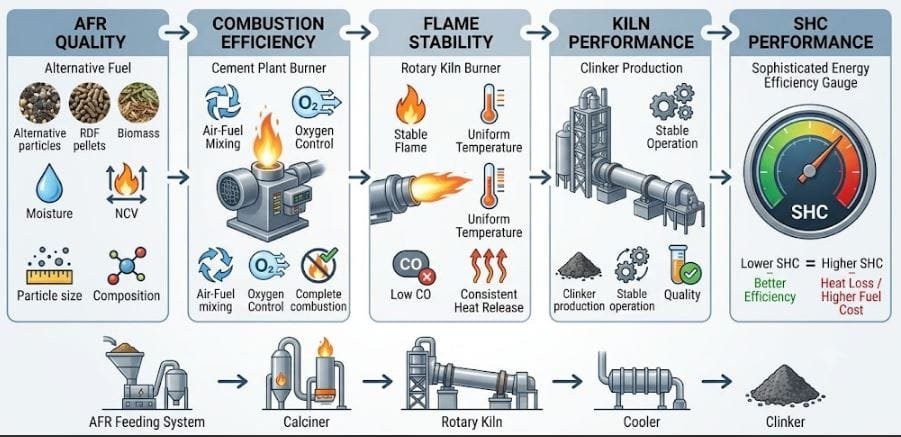
Does Higher TSR Always Reduce SHC in Cement Plant infographic showing relationship between Thermal Substitution Rate, Specific Heat Consumption, AFR quality and kiln efficiency.

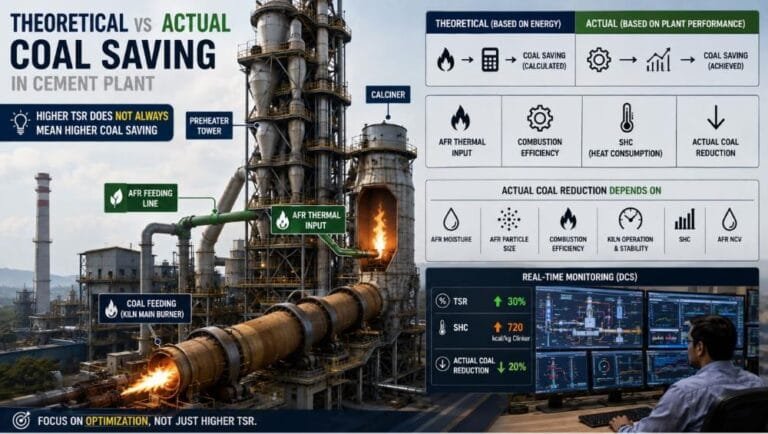
One of the most common misconceptions in cement manufacturing is that increasing Thermal Substitution Rate (TSR) will automatically reduce Specific Heat Consumption (SHC). In reality, a higher TSR does not always mean lower thermal energy consumption. While increasing TSR can reduce fossil fuel consumption and improve sustainability performance, its impact on SHC largely depends on fuel quality, combustion efficiency and kiln system stability.

Many cement plants observe an increase in SHC immediately after increasing AFR utilisation. In some cases, production decreases, flame stability is affected and kiln operation becomes more challenging despite achieving higher TSR values. Therefore, the objective should not simply be to maximise TSR, but to achieve a stable and optimised TSR that maintains production, clinker quality and thermal efficiency.

Why Does This Happen?

TSR and SHC do not share a simple linear relationship. Increasing TSR does not automatically reduce SHC, as both parameters are influenced by multiple operational and process-related variables. The impact of TSR on SHC largely depends on how efficiently the kiln system utilises alternative fuels while maintaining stable combustion and production.

Several factors influence this relationship, including:

  • AFR quality, size and moisture content
  • Net Calorific Value (NCV)
  • Burner performance and combustion efficiency
  • Calciner design and operation
  • Kiln draft conditions
  • Production stability and clinker quality
  • Overall process stability

Even small variations in these parameters can significantly affect thermal efficiency. For example, high-moisture or low-NCV fuels may require additional heat for combustion, increasing SHC despite achieving a higher TSR. Similarly, poor burner optimisation or unstable AFR feeding can negatively impact flame stability and kiln performance.

For process engineers, the ultimate objective should never be maximising TSR alone. Instead, the focus should be on achieving the optimum balance between TSR, SHC, production rate, clinker quality and operating cost. A successful TSR strategy is one that delivers sustainable fuel substitution while maintaining stable kiln operation and thermal efficiency.

Split-page engineering textbook illustration comparing two rotary kiln systems. Left side: optimized alternative fuel combustion with stable flame, efficient heat transfer, low SHC, smooth gas flow and complete combustion. Right side: poor AFR combustion with unstable flame, higher gas volume, incomplete combustion, CO generation, heat losses and increased SHC. Clean technical layout, realistic cement plant equipment, white background, industrial engineering illustration, ultra detailed, no humans, no artistic effects.

Recommended Reading: Since clinker quality is closely linked to kiln operation, understanding burning conditions, heat balance, and thermal efficiency is essential for improving cement mill performance. For a detailed explanation of these topics, check out this comprehensive guide on Amazon Kindle.

What is Specific Heat Consumption (SHC)?

Specific Heat Consumption (SHC) represents the amount of thermal energy required to produce one kilogram of clinker and is usually expressed as kcal/kg clinker. It is one of the most important Key Performance Indicators (KPIs) used to evaluate the thermal efficiency of a cement kiln system. SHC directly influences several critical aspects of cement manufacturing, including:

  • Coal consumption
  • Fuel cost
  • Production cost
  • Kiln efficiency
  • CO₂ emissions
  • Overall plant profitability

A lower SHC generally indicates better thermal efficiency, meaning less heat energy is required to produce the same quantity of clinker. This can contribute to lower fuel consumption and improved operating economics.

However, SHC should never be evaluated in isolation. Lower SHC is beneficial only when clinker quality, production rate and kiln stability remain consistent. Reducing SHC at the expense of production performance or clinker quality cannot be considered successful process optimisation.

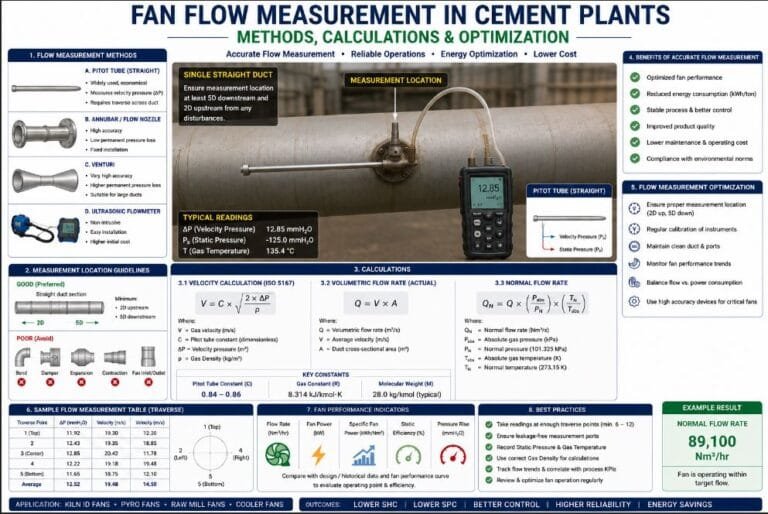
In a Vertical Roller Mill (VRM), harder clinker often requires increased fan airflow to transport the additional internal recirculation and maintain efficient material separation. Understanding and accurately measuring actual fan flow is therefore essential for stable mill operation and energy optimisation. For a detailed explanation, read Fan Flow Measurement in Cement Plants: Methods, Calculations & Optimisation.

Does Higher TSR Always Reduce SHC?

The Answer is NO. A higher TSR does not always result in lower SHC. Depending on fuel quality, combustion conditions and overall process stability, increasing TSR can produce different operational outcomes. A higher TSR may:

  • Reduce SHC.
  • Maintain SHC at existing levels.
  • Increase SHC.

All three scenarios are practically possible in cement plant operation. Therefore, TSR should always be evaluated together with SHC, production performance and clinker quality rather than as an independent KPI.

Scenario 1: Higher TSR + Stable SHC

This is considered an optimised TSR operation and indicates that the kiln system is efficiently utilising alternative fuels without affecting thermal performance. It is generally achievable when the plant has:

  • Stable AFR feeding.
  • Low-moisture AFR.
  • low size AFR material
  • Proper burner tuning.
  • Efficient combustion.
  • Stable calciner operation.
  • Consistent process conditions.

Result: Higher TSR + Stable Production + Stable SHC

This represents one of the most desirable operational outcomes because it improves sustainability performance while maintaining thermal efficiency and production stability.

Scenario 2: Higher TSR + Lower SHC

This scenario is achievable when alternative fuels contribute sufficient thermal energy and the kiln system operates efficiently. It is typically possible when:

  • AFR possesses a good calorific value.
  • Combustion efficiency is high.
  • Flame stability remains unaffected.
  • Process optimisation is properly implemented.
  • Heat losses are minimised throughout the kiln system.

Result: Higher TSR + Lower Coal Consumption + Improved SHC

Although this is an ideal outcome, it should not be considered an automatic consequence of increasing TSR. Achieving both higher TSR and lower SHC requires proper fuel selection, combustion optimisation and stable kiln operation.

Scenario 3: Higher TSR + Higher SHC

This is one of the most common operational challenges observed during TSR implementation. Increasing TSR without proper process optimisation may negatively affect thermal efficiency and increase operating costs. Possible reasons include:

  • High AFR moisture and material size.
  • Low NCV.
  • Poor feeding consistency.
  • Incomplete combustion.
  • Higher false air.
  • Increased gas volume generation.
  • Burner optimisation issues.
  • Production reduction.

Result: Higher TSR + Higher SHC + Higher Operating Cost

Increasing TSR at the expense of thermal efficiency should never be considered successful process optimisation. The objective should always be to achieve an economical and operationally stable TSR that maintains production, clinker quality, and kiln performance.

image 32

How Do Moisture and AFR Size Increase SHC?

Moisture content and AFR particle size are two of the biggest hidden contributors to higher SHC during high TSR operation. Before combustion can begin, the moisture present in AFR must first absorb heat and evaporate, while larger or non-uniform AFR particles require additional time for ignition and complete combustion. These factors can adversely affect heat transfer, combustion efficiency and overall kiln performance. Higher moisture content and improper AFR sizing may result in:

  • Higher fuel consumption.
  • Increased SHC.
  • Higher gas volume generation.
  • Increased draft requirement.
  • Higher ID fan load.
  • High CO generation
  • Reduced thermal efficiency.
  • Delayed and incomplete combustion.
  • Flame instability and process fluctuations.
  • Production instability in severe cases.

Effect of Moisture on SHC

Moisture present in alternative fuels has a direct impact on kiln thermal efficiency. Before the fuel can burn, the moisture must first absorb heat and evaporate. This additional heat requirement reduces the effective thermal contribution of the fuel and can increase Specific Heat Consumption (SHC).

Higher AFR moisture may lead to:

  • Lower Net Calorific Value (NCV) of the fuel.
  • Increased CO generation due to incomplete combustion.
  • Increased AFR feeding requirements to maintain the desired heat input.
  • Additional thermal energy consumption for moisture evaporation.
  • Higher Specific Heat Consumption (SHC).
  • Increased gas volume generation inside the kiln system.
  • Higher draft and ID fan requirements.
  • Reduced thermal efficiency and potential production instability.

For this reason, continuous monitoring of AFR moisture content is essential for maintaining stable kiln operation, optimising SHC and achieving sustainable TSR performance.

Related Reading: If you would like to learn more about mill stability, read our article on Common Causes of Vibration in Vertical Roller Mills (VRM) and Their Troubleshooting, where the most common process and mechanical-related vibration issues are explained with practical troubleshooting tips.

Effect of AFR Particle Size

AFR particle size plays an important role in combustion efficiency and heat release inside the kiln system. Larger or non-uniform AFR particles require more time for ignition and complete combustion, which can adversely affect flame characteristics and calciner performance. Similarly, unstable calciner temperatures and excessive CO generation are clear indicators of combustion inefficiencies that can negatively impact SHC and overall kiln performance.

These conditions may result in:

  • Delayed ignition and incomplete combustion.
  • Poor and non-uniform heat release patterns.
  • Reduced combustion efficiency.
  • Calciner temperature fluctuations.
  • Increased CO generation due to incomplete combustion.
  • Higher Specific Heat Consumption (SHC).
  • Flame instability and process fluctuations.
  • Increased gas volume and draft requirements.
  • Production instability in severe cases.
  • Lower overall thermal efficiency of the kiln system.

Large AFR particles may not burn completely within the available residence time of the calciner, causing uneven heat release and temperature variations. Inadequate combustion can also increase CO levels, indicating that the thermal energy supplied by the fuel is not being utilised efficiently. As a result, additional fuel may be required to maintain kiln temperatures, ultimately increasing SHC.

For this reason, maintaining a consistent AFR particle size distribution, stable calciner temperatures and minimal CO generation should always be considered critical process parameters for sustainable high TSR operation. Proper AFR preparation, optimised combustion conditions and continuous process monitoring are essential for achieving lower SHC while maintaining stable kiln performance.

Recommended Reading: Since baghouse performance is closely influenced by raw mill gas flow, temperature, moisture, and process stability, understanding Raw Mill operation and optimisation can help improve overall baghouse efficiency. For a detailed guide on raw mill operation, troubleshooting, and process optimisation, check out this comprehensive book on Amazon Kindle.

Effect of NCV on SHC

Net Calorific Value (NCV) is one of the most important fuel properties influencing SHC. It represents the amount of useful heat energy released during fuel combustion. Alternative fuels having identical feeding rates may contribute significantly different amounts of thermal energy depending on their NCV values. The following example illustrates how NCV can influence kiln thermal performance.

ParameterAFR-1AFR-2
Feed Rate5 TPH5 TPH
NCV4,500 kcal/kg2,800 kcal/kg
MoistureLowHigh
CombustionStableModerate
SHC ImpactLowerHigher

Although both fuels are fed at the same rate, AFR-1 provides a higher thermal energy contribution because of its higher NCV and lower moisture content. AFR-2, on the other hand, may require additional fuel feeding to maintain the same heat input, which can adversely affect SHC and process stability.

Lower NCV fuels generally require:

  • Higher feeding rates.
  • Better combustion control.
  • More precise process optimisation.
  • Improved AFR quality management.
  • Stable calciner and burner operation.

Therefore, AFR quality becomes equally important as TSR itself. Increasing TSR with low-quality fuels may not necessarily improve thermal efficiency unless combustion conditions and process parameters are properly optimised.

How Can Higher TSR Affect Production?

Higher TSR can significantly influence clinker production if AFR quality, combustion efficiency, and process stability are not properly maintained. Increasing TSR changes the quantity, quality, and combustion behaviour of alternative fuels introduced into the kiln system. As a result, heat release patterns inside the calciner may change, directly affecting thermal efficiency and kiln throughput.

High-moisture AFR, low NCV fuels, improper particle size distribution, or inconsistent AFR feeding can lead to unstable combustion conditions. These issues may cause calciner temperature fluctuations, increased CO generation, and changes in flame characteristics, making it difficult to maintain stable kiln operation. In such situations, kiln feed rates are often reduced to stabilise the process, which ultimately affects clinker production.

The relationship between TSR and production can be summarised as follows:

Higher TSR → AFR Feeding Changes → Combustion Efficiency Changes → Calciner Temperature Variation → CO Generation & Flame Instability → Production Changes → SHC and Fuel Cost Changes

The impact of higher TSR on production may include:

  • Calciner temperature fluctuations.
  • Increased CO generation due to incomplete combustion.
  • Changes in flame shape and flame length.
  • Reduced combustion efficiency.
  • Higher gas volume and draft requirements.
  • Production instability and lower kiln throughput.
  • Increased SHC and operating costs in severe cases.

Therefore, higher TSR should never result in:

  • Lower production rates.
  • Higher free lime values.
  • Increased SHC.
  • Excessive CO generation.
  • Unstable kiln operation.
  • Inconsistent clinker quality.

A successful TSR strategy is not defined by achieving the highest TSR value, but by achieving the optimum balance between TSR, production rate, SHC, clinker quality, and process stability. The ideal operational target should always be Higher TSR + Stable Production + Stable SHC + Consistent Clinker Quality + Efficient Combustion.

Parameters That Influence SHC at Higher TSR

Several fuel, process and operational parameters influence SHC during higher TSR operation. Process engineers should continuously monitor the following:

  • AFR quality parameters such as NCV, moisture content, volatile matter and ash content.
  • Kiln operating parameters including Kiln O₂, calciner temperature, burning zone temperature and secondary air temperature.
  • Process performance indicators such as production rate, pre-heater differential pressure, CO levels, kiln draft, flame shape and flame length.
  • Operational parameters including AFR feeding stability, burner performance, coal consumption, clinker quality and SHC trends.

Maintaining stable values for these parameters is essential for achieving higher TSR without compromising thermal efficiency, clinker quality, or production performance.

Practical Recommendations for Stable SHC at Higher TSR

Before increasing TSR, cement plants should ensure that fuel quality, AFR characteristics and process conditions are properly optimised. Stable kiln operation at higher TSR requires continuous monitoring of combustion efficiency, AFR quality, and production performance.

Key recommendations include:

  • Maintain stable AFR moisture content, NCV values and particle size distribution.
  • Ensure that the selected AFR material is suitable for the intended feeding point and combustion requirements.
  • Follow proper AFR storage, blending and handling practices to minimise fuel quality variations.
  • Maintain stable and consistent AFR feeding rates.
  • Complete burner optimisation and ensure stable calciner operation.
  • Optimise kiln draft, pre-heater performance conditions.
  • Maintain stable production rates while minimising CO generation and process fluctuations.
  • Continuously monitor SHC trends together with TSR performance and clinker quality.

Best Practices for TSR Optimisation

The most economical TSR is not necessarily the highest TSR. Successful TSR implementation should always be evaluated using multiple KPIs rather than TSR alone. Process engineers should continuously monitor:

  • TSR (%), SHC (kcal/kg clinker) and production rate.
  • AFR moisture, NCV, particle size distribution and material characteristics.
  • Coal and AFR consumption trends.
  • Kiln O₂, calciner temperature, and combustion efficiency.
  • CO levels, kiln draft, and pre-heater differential pressure.
  • Flame characteristics, clinker quality, and free lime trends.
  • AFR feeding stability and overall kiln performance.

Similarly, the following operational mistakes should always be avoided:

  • Increasing TSR aggressively without proper burner optimisation.
  • Ignoring AFR moisture, NCV, particle size, and material variations.
  • Monitoring TSR without considering SHC and production trends.
  • Ignoring clinker quality deterioration or production losses.
  • Focusing only on coal savings while overlooking thermal efficiency.
  • Ignoring flame stability, calciner temperature variations, and CO generation problems.
  • Operating with unstable AFR feeding systems.

Remember: Higher TSR does NOT automatically mean better kiln performance.

The ideal operational target should always be:

Higher TSR + Stable SHC + Stable Production + Stable Clinker Quality + Lower Fuel Cost + Efficient Combustion

A successful TSR strategy is one that improves sustainability performance while maintaining thermal efficiency, production stability, and long-term operational reliability.

Conclusion

Thermal Substitution Rate (TSR) and Specific Heat Consumption (SHC) are closely interconnected, but their relationship is far more complex than simply increasing AFR utilisation. A higher TSR does not automatically guarantee lower SHC, improved thermal efficiency, or better kiln performance. Its success largely depends on fuel quality, AFR characteristics, combustion efficiency, and overall process stability.

Process engineers should always evaluate TSR together with SHC, production performance, clinker quality, operating costs, and key process parameters such as AFR moisture, NCV, particle size distribution, material characteristics, and calciner stability. Sustainable TSR optimisation can only be achieved when these parameters are effectively monitored and controlled.

The objective should never be to achieve the highest possible TSR value. Instead, cement plants should focus on achieving the most economical and operationally stable TSR that maintains production, clinker quality, and thermal efficiency while minimising fuel costs and environmental impact.

In cement manufacturing, successful TSR implementation is not defined by how much alternative fuel is consumed, but by how efficiently thermal energy is substituted without compromising process stability, clinker quality, or long-term plant profitability.Baghouse Optimisation in Cement Plants (Part-1)

Leave a Reply