Formula, Calculation, Benefits, and Challenges Explained
Table of Contents
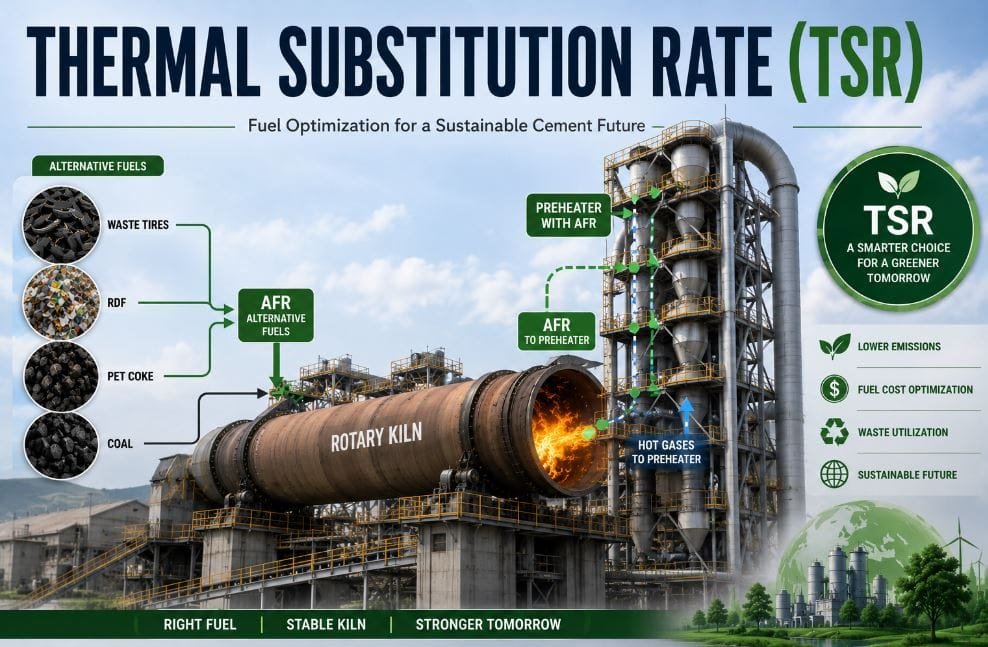
Thermal Substitution Rate (TSR) is one of the key performance indicators (KPIs) used in modern cement plants to measure the contribution of alternative fuels in the kiln firing process. With increasing fuel costs, environmental regulations, and the need to reduce CO₂ emissions, cement plants are focusing more on Alternative Fuels and Raw Materials (AFR) to reduce dependency on conventional fuels like coal and pet coke.
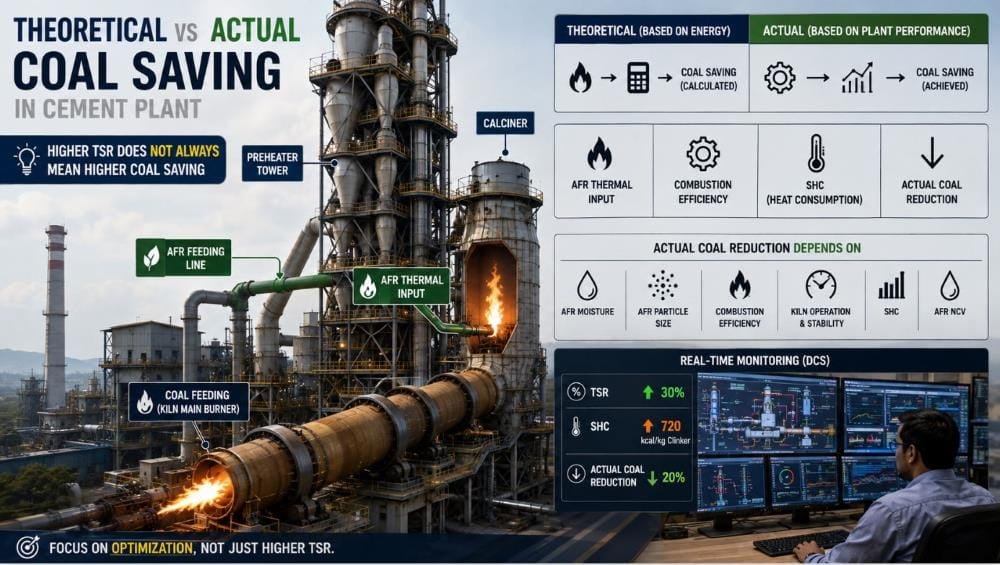
However, simply increasing alternative fuel feeding does not always mean higher TSR. TSR represents the percentage of total thermal energy supplied to the kiln system by alternative fuels compared to conventional fossil fuels.
For example, if 30% of the kiln’s total heat requirement is supplied by alternative fuels, the TSR is 30%.
Understanding TSR calculation and its impact on kiln operation is important for process engineers, CCR operators, and production teams to achieve better fuel optimisation, stable kiln operation, and sustainable cement production.
Related Reading: If you would like to learn more about mill stability, read our article on Common Causes of Vibration in Vertical Roller Mills (VRM) and Their Troubleshooting, where the most common process and mechanical-related vibration issues are explained with practical troubleshooting tips.
What is Thermal Substitution Rate (TSR)?
Thermal Substitution Rate (TSR) is the percentage of total thermal energy supplied to the kiln system by alternative fuels.
Formula:
TSR (%) = (Heat Energy Supplied by Alternative Fuels ÷ Total Thermal Energy Requirement) × 100
One important point to remember is that TSR is based on the heat energy contributed by the fuel, not the quantity of fuel being fed.
Example
| Fuel | Feed Rate | NCV |
|---|---|---|
| Coal | 1 TPH | 6,200 kcal/kg |
| RDF | 1 TPH | 3,200 kcal/kg |
Although both fuels are fed at the same rate (1 TPH), coal provides almost twice the heat energy compared to RDF. This means that feeding the same quantity of two different fuels does not result in the same TSR value.
10% AFR feeding does not necessarily mean 10% TSR.
The actual TSR depends on how much thermal energy the alternative fuel contributes to the total heat requirement of the kiln.
In a Vertical Roller Mill (VRM), harder clinker often requires increased fan airflow to transport the additional internal recirculation and maintain efficient material separation. Understanding and accurately measuring actual fan flow is therefore essential for stable mill operation and energy optimisation. For a detailed explanation, read Fan Flow Measurement in Cement Plants: Methods, Calculations & Optimisation.
How is TSR Calculated?
TSR is calculated based on the thermal energy contribution of each fuel used in the kiln system. The calculation can be done in three simple steps.
Step 1: Calculate the Heat Contribution of Each Fuel
Use the following formula to calculate the heat input from every fuel:
Heat Input (Gcal/hr) = TPH × 1000 × NCV ÷ 10⁶
Where:
- TPH = Fuel Feed Rate (Tonnes per Hour)
- NCV = Net Calorific Value (kcal/kg)
This calculation should be performed separately for all fuels, including coal, pet coke, RDF, biomass, or any other alternative fuels.
Step 2: Calculate the Total Thermal Heat Input
Add the heat contribution from all fuels to determine the total thermal energy supplied to the kiln system.
Total Heat Input = Fossil Fuel Heat Input + Alternative Fuel Heat Input
Step 3: Calculate the TSR
Once the total heat input is known, TSR can be calculated using the following formula:
TSR (%) = (Alternative Fuel Heat Input ÷ Total Thermal Heat Input) × 100
The final TSR value represents the percentage of the kiln’s total thermal energy that is supplied by alternative fuels. Since TSR is based on heat contribution rather than fuel quantity, two fuels fed at the same rate can produce different TSR values if their calorific values are different.
Practical TSR Calculation Example
The following example shows how the heat contribution of each fuel is calculated to determine the final TSR value.
Step 1: Calculate the Heat Input of Each Fuel
| Fuel | Feed Rate (TPH) | NCV (kcal/kg) | Calculation in kg | Heat Input (Gcal/hr) |
|---|---|---|---|---|
| Coal | 12.5 TPH | 6,200 kcal/kg | 12.5 × 6,200 ÷ 1,000 | 77.50 Gcal/hr |
| Pet Coke | 3.0 TPH | 8,100 kcal/kg | 3.0 × 8,100 ÷ 1,000 | 24.30 Gcal/hr |
| RDF | 4.0 TPH | 3,200 kcal/kg | 4.0 × 3,200 ÷ 1,000 | 12.80 Gcal/hr |
| Waste Tyres | 1.5 TPH | 6,800 kcal/kg | 1.5 × 6,800 ÷ 1,000 | 10.20 Gcal/hr |
Step 2: Calculate the Total Thermal Heat Input
Add the heat contribution from all fuels supplied to the kiln system.
Total Heat Input = 77.50 + 24.30 + 12.80 + 10.20 = 124.80 Gcal/hr
Step 3: Calculate the AFR Heat Input
Since RDF and Waste Tyres are classified as alternative fuels, their combined heat contribution is:
AFR Heat Input = 12.80 + 10.20 = 23.00 Gcal/hr
Step 4: Calculate the TSR
Now, apply the TSR formula:
TSR (%) = (AFR Heat Input ÷ Total Heat Input) × 100
Substituting the values:
TSR (%) = (23.00 ÷ 124.80) × 100 = 18.43%
Final TSR = 18.43%
This means that approximately 18.43% of the kiln’s total thermal energy requirement is being supplied by alternative fuels, while the remaining 81.57% is supplied by conventional fuels such as coal and pet coke.
Note: A higher AFR feed rate does not always result in a higher TSR. The actual TSR depends on the thermal energy contributed by the fuel, which is determined by its Net Calorific Value (NCV). Therefore, fuels with lower NCV may contribute less to TSR even when they are fed at higher quantities.e fuels.
Recommended Reading: Since clinker quality is closely linked to kiln operation, understanding burning conditions, heat balance, and thermal efficiency is essential for improving cement mill performance. For a detailed explanation of these topics, check out this comprehensive guide on Amazon Kindle.
Why is TSR Important?
TSR has become an important performance indicator for cement plants because it provides economic, environmental and operational benefits. Increasing TSR not only reduces dependence on conventional fuels but also supports sustainable and efficient cement production.
Economic Benefits
- Reduces the consumption of conventional fuels such as coal and pet coke, helping plants lower overall fuel costs.
- Improves fuel cost optimisation by utilising suitable alternative fuels based on their calorific value and availability.
- Reduces dependency on imported fossil fuels and minimises the impact of fuel price fluctuations.
- Supports long-term operational efficiency by diversifying the plant’s fuel portfolio.
Environmental Benefits
- Helps lower CO₂ emissions by partially replacing fossil fuels with alternative fuels.
- Improves the plant’s sustainability performance and supports environmental commitments.
- Enables the safe co-processing of industrial and municipal waste, reducing the burden on landfills.
- Contributes to global decarbonisation initiatives and helps cement plants move toward lower-carbon production.
Operational Benefits
- Provides greater fuel flexibility by allowing the kiln system to utilise multiple fuel sources.
- Improves resource utilisation by recovering useful thermal energy from suitable waste materials.
- Enhances the plant’s long-term competitiveness by adopting sustainable fuel practices.
- Increases adaptability to changing fuel markets, helping maintain stable operations even when conventional fuel prices or availability fluctuate.
When properly implemented, TSR is not just a sustainability metric, it is also an effective tool for improving fuel efficiency, reducing operating costs, and achieving stable kiln performance.
Recommended Reading: Since baghouse performance is closely influenced by raw mill gas flow, temperature, moisture, and process stability, understanding Raw Mill operation and optimisation can help improve overall baghouse efficiency. For a detailed guide on raw mill operation, troubleshooting, and process optimisation, check out this comprehensive book on Amazon Kindle.
Benefits of Higher TSR
Increasing the Thermal Substitution Rate (TSR) offers several economic, operational and environmental benefits for cement plants. When implemented properly, a higher TSR can improve fuel flexibility while supporting sustainable clinker production.
1. Reduced Fossil Fuel Consumption
A higher TSR reduces the dependence on conventional fossil fuels such as coal and pet coke by partially replacing them with alternative fuels. This helps diversify the plant’s fuel mix and improves energy security.
2. Improved Fuel Cost Optimisation
Where AFR utilisation is technically and economically feasible, increasing TSR can contribute to better fuel cost management. Utilising suitable alternative fuels may reduce exposure to fluctuations in fossil fuel prices and improve overall fuel economics.
3. Environmental Benefits
Higher TSR can significantly improve a plant’s environmental performance by:
- Reducing greenhouse gas emissions.
- Improving the utilisation of industrial and municipal waste.
- Supporting decarbonisation initiatives.
- Reducing the overall environmental footprint of cement manufacturing.
4. Better Resource Utilisation
Alternative fuels enable cement plants to recover useful thermal energy from suitable waste materials. This not only improves resource utilisation but also supports the principles of co-processing and the circular economy.
5. Long-Term Sustainability
TSR plays an important role in achieving the cement industry’s long-term sustainability goals. By reducing dependence on conventional fuels and increasing the use of alternative energy sources, cement plants can move toward more sustainable and environmentally responsible operations.
A well-planned TSR strategy helps balance fuel cost optimisation, operational stability, and environmental performance, making it an important component of modern cement manufacturing.
Challenges and Disadvantages of Higher TSR
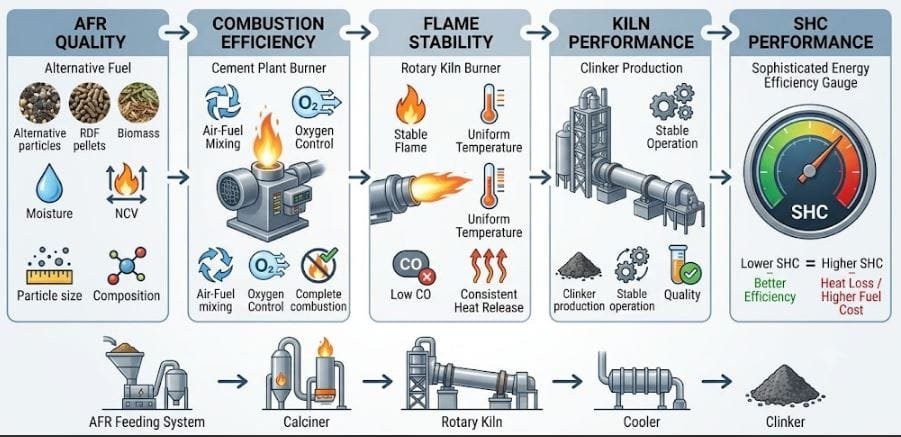
Although a higher TSR offers significant benefits, it also introduces several operational challenges. Successful high TSR operation requires stable fuel feeding, proper combustion control, and continuous process monitoring to avoid adverse effects on kiln performance.
1. Flame Stability Issues
Alternative fuels have different combustion characteristics compared to coal and pet coke. Increasing TSR may influence:
- Flame shape and flame length.
- Burning zone temperature.
- Heat distribution inside the kiln.
- Overall combustion stability.
Poor flame stability can affect clinker quality, kiln operation, and thermal efficiency.
2. AFR Feeding Challenges
Alternative fuels often exhibit variations in their physical and chemical properties, such as:
- Moisture content.
- Net Calorific Value (NCV).
- Particle size distribution.
- Feeding consistency.
Sudden fluctuations in these parameters can cause unstable heat input, leading to process disturbances and difficulties in maintaining stable kiln conditions.
3. Pre-heater Performance Issues
Higher TSR operation may increase the likelihood of process-related problems in the pre-heater system, including:
- Cyclone build-up.
- Coating formation.
- Pressure drop variations.
- Increased material circulation.
- Higher risk of blockages in severe cases.
Proper control of fuel quality and kiln operating conditions is essential to minimise these issues.
4. Maintenance Challenges
High TSR operation often requires greater attention to equipment reliability and maintenance practices. Particular focus should be given to:
- Burner performance and maintenance.
- AFR conveying and feeding systems.
- Reliability of dosing and feeding equipment.
- Regular weigh feeder calibration.
- Inspection of conveying lines and storage systems.
Maintaining consistent AFR quality and ensuring reliable feeding are critical for achieving stable and efficient high TSR operation.
A higher TSR should always be accompanied by proper process optimisation. Increasing alternative fuel usage without considering combustion behaviour, equipment capability, and process stability can negatively impact kiln performance and clinker quality.
Conclusion
Thermal Substitution Rate (TSR) is much more than just a number reported in daily production data. It reflects how effectively a cement plant utilises alternative fuels while maintaining process stability, fuel efficiency, and sustainability goals.
Accurate TSR calculation and proper process monitoring help plants maximise the benefits of alternative fuel utilisation without compromising kiln performance or clinker quality. However, increasing TSR should always be supported by stable AFR feeding, optimised combustion conditions, and reliable process control.
The objective of TSR optimisation should not be to achieve the highest possible TSR value. Instead, cement plants should focus on achieving an economical, sustainable, and operationally stable TSR that supports long-term plant performance while maintaining production targets and product quality.Baghouse Optimisation in Cement Plants (Part-1)