Table of Contents

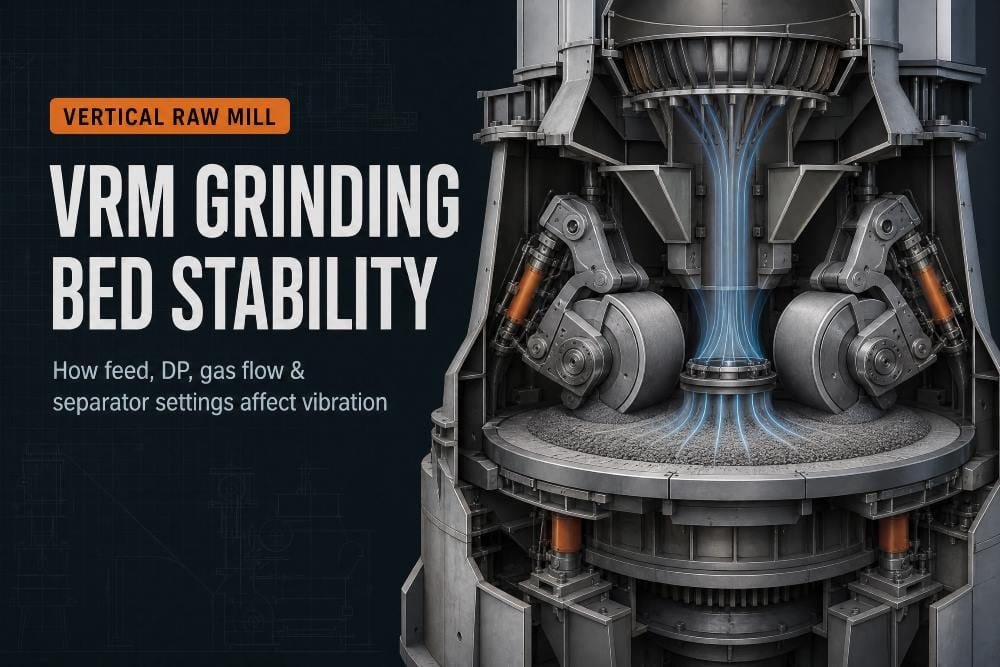
Illustrative VRM grinding-zone cutaway. This is a conceptual visual, not an OEM drawing or a dimensioned design reference.
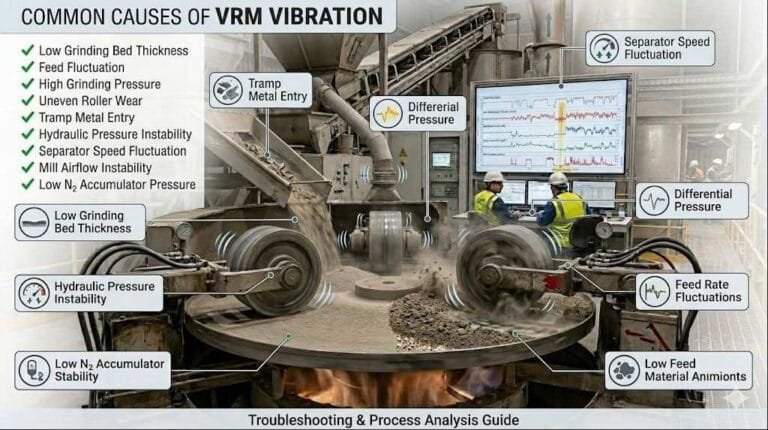
When a vertical roller mill starts vibrating, the first reaction is often to look at grinding pressure, reduce feed, or change separator speed. Sometimes that works. Many times it only moves the problem somewhere else. The reason is simple: a VRM does not respond to one setting in isolation. The grinding bed is affected by feed rate, material behaviour, gas transport, separator return, hydraulic force, and the condition of the mill internals. A vibration alarm may be the first visible symptom, but it is not a direct measurement of the bed.
A better question is not “What should I adjust first?” It is “Which trend changed first, and what does that tell us about material inventory and transport inside the mill?”
What the Grinding Bed Really Is
Inside a VRM, feed lands on the rotating grinding table and moves outward into the grinding track. The rollers apply force to the material layer, while the gas stream lifts fine material toward the separator. Coarse material rejected by the separator returns to the table for further grinding. The material layer between the rollers and table is commonly called the grinding bed. It provides the material through which grinding happens and helps cushion the roller-to-table interaction. A stable bed does not mean a fixed physical height at every point on the table. The bed changes continuously with feed, circulating load, gas transport, and material behaviour.
Vertical roller mills combine grinding, drying, separation, and transport in one process arrangement, which is one reason their operating variables are closely connected.1

Figure 1. Simplified VRM grinding-zone material flow. The diagram is illustrative and not to scale.
In normal running, operators do not measure bed thickness directly. They infer its condition from several signals moving together:
| Signal | What it helps indicate | Why it cannot be used alone |
|---|---|---|
| Mill vibration | Grinding stability and possible disturbance | Mechanical looseness, foreign material, roller condition, and hydraulics can create similar symptoms. |
| Mill DP | Gas-side loading and internal material circulation | DP also changes with gas flow, feed condition, duct resistance, and instrumentation health. |
| Mill power | Grinding load and material response | Power changes with feed rate, hardness, pressure, fineness, and mill condition. |
| Feed rate | Material input to the grinding zone | A stable feed rate does not guarantee stable feed moisture, PSD, or grindability. |
| Separator speed | Classification sharpness and coarse return | Its effect depends on feed condition, gas flow, and product target. |
| Gas flow and outlet temperature | Material transport and drying condition | The correct range is specific to the mill, material, and process circuit. |
The key point is that bed condition is a process interpretation, not a single instrument value.
Why Bed Stability Matters
A stable bed usually gives the rollers a more consistent material layer. That supports steadier vibration, power, differential pressure, and product quality. If the material layer repeatedly builds and collapses, the mill can become difficult to control. A thin bed can make the grinding zone more sensitive. A heavily loaded bed can raise internal circulation and resistance. But neither condition should be diagnosed from one number. The useful information comes from the direction and timing of the changes. Research and operational studies also show that VRM performance is sensitive to process variation and vibration, which is why root-cause troubleshooting is more useful than repeated trial-and-error adjustments.1
Thin Bed and High Loading: Think in Trend Patterns
A thin-bed tendency and a high-loading tendency often look different on the DCS, but they are not universal patterns. The same vibration can be produced by process, mechanical, or measurement problems.
| Possible condition | What may happen together | First areas to check |
|---|---|---|
| Thin-bed tendency | Feed or material availability falls; DP and power may fall; vibration risk may rise | Feed stability, material availability, gas transport, nozzle-ring condition, hydraulic stability |
| High-loading tendency | Feed or circulation rises; DP and power may rise; capacity may fall or vibration may increase | Separator setting, gas transport, feed grindability, moisture, dam/nozzle-ring condition |
| Unclear pattern | Vibration changes but DP and power do not show a clear response | Mechanical condition, hydraulics, foreign material, instrumentation, roller/table condition |

Figure 2. Trend patterns that may indicate thin-bed or high-loading conditions. These are diagnostic clues, not universal operating rules.
When the bed appears too thin
A thin bed means there may be insufficient material between the rollers and table. The mill can become more sensitive to a sudden feed loss, excessive material transport, poor retention, or a sharp change in material behaviour. Typical symptoms can include increased vibration, unstable roller movement, fluctuating power, or difficulty holding steady operation. However, high vibration does not automatically mean a thin bed. Before changing a set point, compare the vibration trend with feed, DP, power, gas flow, hydraulic pressure, and any recent material change.
When material loading becomes excessive
High material loading is not automatically good for grinding. If material accumulates faster than the grinding and transport system can handle it, internal circulation can increase. DP and power may rise, while the mill becomes less stable or loses output. The correct objective is not maximum bed thickness. It is the stable material inventory that suits the mill, product target, and feed condition.
The Main Variables That Disturb the Grinding Bed
1. Feed rate, feed PSD, and material availability
A sudden feed increase adds material to the table. If grinding and transport cannot respond quickly enough, material inventory can rise. A sudden feed reduction can have the opposite effect and make the grinding zone less stable. Feed rate is only part of the story. Two feeds with the same tonnes per hour can behave very differently if moisture, particle-size distribution, hardness, or fine fraction changes. Published VRM reviews note that abnormal feed size or distribution and excess fines can destabilise the grinding bed and increase vibration.1
A practical operator check is to compare:
- feeder trend and actual feeder performance;
- crusher or pre-grinding condition;
- recent clinker/raw-material/additive changes;
- feed moisture and temperature; and
- screen or PSD information where available.
2. Moisture and material behaviour
Moisture affects how many materials move, stick, disperse, and circulate. In a raw mill, a change in moisture can alter drying demand and material transport. In cement grinding, additives and gypsum condition can affect mill behaviour differently. The point is not that “more moisture always causes a high bed” or “dry feed always causes vibration.” The effect depends on the material and mill design. Use the mill’s approved operating envelope and compare the change with actual gas temperature, outlet temperature, DP, and product behaviour.
3. Gas flow and nozzle-ring transport
Gas has a transport role inside the mill. Too little transport can allow material to accumulate. Too much transport can change how material is lifted, classified, and returned. Gas flow must therefore be optimised, not simply maximised. The nozzle ring matters because it influences how gas moves through the grinding area. Wear, blockage, poor condition, or an unsuitable configuration can change material transport and the effective retention on the table.
A useful way to think about the relationship is:
Gas transport → internal circulation → mill DP → material inventory → bed behaviour
When a mill shows persistent instability, investigate gas flow and nozzle-ring condition along with feed and separator settings. Do not treat fan speed as the automatic solution to every DP problem.
4. Separator speed and coarse return
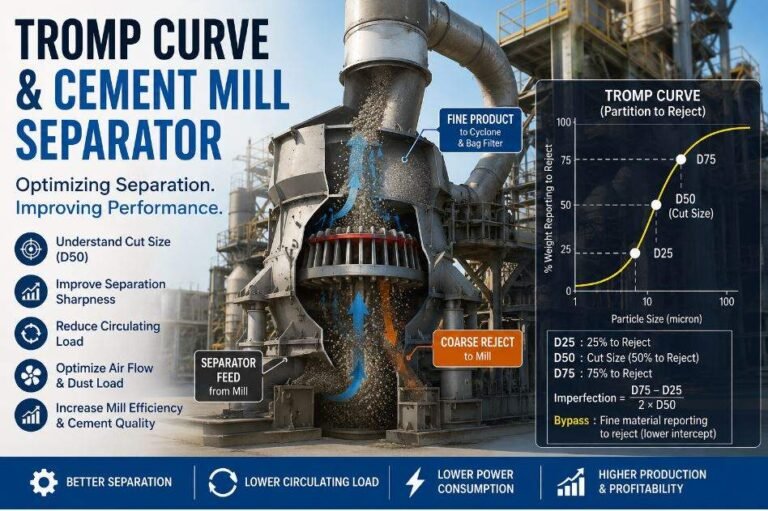
The separator controls how much material is accepted as product and how much coarse material returns to the table. Increasing separator speed generally produces a finer cut, but it can also increase the amount of material returning for further grinding. That affects internal circulation and can alter the bed condition. In one industrial raw-mill case study, classifier rotor speed, grinding pressure, and gas-flow rate were all evaluated as operational variables affecting VRM power and product size.2 The exact response of your mill will depend on design, feed, product target, and process circuit, so do not copy a speed change from another plant as a fixed rule.
5. Grinding pressure and hydraulic stability
Grinding pressure changes the force applied through the rollers. Too little pressure can reduce grinding effectiveness. Too much pressure, especially when the material layer is unstable, can increase mechanical stress or worsen vibration. Do not use grinding pressure as a blind vibration-control lever. If vibration rises because feed has fallen or material transport has changed, increasing pressure may not solve the real cause. First confirm whether the bed, the gas circuit, the separator, or the hydraulic system changed.
6. Water injection, where applicable
Where water injection is installed and approved for the specific VRM application, it can influence material behaviour, outlet temperature, and bed stability. It is not a universal solution for vibration. Unstable or excessive water injection may disturb the process. Insufficient moisture control may also create issues in some applications. Any adjustment should follow the plant procedure and OEM guidance, with the result checked against outlet temperature, DP, vibration, power, and product quality.
7. Dam ring and grinding-zone condition
The dam ring helps retain material on the grinding table. Wear, damage, or an unsuitable effective height can change the material profile and retention time. Combined with nozzle-ring condition and gas flow, it can influence how much material remains in the grinding zone. This is not usually the first item to adjust during a short disturbance. But if a mill remains unstable after normal process variables have been checked, inspection of the dam ring, nozzle ring, table, and rollers becomes important.
Do Not Chase One Parameter
A common mistake is to react to a single symptom without checking the linked variables.
| Symptom | A tempting reaction | Why that can fail | Better first step |
|---|---|---|---|
| Vibration rises | Increase grinding pressure | The actual cause may be thin bed, feed fluctuation, hydraulic instability, or mechanical condition | Compare feed, DP, power, gas, and hydraulic trends first. |
| DP rises | Increase fan speed | The real issue may be high loading, circulation, material change, or a restriction | Build a short pressure and trend picture before changing transport. |
| Power falls | Increase feed quickly | The lower power may be part of a thin-bed or material-availability problem | Confirm feed availability, product quality, and vibration response. |
| Fineness changes | Change separator speed sharply | Abrupt separator changes can alter coarse return and circulation | Make a controlled change and watch the full response. |
A VRM is a coupled process. One change can influence several other variables, often with a delay. The safest operating habit is to make one controlled correction at a time and then observe the response.
A Practical Troubleshooting Sequence When Vibration Rises
When vibration rises, do not assume that the bed is the cause. Use a repeatable sequence.

Figure 3. Troubleshooting sequence for suspected grinding-bed instability. Follow site safety procedures and approved operating limits.
Step 1: Check what changed first
Look at the minutes before the vibration rise. Was there a feed change, a material change, a gas-temperature movement, a separator adjustment, or a hydraulic event? The first change is often more useful than the final alarm.
Step 2: Correlate feed, DP, power, and vibration
If feed, DP, and power are all falling while vibration rises, a thin-bed tendency is possible. If feed, DP, and power are rising together, high loading or circulation may be involved. If vibration rises without a meaningful process trend, expand the check to mechanical and instrument causes.
Step 3: Check transport and classification
Review fan behaviour, gas flow, damper/VFD position, temperature, separator RPM, and recent changes to product target. A process change may have disturbed material transport or coarse return rather than the grinding force itself.
Step 4: Check hydraulics and mechanical condition
If process trends look normal but vibration remains high, investigate roller condition, table condition, hydraulic pressure stability, lubrication, mechanical looseness, gearbox behaviour, foreign material, and instrumentation. Do not continue changing process settings until these checks are complete.
Example: How to Use Trend Correlation
Consider an illustrative situation. Feed drops unexpectedly because of a feeder issue. A short time later, power and DP also fall, while vibration increases. In this case, reducing feed further may worsen the disturbance. The better response is to confirm material availability, stabilize the feeder, check gas transport, and then allow the mill to recover through controlled adjustments within the approved operating range.
Now consider a different pattern: feed remains high, separator speed was increased for a finer target, DP and power rise, and output starts falling. This may indicate increased internal circulation or material loading. The right action is not automatically to increase fan speed. First verify the product target, separator change, gas transport, and feed condition, then make a controlled correction.
These examples are only a way of thinking. They are not a substitute for site-specific operating procedures, OEM instructions, or real plant trend data.
What to Record After a Disturbance
A simple record makes repeat problems easier to solve. After a significant disturbance, note:
- time and duration of the event;
- feed rate and feed-material change;
- DP, power, vibration, and outlet-temperature trends;
- gas flow, fan position or speed, and separator speed;
- grinding-pressure or hydraulic response;
- product fineness/residue where relevant; and
- any mechanical, instrument, or maintenance observation.
Over time, these records become more useful than a generic troubleshooting chart because they show how your own mill responds to your own materials.
Final Takeaway
Grinding-bed stability is central to VRM operation, but it should never be treated as one isolated parameter. A stable bed comes from the right balance of feed, material behaviour, grinding force, gas transport, separator return, and grinding-zone condition. When vibration or DP changes, resist the urge to chase one number. Look at the sequence of events, correlate the process trends, and separate a process disturbance from a mechanical or instrumentation issue. That approach gives the operator a better chance of restoring stable production without creating a new problem elsewhere in the circuit.
Plant Note and Limitations
This article provides general engineering guidance. Bed behaviour differs between raw mills, cement mills, coal mills, mill designs, material properties, product targets, and local operating practices. Use the applicable OEM operating envelope, plant procedures, and qualified technical review before changing feed, grinding pressure, gas flow, water injection, dam-ring condition, nozzle-ring configuration, or separator settings.
Sources and Further Reading
- Pareek, P. and Sankhla, V. S., “Review on vertical roller mill in cement industry & its performance parameters”, Materials Today: Proceedings (2021).
- Ghalandari, V. et al., “A case study on energy and exergy analyses for an industrial-scale vertical roller mill assisted grinding in cement plant”, Advanced Powder Technology (2020). This is a raw-mill case study; its figures and operating response should not be treated as universal targets.
- Dey, A. et al., “Increase productivity of vertical roller mill using seven QC tools”, IOP Conference Series: Materials Science and Engineering 1017 (2021).