Understanding Process and Mechanical Causes of VRM Vibration for Stable, Efficient and Trouble-Free Mill Operation
Table of Contents
Introduction
Anyone who has operated a Vertical Roller Mill (VRM) knows that maintaining stable operation is often more challenging than achieving high production. During cement plant operations, vibration is one of the most common issues that can directly affect mill performance, production stability, and equipment life.
Over the years, vibration has repeatedly proven to be one of the toughest challenges in both Raw Mill and Cement Mill operation. In many cases, vibration itself is not the real problem but a warning sign that something within the grinding process is becoming unstable. Feed fluctuations, grinding bed instability, worn grinding components, material variations, and separator issues are among the most common contributors.
This article explains the most frequent causes of VRM vibration, how to identify them, and the actions that can be taken to restore stable and efficient mill operation.
Importance of Vibration Control in VRM Operation
A stable VRM is the foundation of efficient cement mill operation. From practical plant operations, vibration is often one of the first indicators that the grinding process is becoming unstable. Ignoring rising vibration levels can quickly lead to reduced mill output, higher power consumption, and frequent operational disturbances.
Excessive vibration places additional stress on critical components such as rollers, grinding tables, bearings and gearboxes that accelerating wear and increasing maintenance requirements. It can also affect grinding efficiency, resulting in fluctuations in product fineness and overall cement quality. In severe cases, high vibration may force mill trips, causing production losses and unplanned downtime.
Controlling vibration is therefore not just about preventing alarms and trips. It is essential for maintaining stable production, maximising equipment life, reducing operating costs, and ensuring safe mill operation.
VRM Vibration Fundamentals
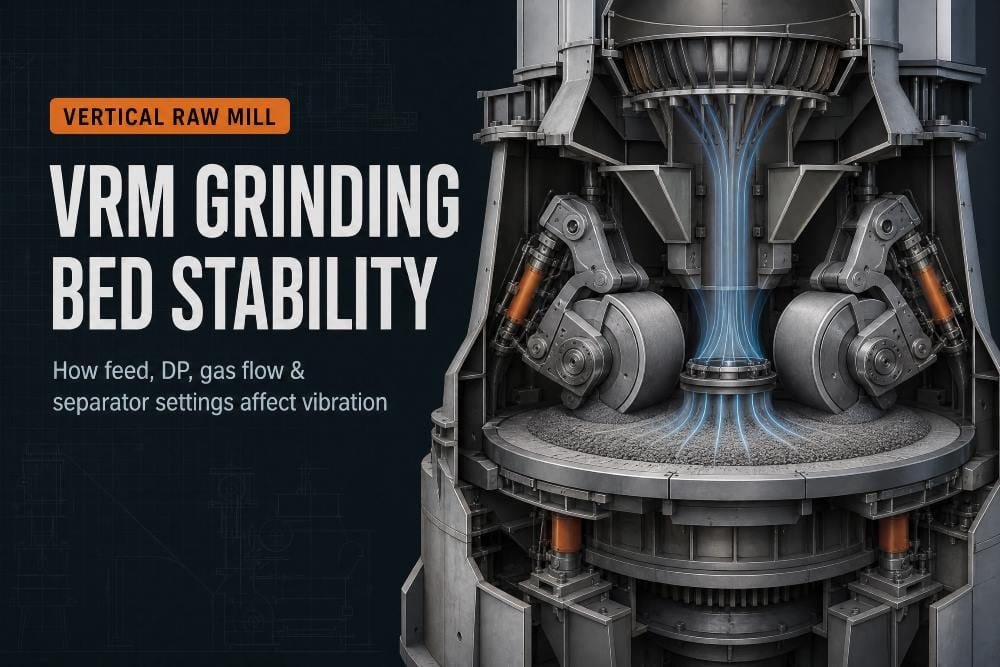
Before troubleshooting any vibration issue, it is important to understand how a VRM actually generates stable grinding conditions. In most cases, vibration is closely linked to the condition of the grinding bed and the forces acting inside the mill.
Grinding Bed, Hydraulic Force and Their Impact on Vibration
A stable grinding bed is the key to smooth VRM operation. The material layer between the grinding table and rollers acts as a cushion, absorbing grinding forces and preventing direct metal-to-metal contact. Hydraulic cylinders apply pressure on the rollers which is then transferred through the material bed to achieve efficient grinding.
When the grinding bed remains stable and uniform, the mill runs smoothly with low vibration levels. However, if the bed becomes too thin, too thick or unevenly distributed, grinding forces become unstable. This can cause roller bouncing, table impacts and sudden vibration spikes. Many vibration problems in VRM can ultimately be traced back to poor grinding bed stability.
Process Vibration vs. Mechanical Vibration
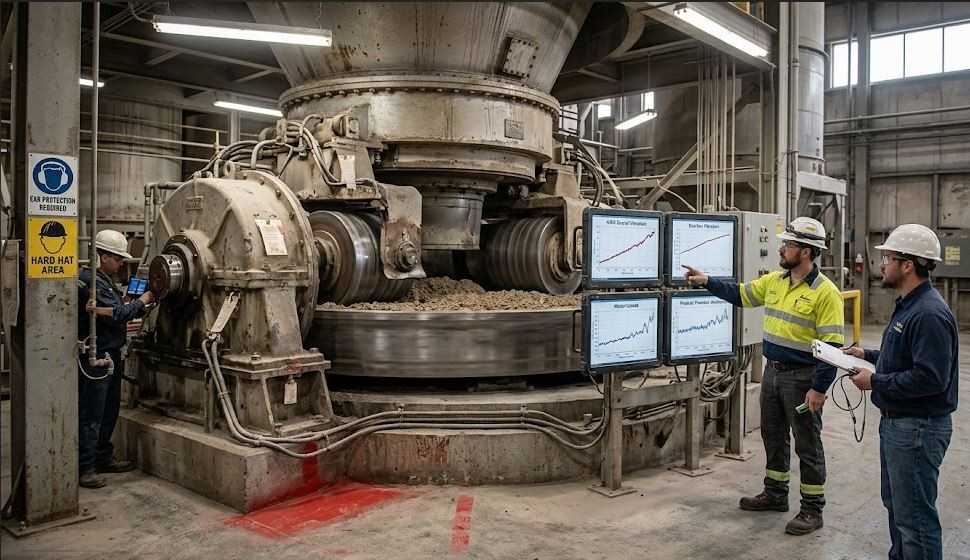
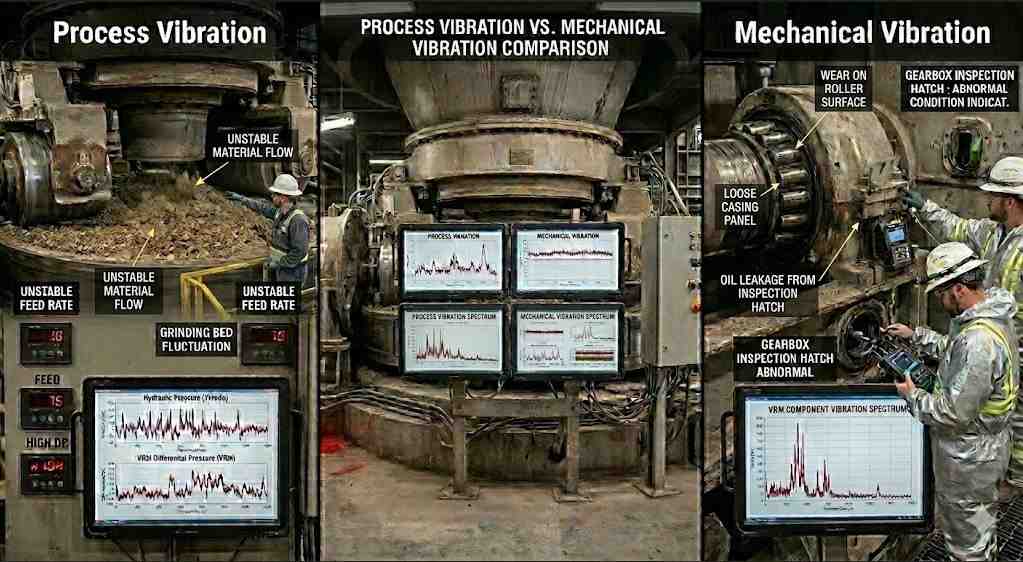
During VRM operation, vibrations can generally be classified into two categories: process vibration and mechanical vibration. Understanding the difference between them is essential because the root causes and corrective actions are completely different.
Process vibration is related to instability within the grinding process itself. Common causes include fluctuating feed rate, inconsistent material size, sudden changes in moisture content, variations in grindability, unstable grinding bed thickness, improper hydraulic pressure, low or high mill differential pressure, insufficient material retention on the table, excessive feed segregation, poor nozzle ring airflow distribution, unstable hot gas flow, separator operating issues, sudden changes in reject circulation, and incorrect mill operating parameters. Process vibration usually changes with mill conditions and often increases during feed disturbances or operational upsets.
Mechanical vibration originates from defects or abnormalities in the mill’s mechanical components. Typical causes include worn roller bearings, damaged table bearings, gearbox defects, coupling misalignment, rotor imbalance, separator imbalance, loose foundation bolts, structural looseness, damaged liners, roller wear, table wear, shaft misalignment, gear tooth damage, hydraulic accumulator problems, lubrication failures and excessive clearances in rotating equipment. Mechanical vibration is generally more consistent and often remains present even when process conditions are stable.
A simple way to differentiate between the two is to observe the mill’s response to process changes. If vibration varies significantly with feed rate, hydraulic pressure, material characteristics or airflow, the cause is usually process-related. If vibration remains relatively constant regardless of operating conditions, a mechanical issue should be suspected. Correct identification of the vibration type is the first and most important step in successful VRM troubleshooting.
Common Causes of VRM Vibration and Their Troubleshooting
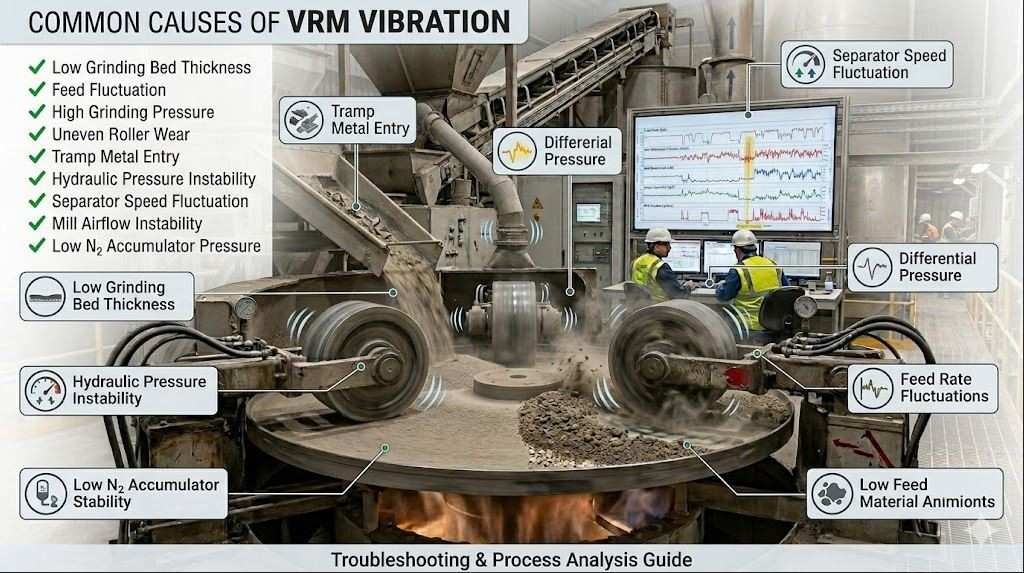
This section delves into specific causes of VRM vibration, providing insights into their mechanisms, symptoms, diagnostic methods and corrective/preventive actions.
1. Low Grinding Bed Thickness
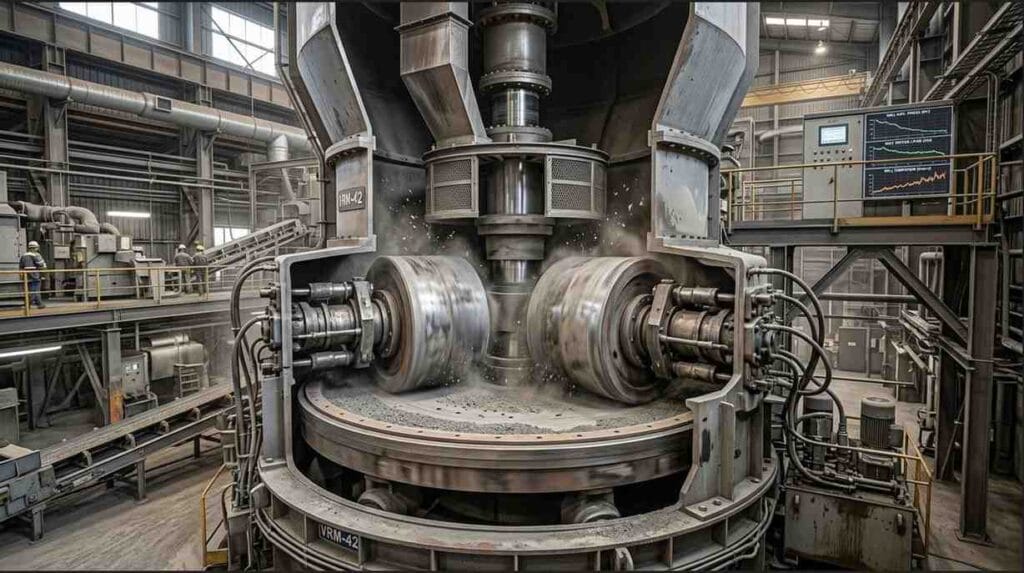
Low grinding bed thickness is one of the most frequent causes of vibration in a VRM. During operation, whenever the material bed becomes insufficient to absorb grinding forces, the mill starts losing stability. In most cases, vibration begins to increase along with a reduction in mill differential pressure, indicating poor material retention on the grinding table.
Typical Process Indicators
- Rising mill vibration
- Falling or unstable mill DP
- Reduction in mill motor load
- Reject might be too low when mill became empty
Process Analysis
Whenever vibration increases, the parameter to observe are mill DP and mill motor load. If vibration is rising while DP is continuously falling, the grinding bed is likely becoming thinner. This situation is commonly seen after sudden feed reduction, excessive drying, poor mate or inadequate circulation inside the mill.
A stable grinding bed normally produces stable DP, motor load and vibration values. When this balance is disturbed, the rollers begin interacting with an insufficient material layer, resulting in vibration spikes.
Corrective Actions
- Gradually increase feed rate to rebuild the grinding bed.
- Avoid sudden changes in feed or grinding pressure.
- Maintain stable material circulation within the mill.
- Look for main drive motor load accordingly
- Optimise water spray, especially when excessive drying affects bed formation.
- Monitor DP trends continuously and take corrective action before vibration reaches alarm limits.
- During shutdown inspections, verify the condition of the dam ring, grinding parts and table wear pattern if poor material retention is repeatedly observed.
Practical Observation
In many cases, operators focus only on vibration values. However, vibration is usually the result rather than the root cause. A continuous drop in DP often appears much earlier than the vibration alarm and provides an opportunity to correct the problem before mill stability is affected.
Recommended Reading: For practical insights into kiln optimisation, heat balance calculation, thermal efficiency improvement, and reducing heat losses in cement plants, read this detailed guide on Amazon Kindle.
2. Feed Fluctuation
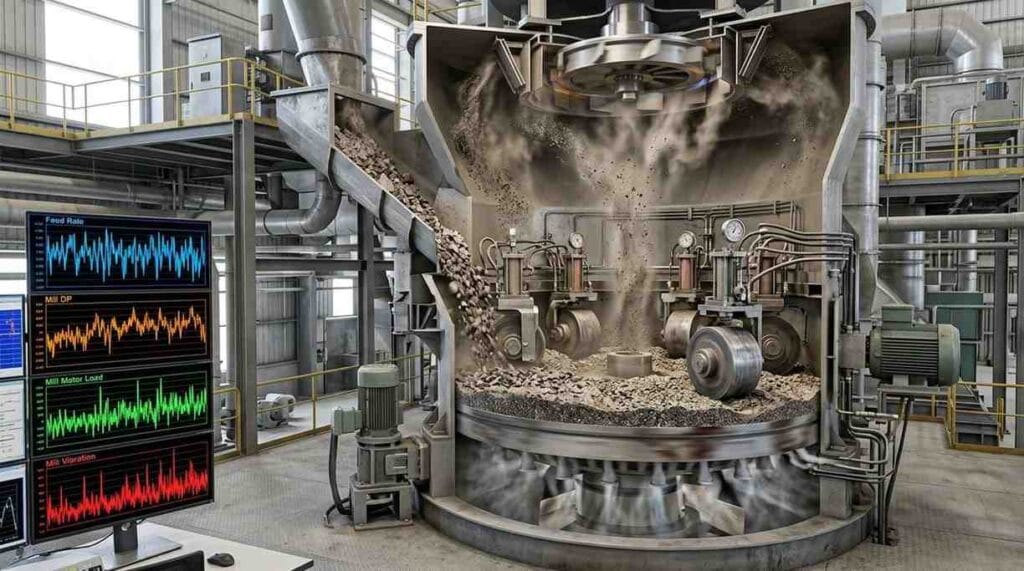
Feed fluctuation is one of the most common process-related causes of VRM vibration. A stable grinding process depends on a consistent material flow to the grinding table. Whenever feed rate starts fluctuating significantly, the grinding bed becomes unstable, resulting in corresponding changes in mill vibration, differential pressure and mill load.
A sudden reduction in feed can quickly reduce grinding bed thickness, while a sudden increase may overload the grinding zone and disturb material circulation. Both conditions create instability inside the mill and often lead to vibration spikes.
Typical Process Indicators
- Frequent fluctuations in mill vibration
- Unstable differential pressure (DP)
- Variations in mill motor current and power consumption
- Unstable reject quantity
- Occasional vibration alarms or mill trips
Process Analysis
Whenever vibration increases intermittently, feed trend should be one of the first parameters analysed. In many cases, vibration spikes follow sudden feed reductions or surges. The relationship between feed rate, DP, mill load and vibration often provides a clear indication of whether feed instability is the root cause.
Feed fluctuations can originate from weigh feeder instability, inconsistent upstream material flow, poor material extraction from storage bins, varying moisture content, or sudden changes in crusher output. When feed becomes unstable, the grinding bed continuously expands and collapses, making it difficult for the mill to maintain steady grinding conditions.
Corrective Actions
- Maintain a stable and consistent feed rate to the mill.
- Monitor feed trend, DP trend and vibration trend together for early detection of instability.
- Minimise sudden production changes whenever possible.
- Coordinate with upstream operations to ensure uniform material supply.
- Optimise feeder control logic and feed control loops.
- Adjust grinding pressure and water spray carefully during major feed changes to maintain bed stability.
Practical Observation
One common mistake during vibration events is focusing only on hydraulic pressure or water spray settings while ignoring feed stability. In many situations, vibration starts because the grinding bed is continuously disturbed by fluctuating feed. Restoring a stable feed rate often stabilises DP, mill load and vibration without requiring major adjustments to other operating parameters.
3. High Grinding Pressure
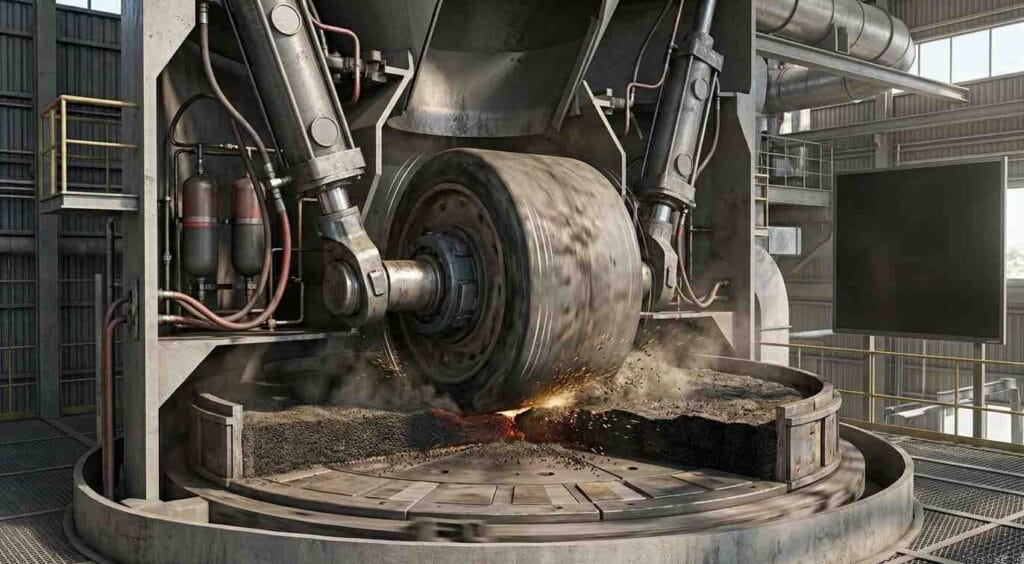
Grinding pressure plays a critical role in VRM performance, but increasing hydraulic pressure does not always improve grinding efficiency. A common misconception is that higher pressure will automatically result in higher production. In reality, when grinding pressure exceeds the level that the material bed can comfortably support, mill stability often begins to deteriorate.
Excessive grinding pressure can compress the grinding bed beyond its optimum condition, restricting material movement and disturbing the natural grinding process. As a result, vibration levels increase and the mill becomes more difficult to stabilise.
Typical Process Indicators
- Increasing mill vibration
- High mill motor current and power consumption
- Unstable grinding bed behaviour
- Frequent fluctuations in DP
- Reduced mill stability despite adequate feed rate
- Increased reject variations
- Higher hydraulic pressure with limited improvement in production
- Difficulty maintaining stable operation at higher throughput
Process Analysis
When vibration increases after raising grinding pressure, the relationship between hydraulic pressure, mill vibration, DP, and mill load should be carefully evaluated. In many cases, the mill initially responds positively to higher pressure, but beyond a certain point the grinding bed loses stability and vibration starts increasing.
This situation becomes more critical when feed rate is insufficient to support the applied grinding force. A grinding bed that is too thin cannot absorb the additional pressure effectively, resulting in unstable grinding conditions and vibration spikes.
Corrective Actions
- Gradually reduce grinding pressure and observe mill response.
- Maintain a balance between feed rate and grinding pressure.
- Monitor DP trends while adjusting hydraulic pressure.
- Avoid sudden pressure changes during operation.
- Optimise water spray to improve bed stability where applicable.
- Focus on stable mill operation rather than maximum hydraulic pressure.
Practical Observation
In many VRM operations, vibration issues appear shortly after grinding pressure is increased in an attempt to improve production. However, production gains are often temporary while vibration, power consumption, and process instability continue to rise. The most stable operating point is usually achieved not at the maximum grinding pressure, but at the pressure level where the grinding bed remains stable and vibration stays under control.
4. Uneven Roller Wear
Uneven roller wear is a less frequent but important cause of persistent VRM vibration. Unlike normal process-related vibration, this type of vibration often continues even when feed rate, differential pressure, grinding pressure, and other operating parameters appear stable.
As roller wear progresses unevenly, the grinding force is no longer distributed uniformly across the grinding table. This creates localised load variations that can affect grinding bed stability and result in recurring vibration problems.
Typical Process Indicators
- Persistent vibration despite stable process parameters
- Repeated vibration at similar operating conditions
- Stable feed rate but unstable vibration trend
- Differences in individual roller hydraulic pressure readings
- Gradual increase in vibration over several months
- Reduced grinding efficiency at normal operating parameters
- Higher specific power consumption without corresponding production gains
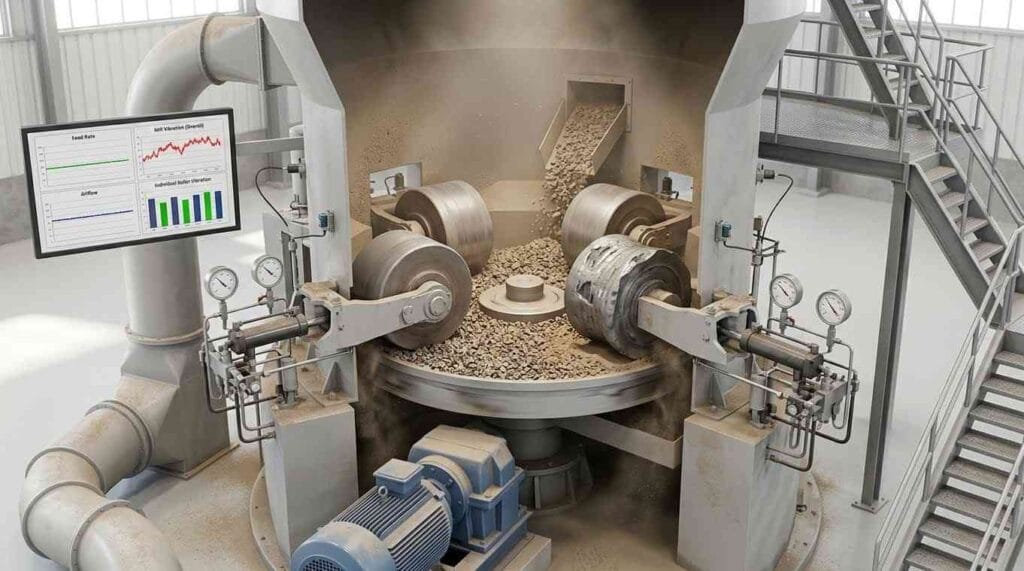
Process Analysis
When vibration remains elevated despite stable feed rate, DP, grinding pressure, gas flow, and separator operation, the possibility of uneven roller wear should be considered.
A common observation is that operators continuously adjust process parameters to reduce vibration, but the improvement remains temporary. The mill may run acceptably at lower production rates but vibration increases rapidly whenever throughput is increased. This often indicates that the root cause is no longer purely process-related.
Another useful indicator is abnormal variation in individual roller hydraulic pressures. When one roller consistently behaves differently from the others, uneven wear may be affecting load distribution within the grinding zone.
Corrective Actions
- Verify that process parameters are stable before suspecting a mechanical cause.
- Review long-term vibration trends rather than short-term fluctuations.
- Compare individual roller hydraulic pressure behaviour.
- During the next planned shutdown, inspect roller wear patterns and grinding component condition.
- Carry out hard facing or component replacement if excessive wear is confirmed.
- Restore worn grinding parts before attempting higher production targets.
Practical Observation
When vibration remains high even after optimizing feed rate, DP, grinding pressure, water spray, and separator settings, the problem is often not in the process anymore. In several cases, the real cause is only identified during shutdown inspection, where uneven roller wear or abnormal grinding component wear becomes evident. For this reason, persistent vibration that does not respond to process adjustments should always be investigated from a mechanical perspective as well.
5. Tramp Metal Entry
Tramp metal entry is one of the most sudden and severe causes of VRM vibration. Unlike normal process disturbances, where vibration gradually increases, tramp metal typically causes an instant vibration spike that can lead to an immediate mill trip.
Foreign metallic objects such as bolts, welding rods, liner fragments, grinding media remnants, or maintenance debris can occasionally enter the mill feed stream. When these objects reach the grinding zone, they disturb the grinding bed and create severe impact forces between the rollers and grinding table.
Typical Process Indicators
- Sudden and extremely high vibration spike
- Immediate vibration alarm or mill trip
- Sharp metallic impact sound from the mill
- Sudden fluctuation in mill load and grinding pressure
- Temporary disturbance in DP and material circulation
- No prior indication from normal process parameters
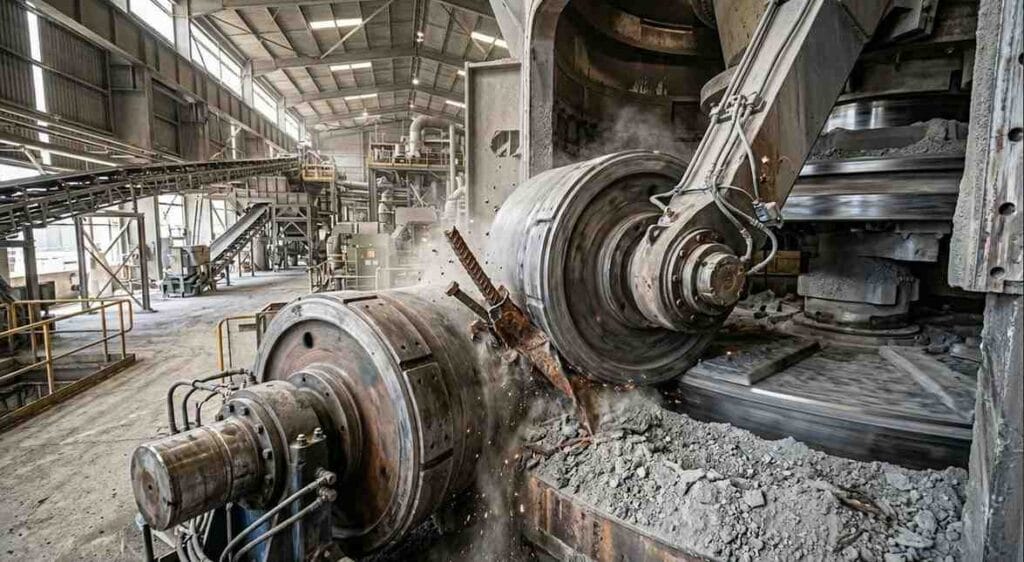
Process Analysis
One of the key characteristics of tramp metal-related vibration is its sudden nature. Unlike feed fluctuations or grinding bed instability, operators usually do not observe a gradual deterioration in process parameters before the event occurs.
The vibration trend often shows a sharp spike within seconds, frequently followed by an automatic mill trip. If all process parameters were stable before the incident and vibration increased instantaneously, tramp metal should be considered a likely cause.
After the event, reject material observations can sometimes provide additional clues, especially if metallic fragments are found in the reject stream.
Corrective Actions
- Stop the mill and follow plant inspection procedures if tramp metal entry is suspected.
- Check reject material and mill internals as per maintenance requirements.
- Verify the condition and effectiveness of upstream magnetic separators.
- Confirm proper operation of metal detectors installed in the feed system.
- Inspect grinding components for any abnormal damage before restarting the mill.
- Identify the source of the metallic object to prevent recurrence.
Practical Observation
A major difference between tramp metal vibration and normal process vibration is the speed at which it occurs. Process-related vibration usually develops alongside changes in DP, feed rate, grinding pressure, or material bed conditions. Tramp metal events, however, often occur without warning. When a mill running under stable conditions suddenly experiences an extreme vibration spike followed by a trip, tramp metal entry is usually one of the first possibilities that should be investigated.
6. Hydraulic Pressure Instability
A stable hydraulic system is essential for maintaining a stable grinding bed and consistent grinding force in a VRM. Whenever hydraulic pressure becomes unstable, the rollers can no longer apply a uniform force on the material bed, resulting in fluctuating grinding conditions and increased vibration.
Unlike feed-related vibration, hydraulic pressure instability often appears as repeated oscillations in both grinding pressure and vibration trends. In severe cases, the mill may continuously hunt between stable and unstable operating conditions.
Typical Process Indicators
- Lubrication pump frequent start stop
- Continuous fluctuation in mill vibration
- Unstable hydraulic pressure trend
- Repeated variation in grinding force
- Oscillating mill motor current
- Unstable grinding bed behavior
- Fluctuating differential pressure despite relatively stable feed
- Difficulty maintaining stable mill operation
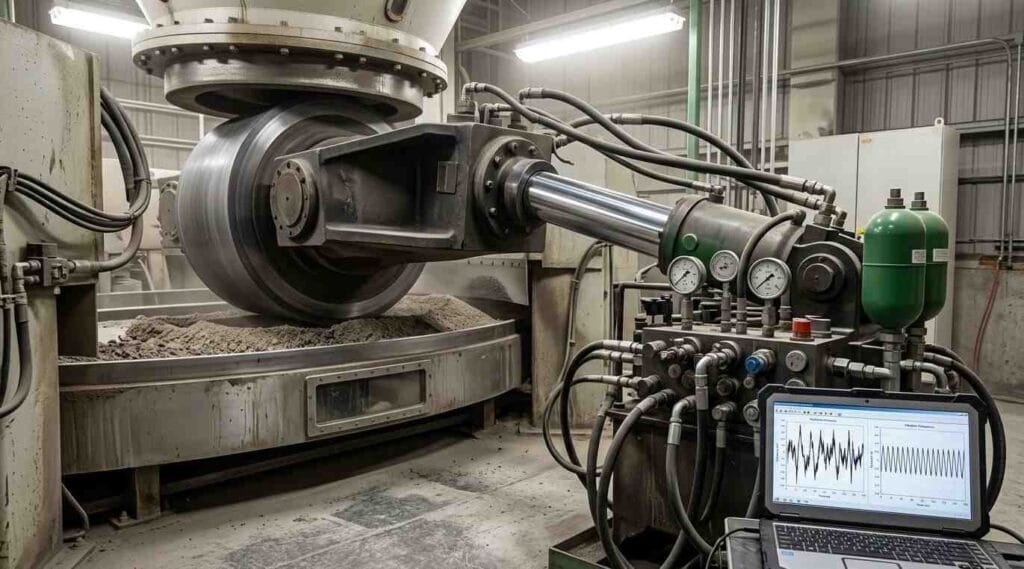
Process Analysis
When vibration and hydraulic pressure begin fluctuating simultaneously, the hydraulic system should be considered as a possible source of instability. A useful observation is whether vibration follows hydraulic pressure changes. If both parameters rise and fall together, the root cause may not be the grinding process itself but instability in the force being applied to the grinding bed.
This condition often becomes more noticeable during higher production rates, where the grinding bed requires consistent pressure to remain stable. Even when feed rate, gas flow, and separator operation remain relatively constant, unstable hydraulic pressure can continuously disturb the grinding process.
Corrective Actions
- Monitor hydraulic pressure trends along with vibration trends.
- Verify that hydraulic pressure remains stable under different production conditions.
- Avoid unnecessary changes in grinding pressure set points.
- Coordinate with the maintenance team if abnormal pressure fluctuations persist.
- Confirm proper operation of the hydraulic control system and pressure regulation loop.
- Restore stable hydraulic pressure before making major process adjustments.
Practical Observation
A common mistake during troubleshooting is to continuously adjust feed rate, water spray, or separator settings while ignoring hydraulic pressure behaviour. In many cases, the grinding process appears unstable simply because the force applied to the rollers is constantly changing. When hydraulic pressure fluctuations are eliminated, vibration often decreases significantly and mill operation becomes much easier to stabilise.
7. Separator Speed Fluctuation
The separator plays a critical role in maintaining grinding stability by controlling product fineness and circulating load. Any instability in separator speed can quickly affect the internal material circulation of the mill, leading to fluctuations in grinding bed stability and vibration levels.
Since the separator directly influences how much coarse material returns to the grinding table, even small variations in separator RPM can create noticeable changes in mill operation. In many cases, vibration caused by separator instability is secondary, originating from disturbances in the circulating load rather than the grinding zone itself.
Typical Process Indicators
- Fluctuating mill vibration
- Unstable differential pressure (DP)
- Variations in circulating load
- Frequent changes in separator motor current
- Product fineness fluctuations
- Increased reject quantity variation
- Unstable mill loading conditions
- Difficulty maintaining consistent product quality
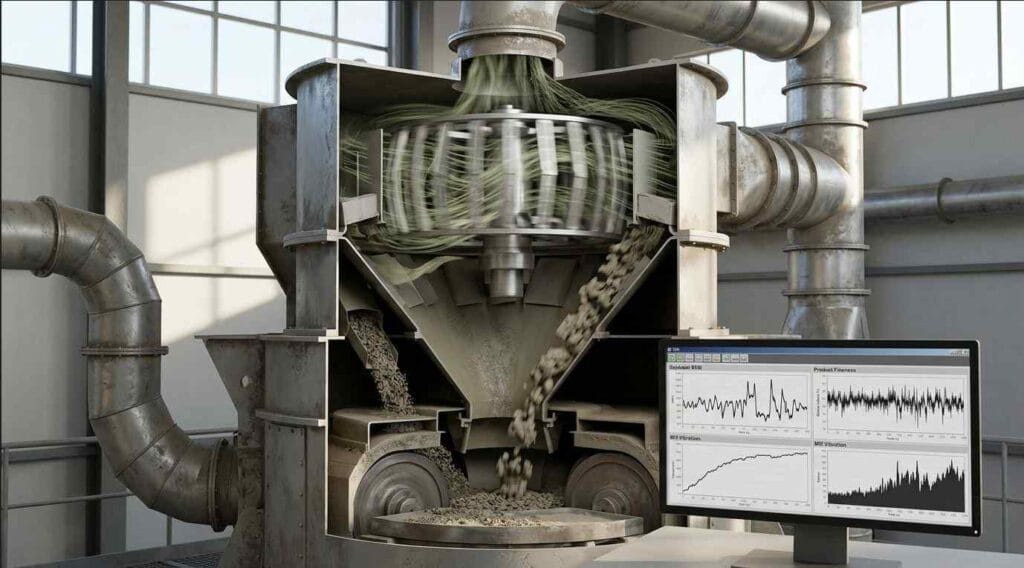
Process Analysis
When vibration occurs alongside unstable separator RPM, changes in circulating load should be carefully analysed. A sudden increase in separator speed can increase coarse material rejection, raising the circulating load and affecting grinding bed stability. Conversely, a reduction in separator speed may allow excessive coarse particles to leave the system, impacting product quality and process balance.
One common observation is that DP, reject quantity, separator motor load, and vibration begin fluctuating together. When these parameters move in the same pattern, separator instability becomes a strong possibility. Trend analysis is often the most effective tool for diagnosis. Comparing separator RPM, DP, vibration, reject flow, and product fineness trends can help identify whether the separator is contributing to mill instability.
Corrective Actions
- Maintain stable separator RPM during operation.
- Avoid unnecessary separator speed changes.
- Monitor separator motor current and RPM trends continuously.
- Verify that circulating load remains stable after separator adjustments.
- Optimise separator settings gradually rather than making large corrections.
- Coordinate with maintenance personnel if RPM instability persists despite stable operating conditions.
Practical Observation
Many vibration issues initially appear to be related to grinding pressure or feed instability, but detailed trend analysis often reveals that separator speed fluctuations are disturbing the internal material circulation. When separator RPM remains stable, circulating load becomes more predictable, grinding bed stability improves, and vibration levels often reduce without major adjustments to other process parameters.
8. Mill Airflow Instability
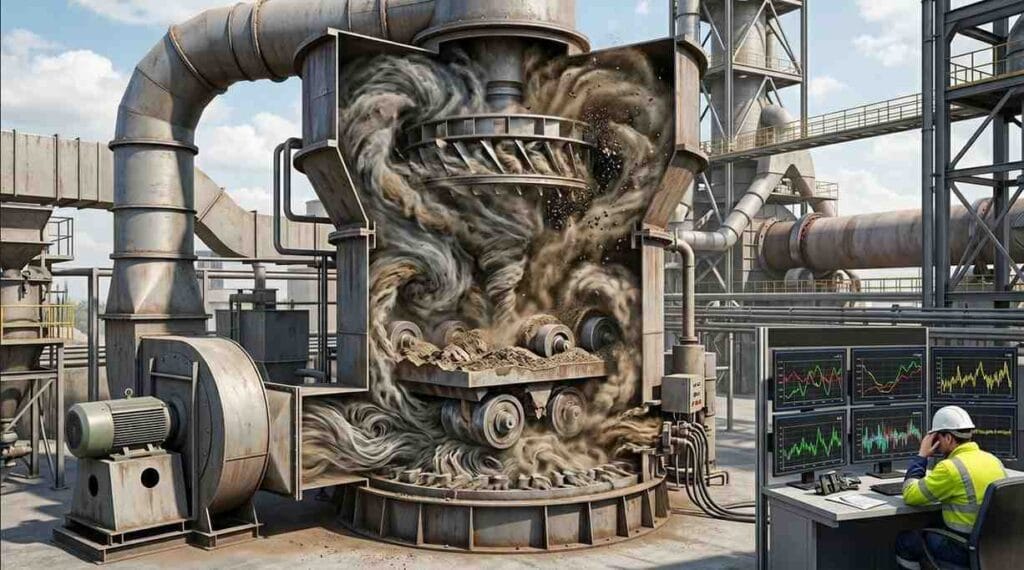
Airflow is one of the most critical parameters affecting VRM stability. Apart from drying the material, the mill airflow is responsible for lifting ground material from the grinding table and transporting it to the separator. When airflow becomes unstable, material movement inside the mill is disturbed, which directly affects grinding bed stability and can lead to increased vibration.
In many cases, operators focus on feed rate and grinding pressure while overlooking airflow behaviour. However, even with stable feed and hydraulic pressure, unstable gas flow can create significant process disturbances.
Typical Process Indicators
- Fluctuating mill vibration
- Unstable differential pressure (DP)
- Variation in mill outlet temperature
- Unstable material circulation
- Fluctuating mill fan load
- Changes in reject quantity
- Difficulty maintaining a stable grinding bed
- Variations in drying performance, especially in Raw Mills
Process Analysis
When airflow fluctuates, the amount of material transported from the grinding table also changes continuously. Low airflow can cause material accumulation inside the mill, resulting in rising DP, unstable grinding conditions, and vibration. Excessive airflow, on the other hand, may remove material too quickly from the grinding zone, reducing bed stability and creating vibration problems.
A common indication of airflow-related issues is simultaneous fluctuation in DP, mill outlet temperature, fan load, and vibration. If these parameters start moving together, airflow instability should be investigated before making major adjustments to grinding pressure or feed rate.
For Raw Mills, airflow instability can become even more critical because drying efficiency is directly affected. Variations in gas flow often result in changing moisture conditions, making the grinding bed more difficult to stabilise.
Corrective Actions
- Maintain stable mill airflow and draft conditions.
- Avoid sudden fan speed or damper position changes.
- Monitor DP, fan load, outlet temperature, and vibration trends together.
- Adjust feed rate and airflow in a coordinated manner.
- Maintain stable gas flow during production changes.
- Coordinate with maintenance personnel if airflow instability persists despite stable process conditions.
Practical Observation
Many vibration problems that appear to be related to grinding pressure or feed rate are actually caused by unstable airflow. In several cases, stabilising mill draft and airflow has resulted in immediate improvement in DP stability, grinding bed formation, and vibration levels without requiring major changes to other operating parameters. For this reason, airflow should always be considered a key parameter when troubleshooting VRM vibration.
9. Hard Feed Material
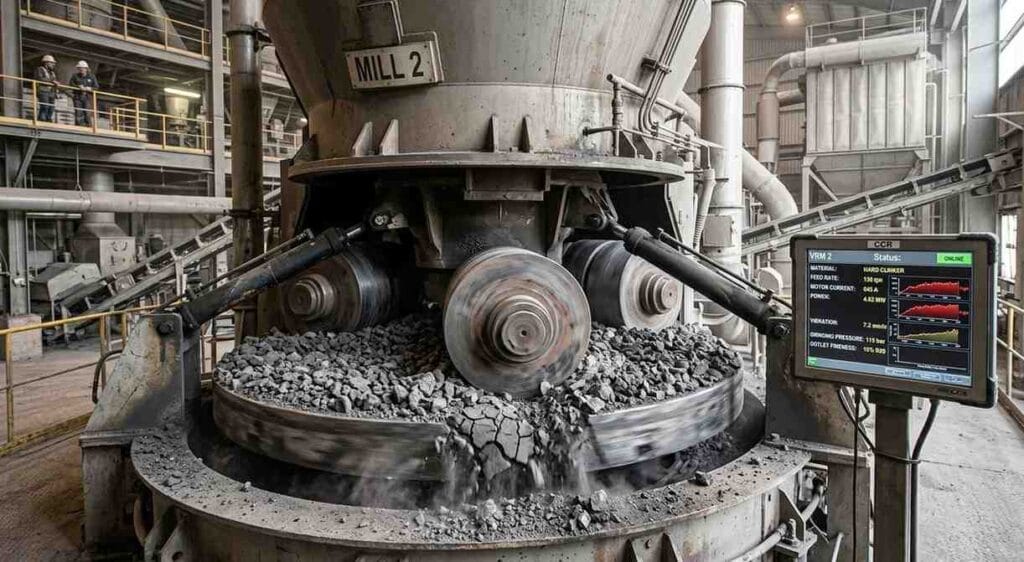
Changes in feed material characteristics can have a significant impact on VRM stability. Even when feed rate, grinding pressure, and airflow remain unchanged, a sudden increase in material hardness can alter the grinding behavior of the mill and lead to increased vibration.
Harder material requires more grinding energy and a longer retention time within the grinding zone. If operating parameters are not adjusted accordingly, the grinding bed may become unstable, resulting in higher vibration levels and reduced mill performance.
Typical Process Indicators
- Gradual increase in mill vibration
- Higher mill motor current and power consumption
- Reduction in mill throughput
- Increased differential pressure (DP)
- Higher circulating load
- Reduced grinding efficiency
- Difficulty achieving target product fineness
- Stable operating parameters but deteriorating mill performance
Process Analysis
Material hardness-related vibration is often more difficult to identify because the increase in vibration is usually gradual rather than sudden. Operators may notice that the mill requires more power to maintain the same production rate, while throughput starts decreasing and vibration slowly increases.
A useful indication is when vibration, motor load, and specific power consumption increase simultaneously without any major change in feed rate, separator settings, or grinding pressure. This often suggests that the material being processed has become more difficult to grind.
In Raw Mills, changes in limestone quality, silica content, or material composition can significantly affect grindability. In Cement Mills, clinker hardness variations can produce similar effects.
Corrective Actions
- Monitor mill performance whenever material characteristics change.
- Adjust grinding pressure according to material grindability.
- Optimise feed rate to avoid overloading the grinding zone.
- Maintain a stable grinding bed during periods of changing material quality.
- Optimise water spray where applicable to improve bed stability.
- Review separator settings if circulating load increases significantly.
- Consider material blending when large variations in hardness are expected.
Practical Observation
A common mistake is to treat all vibration issues as operating problems while ignoring changes in feed material characteristics. In many cases, operators continue adjusting feed rate, airflow, or grinding pressure without significant improvement because the actual challenge is the material itself. Whenever vibration increases together with power consumption and reduced throughput, feed material hardness should be included in the troubleshooting process.
10. Low Nitrogen (N₂) Accumulator Pressure
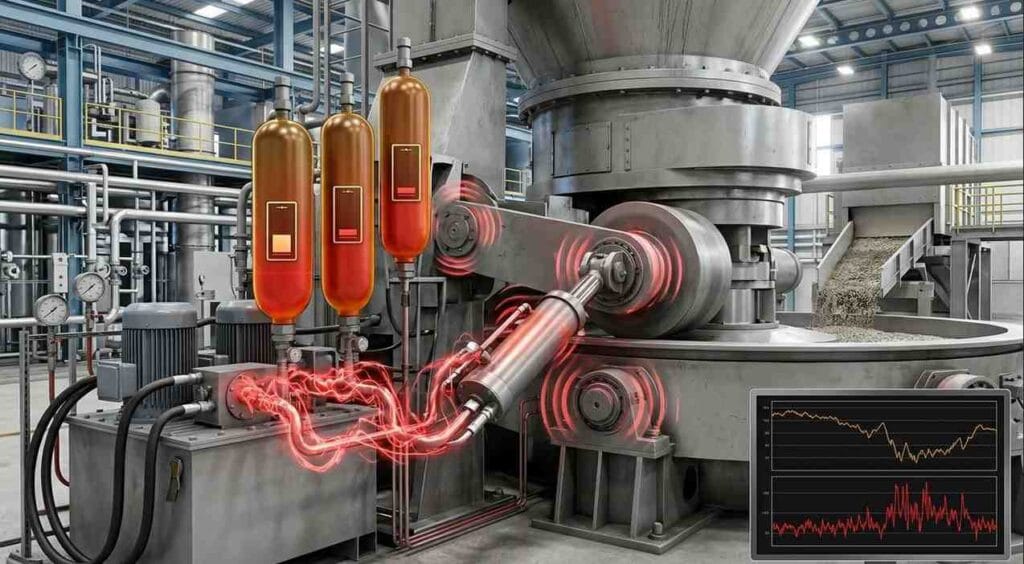
Low nitrogen accumulator pressure is a common but often overlooked cause of persistent VRM vibration. Although the issue originates in the hydraulic system, its effects are usually visible first through process parameters such as vibration and hydraulic pressure behaviour.
The hydraulic accumulators act as shock absorbers for the grinding rollers. When nitrogen pressure falls below the required level, the hydraulic system loses part of its damping capability. As a result, normal variations in grinding bed thickness create stronger pressure fluctuations, which are transmitted directly to the rollers and eventually appear as increased mill vibration.
Typical Process Indicators
- Increased mill vibration despite stable feed conditions
- Sharp fluctuations in hydraulic pressure
- Repeated vibration spikes during normal operation
- Poor grinding bed stability
- Higher sensitivity to feed or material variations
- Difficulty maintaining smooth mill operation
- Stable DP and feed rate but persistent vibration problems
Process Analysis
One characteristic of low accumulator pressure is that vibration often remains higher than normal even when major process parameters appear stable. Feed rate, DP, airflow, and separator operation may all remain within acceptable limits, yet the mill continues to experience vibration spikes.
A useful observation is the relationship between hydraulic pressure and vibration. If hydraulic pressure becomes more erratic and vibration increases without any significant process disturbance, insufficient accumulator damping should be considered as a possible cause.
This condition is often mistaken for grinding bed instability because the symptoms can appear similar. However, repeated vibration problems despite stable operating conditions may indicate that the hydraulic system is no longer absorbing grinding shocks effectively.
Corrective Actions
- Review hydraulic pressure and vibration trends together.
- Compare current mill behaviour with historical operating data.
- Verify accumulator health whenever unexplained vibration persists.
- Coordinate with the maintenance team to check nitrogen pre-charge pressure.
- Restore recommended accumulator pressure before making major process adjustments.
- Confirm mill stability after corrective action through trend monitoring.
Practical Observation
There are situations where operators repeatedly adjust feed rate, grinding pressure, water spray, and airflow in an attempt to reduce vibration, but the improvement remains temporary. In such cases, the grinding process itself may not be the root cause. Low nitrogen accumulator pressure can make the mill extremely sensitive to normal process variations, causing vibration levels to remain elevated until the accumulator system is restored to its proper operating condition.
Practical Troubleshooting Guide
When VRM vibration increases, the focus should not be on the vibration value alone. Vibration is usually the result of an underlying process or mechanical issue. The most effective approach is to analyse related operating parameters such as differential pressure (DP), feed rate, hydraulic pressure, mill load, separator speed, airflow, and reject quantity before taking corrective action.
If Vibration Increases While DP is Falling
This typically indicates a loss of grinding bed stability. Possible causes include low feed rate, excessive airflow, poor material retention, or an approaching bed collapse. The priority should be to restore a stable grinding bed and closely monitor DP recovery.
If Vibration and Feed Rate Fluctuate Together
Feed instability should be investigated first. Sudden changes in feed rate often disturb the grinding bed, resulting in cyclic vibration, unstable DP, and fluctuating mill load. Stabilising the feed usually restores mill stability.
If Vibration and Hydraulic Pressure Fluctuate Simultaneously
The hydraulic system may be contributing to the problem. Pressure instability, accumulator issues, or poor damping characteristics can create repeated vibration spikes even when feed and airflow remain stable.
If Vibration Increases Along with Power Consumption
Material grindability should be reviewed. Harder feed material often requires more grinding energy, resulting in higher motor load, reduced throughput, and increased vibration if operating parameters are not adjusted accordingly.
If DP, Reject Quantity, and Vibration Fluctuate Together
Separator operation and circulating load should be analysed. Instability in material classification can disturb internal material circulation and lead to grinding bed instability.
If Vibration Increases During Airflow Changes
Mill draft and gas flow should be reviewed. Unstable airflow can alter material transport inside the mill, affecting grinding bed formation and overall mill stability.
If a Sudden Extreme Vibration Spike Occurs
A tramp metal event or bed collapse should be suspected immediately. Reviewing vibration, DP, and mill load trends before the event can help identify the root cause and prevent recurrence.
If Vibration Persists Despite Stable Process Parameters
When feed rate, DP, airflow, grinding pressure, and separator operation remain stable but vibration continues, the possibility of a mechanical issue should be considered. Grinding component wear, roller wear, hydraulic system problems, or other equipment-related issues may require further investigation during the next planned shutdown.
Practical Rule
One of the most useful troubleshooting habits is to analyse vibration together with DP, feed rate, hydraulic pressure, mill load, separator speed, and airflow trends. In most cases, the root cause becomes visible long before the vibration reaches alarm or trip limits. Early identification of these trends allows corrective action to be taken before mill stability and production are affected.
Case Studies
Case Study 1: Vibration Caused by Feed Instability
During Raw Mill operation, repeated vibration spikes were observed despite maintaining normal grinding pressure and airflow conditions. Trend analysis showed that every vibration event was preceded by a sudden reduction in feed rate, followed by a drop in differential pressure (DP).
Initially, attention was focused on grinding pressure and water spray settings, but no significant improvement was achieved. A detailed review of feed trends revealed intermittent feed interruptions that were continuously disturbing the grinding bed.
Once feed stability was restored, DP became more consistent, vibration levels reduced significantly, and the mill operated without further vibration-related trips. This case highlighted the importance of analysing feed trends before making major process adjustments.
Case Study 2: Persistent Vibration Despite Stable Process Parameters
A Cement Mill VRM experienced a gradual increase in vibration over several weeks. Feed rate, separator speed, airflow, grinding pressure, and DP remained stable, making the issue difficult to explain from a process perspective.
Trend analysis showed repeated fluctuations in hydraulic pressure that closely matched the vibration pattern. Despite several process optimisations, vibration remained above normal operating levels.
During a planned shutdown, an issue was identified within the hydraulic accumulator system. After corrective action, hydraulic pressure behaviour stabilised and vibration returned to its normal baseline. The case demonstrated that persistent vibration should not always be treated as a process problem, especially when major operating parameters remain stable.
Case Study 3: Bed Collapse Following Grinding Bed Instability
A Raw Mill suddenly tripped on high vibration during normal operation. Review of historical trends showed that vibration had been increasing gradually for several minutes while differential pressure (DP) was becoming increasingly unstable. At the same time, the mill outlet temperature started dropping rapidly, indicating deteriorating drying conditions inside the mill.
As the outlet temperature continued to fall, material moisture increased and the grinding bed became unstable. Just before the trip, DP dropped sharply and was immediately followed by an extreme vibration spike, resulting in a complete bed collapse and mill trip.
Further analysis indicated that changing material conditions combined with insufficient drying had weakened the grinding bed. The sudden reduction in outlet temperature was one of the earliest warning signs that the mill was losing its ability to maintain stable grinding conditions.
Corrective actions focused on restoring proper drying conditions by increasing hot gas availability, stabilising airflow, optimising feed rate, and rebuilding the grinding bed. Mill outlet temperature was closely monitored to ensure adequate drying before gradually increasing production.
After process stabilisation, the mill resumed normal operation without further vibration incidents. This event highlighted the importance of monitoring outlet temperature together with DP and vibration trends, as a sudden temperature drop can often provide an early indication of developing grinding bed instability long before a vibration trip occurs.
Best Practices for Vibration Monitoring and Control
Successful VRM operation is not about reacting to vibration alarms; it is about identifying early warning signs before vibration reaches critical levels. In most cases, the root cause becomes visible in process trends well before the mill trips. Continuous monitoring of key operating parameters allows operators to detect instability early and take corrective action before production is affected.
Key Parameters to Monitor Daily
Instead of focusing only on vibration values, the relationship between multiple process parameters should be monitored throughout the shift.
- Mill vibration trend
- Differential Pressure (DP)
- Feed rate stability
- Hydraulic pressure stability
- Mill motor current and power consumption
- Separator speed and separator motor load
- Reject quantity trend
- Mill outlet temperature
- Mill fan load and airflow stability
A stable VRM normally shows stable behaviour across all these parameters. Sudden changes in any one parameter should always be investigated before vibration begins to increase.
Important KPIs for Mill Stability
The following KPIs provide valuable information about overall mill health and grinding stability:
- Mill Vibration (mm/s): Direct indication of mill stability.
- Differential Pressure (DP): Reflects grinding bed condition and material circulation.
- Specific Power Consumption (kWh/t): Indicates grinding efficiency.
- Mill Outlet Temperature: Reflects drying performance and moisture control.
- Hydraulic Pressure Stability: Indicates consistency of grinding force.
- Reject Quantity: Helps evaluate circulating load behaviour.
- Mill Throughput (TPH): Measures production stability.
Monitoring these KPIs together provides a much clearer picture than observing vibration alone.
Early Warning Signs Before a Vibration Trip
In many cases, vibration trips do not occur without warning. Several process indicators usually begin deviating from their normal pattern before the actual event.
Common warning signs include:
- Increasing vibration trend over time
- Unstable or rapidly changing DP
- Sudden drop in mill outlet temperature
- Fluctuating hydraulic pressure
- Rising reject quantity
- Unstable mill motor current
- Frequent changes in grinding bed condition
- Variations in airflow or mill draft
- Increasing specific power consumption
- Reduced mill throughput at normal operating conditions
Recognising these symptoms early often provides enough time to stabilise the process before vibration reaches alarm or trip limits.
Practical Approach
One of the most effective habits in VRM operation is trend analysis. Rather than reacting to a single parameter, vibration should always be evaluated together with DP, feed rate, hydraulic pressure, airflow, outlet temperature, mill load, and separator performance.
Experience has shown that operators who focus on trend behaviour rather than individual readings are far more successful at preventing vibration trips and maintaining long-term mill stability. In most situations, the process starts showing signs of instability well before the vibration alarm appears on the CCR screen.
Conclusion
VRM vibration is rarely an isolated problem. In most situations, it is a symptom of an underlying process disturbance or equipment-related issue. Experience from day-to-day mill operation shows that vibration is often preceded by changes in key parameters such as differential pressure, feed rate, hydraulic pressure, airflow, outlet temperature, or circulating load.
Successful vibration control depends on identifying these changes early and understanding how they interact with grinding bed stability. A stable grinding bed, consistent feed conditions, reliable hydraulic performance, and controlled airflow remain the foundation of smooth and efficient VRM operation.
One of the most important lessons from VRM troubleshooting is that vibration should never be analysed in isolation. Trend analysis of DP, mill load, hydraulic pressure, separator performance, airflow, and outlet temperature often reveals the root cause long before a vibration alarm or mill trip occurs.
By focusing on proactive monitoring, stable process control, and timely corrective actions, vibration-related disruptions can be significantly reduced. This not only improves mill availability and production stability but also helps optimise power consumption, maintain product quality, and extend the service life of critical mill components.