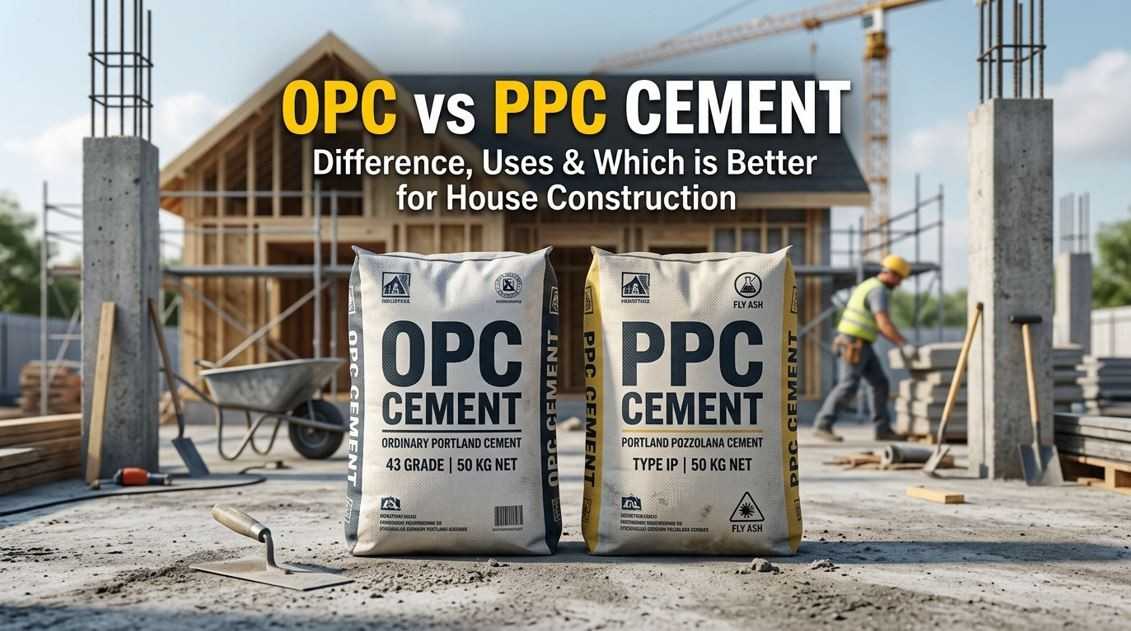
OPC vs PPC Cement: Complete Difference, Uses, Advantages and Which One is Better?
Choosing the right cement is one of the most important decisions in any construction project. Whether you are building a house, doing RCC work, plastering walls, or planning a large civil structure, the type of cement you use directly affects strength, durability, crack resistance, finish quality and even cost.
Two of the most commonly used cement types in India are OPC cement and PPC cement. Most people hear these names from contractors, engineers, masons or cement dealers, but the problem is that the explanation is often shallow or misleading. Some people say OPC is always stronger, others say PPC is better for houses, and many assume OPC 53 grade is the best choice for every construction job. That’s not how it works.
The actual difference between OPC and PPC cement is not just about “strength.” It is about composition, strength development pattern, heat of hydration, workability, durability, crack tendency and application suitability.
What is OPC Cement?
OPC stands for Ordinary Portland Cement. It is one of the most commonly used types of cement and is mainly manufactured by grinding cement clinker and gypsum. Because OPC contains a high proportion of clinker, it reacts faster with water and develops strength quickly in the early stage. This is the main reason why OPC is preferred in construction jobs where high early strength is required.
In practical construction, OPC is often used when the project needs faster formwork removal, quicker setting of structural work, or early strength in RCC members. It is commonly available in 33 grade, 43 grade and 53 grade, with OPC 53 grade being widely used where high early strength is needed.
What is PPC Cement?
PPC stands for Portland Pozzolana Cement. It is made by blending clinker, gypsum, and pozzolanic materials, most commonly fly ash. This pozzolanic material changes the behavior of the cement significantly. Unlike OPC, PPC does not gain strength as aggressively in the early stage, but it generally performs very well over the long term because the pozzolanic reaction helps make concrete denser and more durable.
PPC is widely used in house construction, plastering, brickwork, foundations, mass concreting, and general RCC work where long-term durability, lower heat generation and smoother workability are more important than very fast early strength.
Difference Between OPC and PPC Cement

1) Difference in Composition
The first major difference between OPC and PPC cement is their composition.
OPC Composition
OPC is mainly made from:
- Cement clinker
- Gypsum
PPC Composition
PPC is made from:
- Cement clinker
- Gypsum
- Fly ash or other pozzolanic material
This difference in composition is the main reason why OPC and PPC behave differently in concrete. Since OPC contains more clinker, it generally gains strength faster in the initial days. PPC, because of fly ash, reacts more gradually and contributes more to long-term durability and lower heat generation.
2) Difference in Strength Development
Strength development is one of the biggest reasons why people compare OPC vs PPC cement.
OPC Strength
OPC develops higher early strength. That means concrete made with OPC gains strength faster in the first few days. This makes it suitable for:
- Fast-track construction
- Precast work
- Structural members requiring early loading
- Early de-shuttering of formwork
PPC Strength
PPC generally gains strength slower in the early stage compared to OPC. However, over time, PPC can achieve very good strength and often better durability because of the pozzolanic reaction. So if the requirement is fast early strength, OPC is usually preferred. But if the focus is long-term performance and durability, PPC is often a better option.

Recommended Reading: For practical insights into kiln optimization, heat balance calculation, thermal efficiency improvement, and reducing heat losses in cement plants, read this detailed guide on Amazon Kindle.
3) Difference in Heat of Hydration
Whenever cement reacts with water, it generates heat. This is called heat of hydration.
OPC Heat Generation
OPC produces more heat of hydration because of its higher clinker content and faster hydration process.
PPC Heat Generation
PPC produces less heat of hydration because part of the clinker is replaced by fly ash, and the reaction happens more gradually. This matters in real construction. In thick concrete sections, raft foundations, dams and mass concrete works, high heat can create temperature differences inside the concrete and increase the risk of cracking. That is why PPC is often considered better for such applications.

4) Difference in Durability
Durability is where PPC often has an advantage over OPC.
Concrete made with PPC generally becomes denser over time because fly ash reacts with calcium hydroxide and forms additional cementitious compounds. This helps reduce permeability and improves resistance to moisture ingress and certain chemical attacks. In simple terms, PPC often performs better in conditions where long-term durability matters more.
OPC can also produce durable concrete, but it depends heavily on proper mix design, curing and workmanship. PPC usually provides a more durable and dense matrix over time, which is why it is widely preferred in house construction and foundations.
5) Difference in Workability
Workability means how easy the cement mix is to handle, place and finish.
PPC usually offers better workability than OPC because the fine fly ash particles improve the texture and cohesiveness of the mix. This is one reason why PPC is often preferred for plastering, masonry and general residential construction. It tends to provide a smoother finish and better handling at site.
OPC can also be used effectively, but in many practical cases, PPC gives a better finish and more comfortable working behavior for masons and site workers.
6) Difference in Crack Resistance
Cement alone does not decide whether concrete will crack or not. Cracks depend on many factors such as:
- Water-cement ratio
- Curing quality
- Temperature
- Concrete thickness
- Mix design
- Workmanship
Still, from a cement behavior point of view, PPC often has an advantage because it generates less heat and gains strength more gradually. This can help reduce thermal stress and shrinkage-related cracking, especially in mass concrete or residential construction where curing is not always ideal.
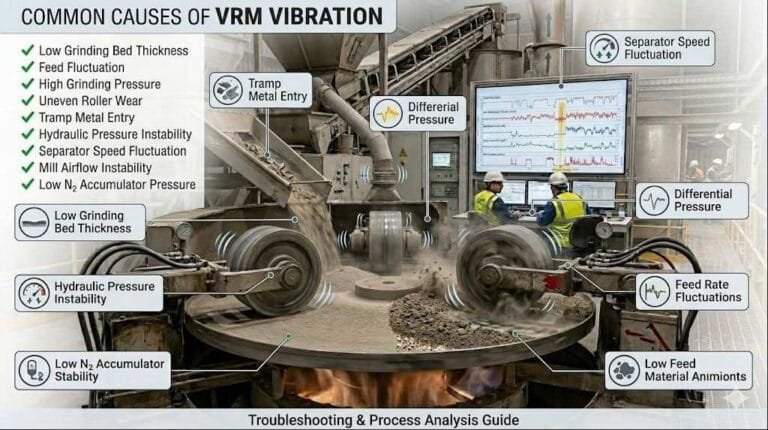
VRM vibration is usually a symptom of process instability, feed inconsistency, grinding pressure issues, gas flow imbalance, or worn internals-not just a mechanical fault.
Source: CementLogic article
7) Difference in Environmental Impact
PPC is generally considered more eco-friendly than OPC because it uses fly ash, which reduces clinker consumption. Since clinker production is the most energy-intensive and carbon-emitting part of cement manufacturing, lowering clinker content reduces the overall environmental impact.
So if sustainability and lower carbon footprint matter, PPC is the better choice.
OPC vs PPC Cement Comparison Table
| Parameter | OPC Cement | PPC Cement |
|---|---|---|
| Full Form | Ordinary Portland Cement | Portland Pozzolana Cement |
| Main Composition | Clinker + Gypsum | Clinker + Gypsum + Fly Ash |
| Early Strength | Higher | Lower than OPC initially |
| Long-Term Strength | Good | Very good, often better in long term |
| Heat of Hydration | High | Lower |
| Durability | Good | Better in many long-term applications |
| Workability | Normal | Better |
| Crack Resistance | Comparatively lower in mass concrete | Better due to lower heat |
| Best For | Early strength and fast construction | House construction, plastering, durability |
| Eco-Friendliness | Lower | Higher |

Advantages of OPC Cement
High Early Strength
The biggest advantage of OPC is that it gains strength quickly. This makes it useful for projects where construction speed matters.
Better for Fast-Track Construction
If the project requires quick progress and early removal of formwork, OPC is often the preferred choice.
Suitable for Precast and Heavy RCC Work
Because of its early strength gain, OPC is widely used in precast units and structural work where faster load-bearing capacity is required.
Advantages of PPC Cement
Better Long-Term Durability
PPC generally gives denser concrete over time, which improves long-term performance.
Lower Heat of Hydration
This makes PPC a better option for mass concreting and helps reduce the risk of thermal cracks.
Better Workability
PPC often provides smoother handling, better plaster finish, and easier site application.
More Suitable for Residential Construction
For normal house construction, PPC is often a balanced choice because it offers durability, workability, and lower heat generation.
More Eco-Friendly
Since PPC uses fly ash and reduces clinker content, it is more environmentally friendly than OPC.
Disadvantages of OPC Cement
The main drawback of OPC is that it generates more heat and can increase the risk of thermal cracking in thick concrete sections if curing is poor. It is also less eco-friendly than PPC because of its higher clinker content. In situations where long-term durability and low heat matter more than early strength, OPC may not be the best option.
Disadvantages of PPC Cement
The biggest limitation of PPC is that it gains strength more slowly in the initial days compared to OPC. So if the project requires very fast early strength or early de-shuttering, PPC may not be the ideal choice. Its performance also depends on the quality of fly ash and proper curing, just like any other cement-based concrete.
A cement mill separator controls particle classification in the grinding circuit—returning coarse material to the mill and sending fine cement forward. Better separator efficiency means lower circulating load, lower power consumption, and more stable cement fineness.
Source: CementLogic article
Which Cement is Better for House Construction: OPC or PPC?
For most normal house construction work, PPC cement is often the better overall choice. The reason is simple: in residential construction, the priority is usually not extremely fast early strength. Instead, the focus is more on durability, good finish, reduced cracking, workability and long-term performance. PPC performs well in all of these areas, which is why it is widely preferred for house construction.
PPC is commonly used for:
- Brickwork
- Plastering
- Foundations
- General RCC work
- Residential slabs and beams
- Masonry work
However, this does not mean OPC has no role in house construction. If the project requires fast strength gain, quick formwork removal, or a specific structural recommendation from the engineer, OPC can still be the better choice for certain RCC elements.
So the practical answer is this: PPC is usually better for general house construction, while OPC is better where early strength is critical.

OPC 43 Grade vs OPC 53 Grade vs PPC
A common mistake in the market is assuming that OPC 53 grade is automatically the best cement for every job. That’s not true.
OPC 43 grade is commonly used for general construction and RCC work.
OPC 53 grade is preferred when higher early strength is required.
PPC is usually preferred where durability, lower heat, and workability matter more.
So the choice should not be based on “which grade sounds stronger.” It should be based on the actual requirement of the construction work.
Common Myths About OPC and PPC Cement
Myth 1: OPC is always stronger than PPC
This is only partly true. OPC gains strength faster in the beginning, but PPC can perform very well over the long term.
Myth 2: PPC is only for plastering
Wrong. PPC is used in RCC, foundations, slabs, beams, and general house construction too.
Myth 3: OPC 53 grade is best for every construction job
Not true. A higher grade does not automatically mean better for all types of work.
Myth 4: Cement type alone decides cracks
Wrong again. Cracks depend on curing, water-cement ratio, mix design, temperature and workmanship as much as cement type.
FAQs on OPC vs PPC Cement
What is the full form of OPC and PPC cement?
OPC stands for Ordinary Portland Cement and PPC stands for Portland Pozzolana Cement.
Which cement is better for house construction?
For most residential construction, PPC cement is usually the better option because of its durability, lower heat generation, and better workability.
Is OPC stronger than PPC?
OPC generally gains strength faster in the early stage, but PPC can offer very good long-term strength and durability.
Can PPC be used for RCC work?
Yes, PPC can be used for RCC work, foundations, slabs, and beams depending on the structural requirement.
Which cement is better for plastering?
PPC is often preferred for plastering because it usually provides better workability and smoother finish.
Which cement generates more heat?
OPC generates more heat of hydration, while PPC generates less heat.