How Clinker Quality Affects Cement Mill Performance

Cement-mill-performance-and-clinker-quality

Impact of Clinker Quality on Cement Mill Production Efficiency and Specific Power Consumption

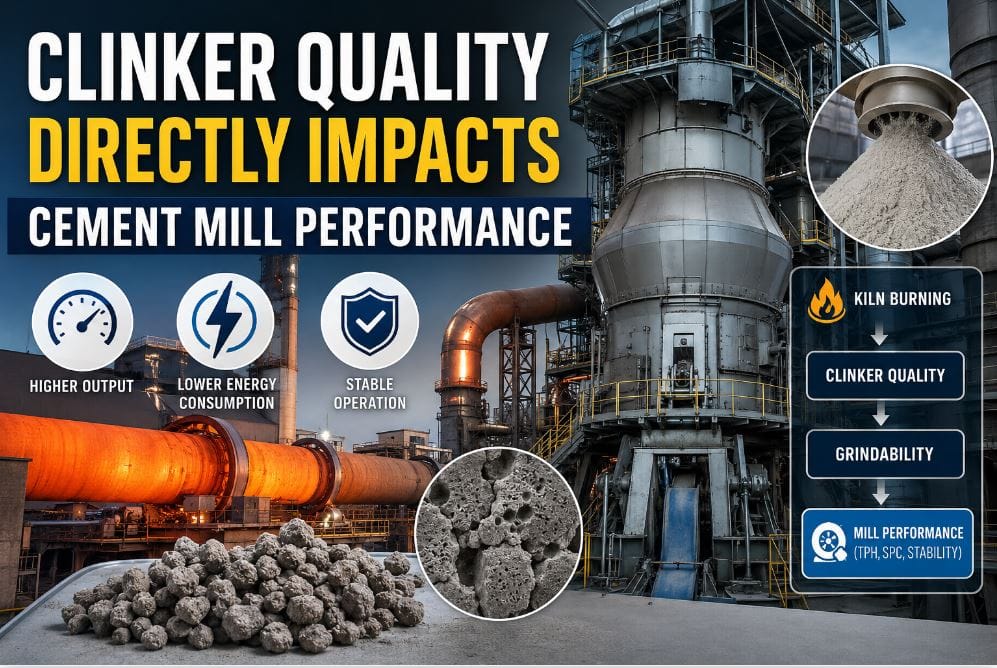
The cement mill is one of the most important sections in any cement plant because it is where clinker is ground into cement. But no matter how modern or efficient the Vertical Roller Mill (VRM) or Ball Mill is, it cannot deliver its full production if the clinker quality is poor.

The reason is simple – the clinker itself decides how easy or difficult it is to grind. Its mineral composition (such as C₃S and C₂S) and physical properties (like hardness, density, and porosity) directly affect how much cement the mill can produce, how much electricity it consumes (Specific Power Consumption or SPC), and the overall grinding cost.

Many times, when mill production suddenly drops, people first suspect problems with the mill, separator, or grinding media. However, the actual reason is often the clinker coming from the kiln. If the kiln produces harder, denser, or over-burnt clinker, the mill has to work much harder to grind it, leading to lower production and higher power consumption. In other words, good cement grinding starts with producing good-quality clinker in the kiln.

Impact of Clinker Quality on Cement Mill Production Efficiency and Specific Power Consumption

How Clinker Mineralogy Affects Grindability

Clinker is mainly made up of four mineral phases: Alite (C₃S), Belite (C₂S), Tricalcium Aluminate (C₃A), and Tetracalcium Aluminoferrite (C₄AF). Among these, C₃S and C₂S have the greatest influence on cement grinding performance.

C₃S (Alite) is relatively easier to grind because it is more brittle and breaks down readily under grinding forces. As a result, clinker with a higher C₃S content generally allows the mill to achieve higher production (TPH) with lower specific power consumption (SPC). It also contributes to better early strength development in cement.

On the other hand, C₂S (Belite) is harder and more resistant to fracture. When the clinker contains a higher proportion of C₂S, the mill has to work harder to achieve the same fineness. This can lead to lower mill output and higher energy consumption.

In actual plant operation, the effect of increased C₂S is not always the same because grinding performance also depends on factors such as clinker porosity, crystal size, burning conditions, cooling rate, and mill operating parameters. However, field experience shows that clinker with significantly higher C₂S content often results in a noticeable reduction in mill throughput and an increase in Specific Power Consumption (SPC).

How Clinker Mineralogy Affects Grindability

In simple terms:

  • Higher C₃S → Easier grinding, higher mill output and lower power consumption.
  • Higher C₂S → Harder grinding, lower mill output and higher power consumption.

This is why maintaining the right clinker mineralogy in the kiln is essential for achieving stable and energy-efficient cement mill operation.

Physical Properties Matter

Clinker chemistry is important, but its physical properties are equally critical for achieving good grinding performance. Even if the chemical composition is within the desired range, poor physical characteristics can make clinker difficult to grind and reduce cement mill efficiency.

One of the most commonly monitored physical properties is Liter Weight (LW), which indicates how dense the clinker is. An optimum clinker typically has a Liter Weight between 1000 and 1200 g/L. Such clinker is more porous and contains tiny internal cracks (micro-cracks) formed during cooling. These natural weak points help the clinker break easily inside the mill, resulting in higher production and lower power consumption.

Clinker chemistry is important, but its physical properties are equally critical for achieving good grinding performance. Even if the chemical composition is within the desired range, poor physical characteristics can make clinker difficult to grind and reduce cement mill efficiency.

On the other hand, over-burnt clinker with a Liter Weight above 1200 g/L is usually denser and less porous because of excessive burning in the kiln. Since it has fewer internal cracks, it is much harder to break during grinding. As a result, the cement mill has to work harder, which can lead to:

  • Lower mill output (TPH)
  • Higher grinding pressure in a VRM
  • Increased circulating load due to more coarse material returning from the separator
  • Higher mill vibrations
  • Increased Specific Power Consumption (SPC)

Another important factor is free lime (f-CaO). A high free lime content generally indicates incomplete clinker formation or unstable kiln burning, which can negatively affect clinker quality and grindability. In addition, excessive liquid phase during burning can produce dense clinker nodules or, under certain kiln conditions, lead to clinker balling (snowman or ring formation). High alkali, sulfur, or moisture in the grinding system may also promote coating on grinding media and mill internals, reducing grinding efficiency and making mill operation less stable.

In simple terms: Well-burnt, moderately porous clinker is easier to grind, while dense, over-burnt clinker requires more energy and reduces mill performance. Therefore, maintaining proper kiln burning conditions and efficient clinker cooling is essential for smooth and economical cement grinding.

clinker quality effect on cement production

Impact on Mill Performance

The quality of clinker has a direct impact on how efficiently the cement mill operates. When clinker is harder or has poor grindability, the mill needs more effort to grind it to the required fineness. As a result, mill performance gradually starts to decline.

Poor clinker grindability can lead to:

  • Reduced mill production (TPH)
  • Higher separator rejects and circulating load
  • Difficulty in maintaining the target Blaine fineness
  • Increased Specific Power Consumption (SPC)
  • Higher wear of grinding media and mill internals, leading to increased maintenance costs

For example, consider a Vertical Roller Mill (VRM) operating at 220 TPH with a Specific Power Consumption (SPC) of 24 kWh/t while grinding normal clinker. If the plant starts receiving harder or over-burnt clinker with poor grindability, the mill output may reduce to around 210 – 215 TPH. Although the mill motor power may increase only slightly, or even remain nearly the same, the SPC can increase to around 25–26 kWh/t because When harder or over-burnt clinker is fed to the mill, it does not break easily under grinding forces. As a result, the material remains longer on the grinding table in a VRM (or inside the grinding chamber of a Ball Mill), increasing internal recirculation. More coarse particles are returned by the separator for regrinding, which increases the circulating load. To transport this additional material through the mill, a higher gas flow is often required, leading to increased mill fan power. The grinding rollers also need to apply greater grinding pressure to achieve the target fineness. All these factors together increase the total energy required for grinding, resulting in higher Specific Power Consumption (SPC).

quality of clinker has a direct impact on how efficiently the cement mill operates

In simple terms, harder clinker is more difficult to grind, so the mill has to work harder to achieve the required fineness. This increases internal material recirculation, separator rejects and the overall grinding load. In a VRM, it may also require higher grinding pressure and increased fan airflow for material transport. As a result, the grinding circuit consumes more energy while mill output decreases, leading to a higher Specific Power Consumption (SPC). Therefore, maintaining consistent clinker quality is essential for achieving high mill productivity, stable operation and lower grinding energy costs.

Related Reading: If you would like to learn more about mill stability, read our article on Common Causes of Vibration in Vertical Roller Mills (VRM) and Their Troubleshooting, where the most common process- and mechanical-related vibration issues are explained with practical troubleshooting tips.

Economic Impact

Grinding is one of the most energy-intensive operations in cement manufacturing, making Specific Power Consumption (SPC) a key performance indicator for every cement plant. Even a small increase in SPC can significantly affect the operating cost of the grinding section, particularly in plants with high annual production.

When clinker quality deteriorates, the mill requires more effort to achieve the target fineness. Harder clinker increases grinding resistance, resulting in higher internal recirculation, greater separator rejects and longer residence time inside the mill. In a Vertical Roller Mill (VRM), it may also require higher grinding pressure and increased fan airflow to transport the material efficiently. These factors increase the overall energy demand of the grinding circuit.

Although an increase of 1-2 kWh/t in SPC may appear insignificant on a per-tonne basis, its cumulative impact over a year can be substantial. For instance, consider a cement plant producing 1 million tonnes of cement annually:

ParameterValue
Annual Cement Production1,000,000 tonnes
Increase in SPC2 kWh/t
Additional Annual Energy Consumption2,000,000 kWh

If the plant pays ₹7 per kWh for electricity, this additional energy consumption would increase the annual electricity cost by approximately ₹14 million (₹1.4 crore). Plants with higher production capacities or higher electricity tariffs would experience an even greater financial impact.

Besides increasing power costs, poor clinker grindability can also reduce mill throughput, increase grinding media wear, shorten the service life of mill internals and raise maintenance requirements. In some cases, lower mill output may even force the plant to operate the grinding circuit for longer hours to meet production targets, further increasing operating costs.

In simple terms, producing easy-to-grind clinker is one of the most effective ways to improve cement mill productivity, reduce electricity consumption and lower the overall operating expenditure (OPEX) of the grinding process.

Case Study

A comparison was carried out by operating the same Vertical Roller Mill (VRM) with clinker produced from three different kilns. The primary difference between the clinker samples was their Liter Weight (LW), which reflected variations in clinker density and grindability.

KilnClinker Liter Weight (g/L)Mill Performance
L-21050 – 1150Stable operation with feed rate around 240 – 250 TPH
L-11150 – 1250Mill capacity reduced to around 220 TPH; stable operation achieved after process adjustments
L-3Above 1300Feed rate reduced to around 180 TPH with frequent operational instability

When L-2 kiln clinker was used, the VRM operated smoothly. The mill maintained a feed rate of 240 – 250 TPH, while key operating parameters such as mill differential pressure (DP), main drive load, and mill draft remained stable. Very few process adjustments were required to sustain consistent production.

When L-1 kiln clinker was introduced, the feed rate had to be reduced to around 220 TPH. The mill initially showed some instability, but after optimizing parameters such as mill fan airflow and feed rate, stable operation was achieved. However, compared to L-2 clinker, the mill required more operator intervention.

The most challenging operation was observed with L-3 kiln clinker, which had a Liter Weight above 1300 g/L. Due to its dense and harder-to-grind nature, the mill feed had to be reduced to approximately 180 TPH. Even at this lower feed rate, the VRM experienced repeated operational instability, requiring frequent adjustments to maintain stable grinding conditions.

As the clinker Liter Weight increased from L-2 to L-3, mill throughput gradually decreased, while the effort required to maintain stable mill operation increased.

Observation: As the clinker Liter Weight increased from L-2 to L-3, mill throughput gradually decreased, while the effort required to maintain stable mill operation increased. This comparison clearly demonstrates how clinker quality can significantly influence VRM productivity and operational stability.

In a Vertical Roller Mill (VRM), harder clinker often requires increased fan airflow to transport the additional internal recirculation and maintain efficient material separation. Understanding and accurately measuring actual fan flow is therefore essential for stable mill operation and energy optimization. For a detailed explanation, read Fan Flow Measurement in Cement Plants: Methods, Calculations & Optimization.

Key Takeaways for Process Engineers

The table below summarizes the common clinker quality issues, their impact on cement mill performance, and the recommended corrective actions.

Clinker ParameterImpact on Cement MillMill Operation Response
High C₂S (Belite) ContentReduced grindability, lower mill output (TPH), higher SPCReduce feed rate if required, optimize separator settings, and closely monitor SPC and product fineness.
High Liter Weight (>1300-1350 g/L)Dense clinker, difficult grinding, higher grinding pressure, unstable VRM operationAdjust mill feed, grinding pressure, separator speed, and fan airflow to maintain stable operation.
Low Liter Weight (<1150 g/L)Easier grinding and higher mill outputMonitor product fineness and avoid over-grinding by optimizing separator settings.
High Free Lime (f-CaO)Variable grindability and unstable grinding behaviourMonitor mill stability, Blaine, and grinding performance. Inform the kiln team if the issue persists.
Low Clinker PorosityHigher grinding resistance and increased energy requirementReduce feed if necessary and optimize grinding parameters to maintain stable mill operation.
Large Clinker SizeHigher grinding load and reduced mill throughputEnsure proper clinker crushing before mill feeding and monitor mill performance.
High Alkali/Sulfur ContentIncreased coating tendency and unstable grinding conditionsMonitor mill internals for coating, optimize grinding aid dosage (if applicable), and maintain stable operating parameters.
Inconsistent Clinker QualityFluctuating TPH, Blaine, DP, and SPCClosely monitor key mill parameters and adjust feed rate and separator settings to maintain process stability.

Key Message – The performance of a cement mill is largely determined by the quality of clinker produced in the kiln. Consistent clinker mineralogy, optimum Liter Weight, proper porosity, and stable kiln operation help achieve higher mill output, lower Specific Power Consumption (SPC), stable grinding conditions, and reduced operating costs. Process engineers should therefore focus on optimizing clinker quality first, as many cement mill performance issues originate upstream in the kiln rather than within the grinding circuit itself.

Recommended Reading: Since clinker quality is closely linked to kiln operation, understanding burning conditions, heat balance, and thermal efficiency is essential for improving cement mill performance. For a detailed explanation of these topics, check out this comprehensive guide on Amazon Kindle.

Conclusion

The performance of a cement mill is largely influenced by the quality of clinker produced in the kiln. Clinker mineralogy, physical properties, and burning conditions play a crucial role in determining how easily the clinker can be ground. Poor clinker quality increases grinding resistance, resulting in lower mill output, higher Specific Power Consumption (SPC), and less stable mill operation.

Although process parameters such as feed rate, grinding pressure, separator speed, and mill airflow can be adjusted to maintain stable operation, they can only compensate to a certain extent. The most effective way to achieve consistently high mill productivity and energy-efficient grinding is to produce clinker with stable mineralogy, optimum porosity, and good grindability.

For cement plant process engineers and operation managers, understanding the relationship between clinker quality and mill performance is essential. Close coordination between the kiln and cement mill teams helps minimize operational fluctuations, improve grinding efficiency, reduce energy consumption, and ensure consistent cement quality.

A well-operated cement mill starts with well-produced clinker. Improving clinker quality at the kiln is often more effective than making repeated adjustments in the grinding circuit.

Leave a Reply

Cement AI Floating Chat
👷 Hello! Need Help?