Table of Contents
Around 1,600 tonnes of limestone may produce only about 1,000 tonnes of clinker after burning. The difference comes from chemical and process losses, which is why Loss on Ignition in cement is a key value in raw mix design. A correct LOI result helps estimate raw meal demand, clinker output, material use and kiln performance.
Why Loss on Ignition in Cement Matters
What LOI measures in cement materials
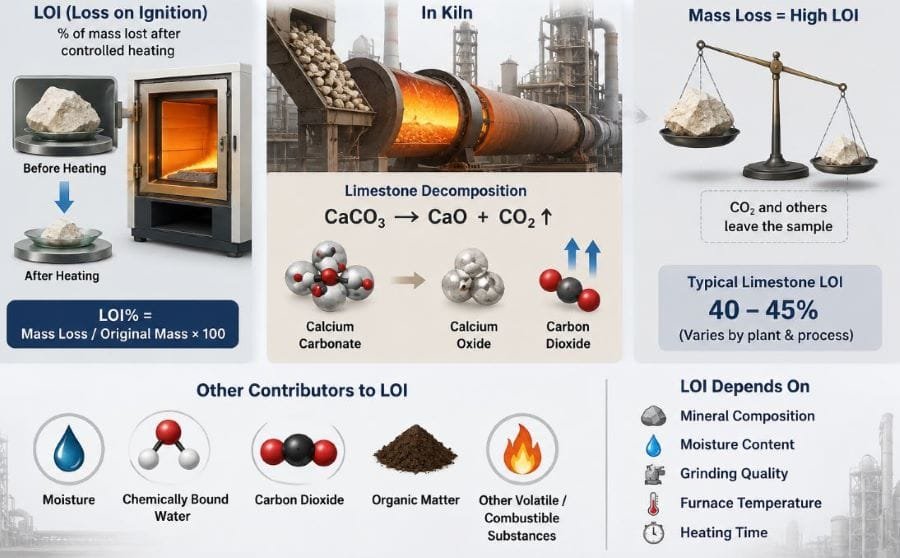
Loss on Ignition is the percentage of mass a material loses after controlled heating. The lost mass may include moisture, chemically bound water, carbon dioxide, organic matter and other volatile or combustible substances. LOI is a mass-loss measurement. It does not measure only one compound. The final value depends on the material’s mineral content, moisture level, grinding quality, furnace temperature and heating time.
Why limestone has a high LOI
Limestone mainly contains calcium carbonate, along with silica, alumina, iron oxide and magnesium oxide. During kiln burning, calcium carbonate breaks down into calcium oxide and carbon dioxide:
CaCO3 → CaO + CO2
The released carbon dioxide leaves the sample. This reduction in mass forms a major part of limestone LOI. Other volatile materials and moisture may add to the total loss.

Typical LOI values for limestone, clay and iron ore
The transcript gives these approximate values:
| Material | Approximate LOI | Main reason for mass loss |
|---|---|---|
| Limestone | 40-45% | Carbonate decomposition and volatile matter |
| Clay | 20% | Moisture, volatile matter and bound water |
| Iron ore | Close to 0% | High iron oxide content and little volatile material |
These figures are not fixed specifications. Actual limestone LOI, clay LOI and iron ore LOI change with deposit location, mineral composition, moisture and sample preparation.
Limestone LOI Is Not the Same as Raw Meal LOI
It is important to distinguish between the LOI of an individual raw material and the LOI of the final raw meal. For example, a limestone sample may have an LOI of around 40-45%, mainly because calcium carbonate releases carbon dioxide during heating. However, this does not mean that the complete raw meal will also have an LOI of 40-45%.
Raw meal is a mixture of different materials. Depending on the plant and raw mix design, it may contain limestone, clay, laterite, iron-bearing materials, bauxite, corrective materials and other additives. Each material has its own LOI and contributes differently to the final raw meal.
Raw Meal LOI Depends on the Complete Mix
The LOI of raw meal depends mainly on:
- Proportion of limestone in the mix
- LOI of each individual raw material
- Carbonate content of the materials
- Moisture and chemically bound water
- Organic and other volatile components
Because limestone usually forms the largest proportion of a cement raw mix, it often contributes significantly to raw meal LOI. However, the final value must be determined from the actual raw mix composition and laboratory analysis.
A Simple Example
Suppose limestone has a high LOI, while clay and iron-bearing corrective materials have lower LOI values. After these materials are mixed together, the LOI of the raw meal becomes a combined result of all the components. Therefore:
Limestone LOI ≠ Raw Meal LOI
The approximate value of 40-45% mentioned for limestone should only be treated as an example for limestone, not as a fixed LOI value for raw meal. For accurate raw mix calculations, clinker yield estimation and kiln material balance, always use the measured LOI of the actual raw meal or the correctly calculated contribution from each raw material.
How LOI Supports Cement Raw Mix Design
LOI must be measured for every raw material
LOI testing should cover every material added to the raw mix, not only limestone. Common inputs include limestone, laterite, bauxite, red mud, sodium silicate, additives, corrective materials and performance enhancers. Each material may contain a different amount of water, carbonate, organic matter or volatile compounds. If the wrong LOI value is used, the calculated raw mix proportions will not match the material behaviour inside the kiln.
LOI affects raw meal and clinker conversion
Burning removes volatile components from raw meal. As a result, the mass of kiln feed is higher than the mass of clinker produced. The transcript mentions a clinkerisation factor of about 1.56 and gives an example of roughly 1,600 tonnes of limestone producing around 1,000 tonnes of clinker. This example shows why the material balance must include ignition losses before estimating clinker yield. LOI-related losses should be kept separate from dust loss, spillage and other plant losses when reviewing the full process balance.
Incorrect LOI data causes calculation errors
An outdated or inaccurate LOI result can affect raw mix proportioning, kiln-feed estimates, clinker production forecasts and material consumption records. It can also distort chemical module calculations and make plant performance harder to assess. Test LOI again when the quarry source, supplier or material quality changes. Comparing laboratory results with kiln-feed and production data can also reveal unusual changes in material behaviour.
Equipment Required for the LOI Test
Platinum crucible and muffle furnace
A platinum crucible holds the sample during weighing and ignition. The transcript refers to crucibles of about 20 to 25 mL, although larger sizes are also available. The crucible must be clean, dry and stable at high temperature. A muffle furnace heats the sample without direct flame contact. The furnace may operate up to about 1,000°C, with the described test using approximately 950°C. This heat removes moisture, volatile matter, organic matter and other components released during ignition.
Desiccator and precision balance
A desiccator cools the hot crucible and residue in a dry chamber. This helps prevent the residue from absorbing moisture from the air before weighing. A precision or analytical balance measures the crucible and sample at each stage. Keep the balance away from fans, air movement, vibration and moisture. Small changes in mass can affect the final LOI percentage.

LOI Test Method: Prepare and Weigh the Sample
Grind the sample evenly
Take a representative portion of the raw material and grind it finely in a laboratory ball mill. Uniform grinding helps the sample heat evenly and allows volatile matter, moisture and bound water to leave more completely. The preparation quantity can range from a small portion up to about 100 g, depending on the test setup. A 20 mL crucible may hold about 10 g or less for the final ignition test. Do not fill the crucible beyond its safe capacity.
Record W1 and W2
First weigh the empty platinum crucible. This value is W1. If the balance is tared with the empty crucible, W1 may appear as zero, but the tare must be applied consistently. Add the prepared sample and weigh the crucible again. This combined weight is W2. Handle the crucible carefully so no sample is lost during transfer.
Ignite, Cool and Reweigh Until Stable
Place the crucible and sample inside the muffle furnace at about 950°C for around 15 minutes, following the procedure described in the transcript. The heating stage removes the mass-forming components that are released during ignition. After heating, remove the crucible carefully and place it in the desiccator. Allow it to cool before weighing. The weight of the crucible and ignited residue is W3. For a reliable result, heat the sample again for a further period if needed, then cool and weigh it again. Successive weights should be nearly equal. A noticeable difference may indicate incomplete burning, moisture absorption, sample loss, furnace problems or weighing error.
LOI Calculation Uses Three Weights
Loss on ignition formula
Using the weights recorded during the testing procedure, the final LOI percentage is calculated using the following formula1:
(W2 – W1) represents the initial sample weight
(W2 – W3) represents the mass lost during ignition1.
The three weights have clear meanings:
| Symbol | Meaning |
|---|---|
| W1 | Empty crucible weight |
| W2 | Crucible plus sample before ignition |
| W3 | Crucible plus residue after ignition |
How to report the result
First calculate the initial sample mass. Next calculate the loss after burning. Divide the loss by the original sample mass and multiply by 100. A laboratory record should include W1, W2, W3, initial sample weight, ignition loss and final LOI percentage. Report the result to the number of decimal places supported by the balance and laboratory practice.
How to Improve LOI Test Accuracy
Control moisture and burning conditions
Always cool the crucible and residue inside a sealed, working desiccator. Weigh the sample soon after cooling, and avoid exposing it to humid laboratory air. Use a uniform sample, the required furnace temperature and the stated heating time. Do not overload the crucible, and check the final mass through repeat ignition when the result is uncertain.
Keep weighing conditions steady
Allow the crucible to cool fully before placing it on the balance. Keep the balance away from fans, drafts, vibrations and sudden temperature changes. Use the same weighing method for every sample. Clear records of W1, W2 and W3 prevent errors when the LOI formula is applied.
Conclusion
LOI converts raw material chemistry into a practical mass balance for cement production. It measures the percentage of mass lost during ignition, including moisture, bound water, carbon dioxide from carbonates and combustible or volatile matter. Approximate values in the transcript include 40-45% for limestone, 20% for clay and nearly zero for iron ore. To test LOI, grind the sample, weigh the crucible and sample, ignite at about 950°C, cool the residue in a desiccator and reweigh until the mass is stable.
Apply:
Accurate LOI data improves raw mix design, clinker yield estimates, material balance and kiln process control. Use fresh test results whenever raw material quality or source changes.
Reference: What is Loss On Ignition? How to Measure LOI