Table of Contents
Lime Saturation Factor (LSF) is one of the most crucial raw mix design parameters in the process of cement manufacturing. It shows if the amount of calcium oxide, CaO, present is in proper proportion with silica, alumina and iron oxide for the formation of the clinker. A proper LSF enables to obtain stable burning, satisfactory free lime, satisfactory soundness of cement and specification strength development. Too high or too low can impact fuel consumption, kiln coating, refractory life, clinker mineralogy, and final cement performance.
Key Takeaways
- LSF is the ratio of CaO to the lime needed in relation to silica, alumina and Fe2O3.
- High LSF may increase the risk of fuel requirement, free lime, thermal load and risk of cement unsoundness.
- Low LSF will increase the burnability but will decrease the clinker quality potential.
- Monitor LSF in conjunction with silica modulus, alumina modulus, free lime and kiln operating indicators.
What is Lime Saturation Factor?
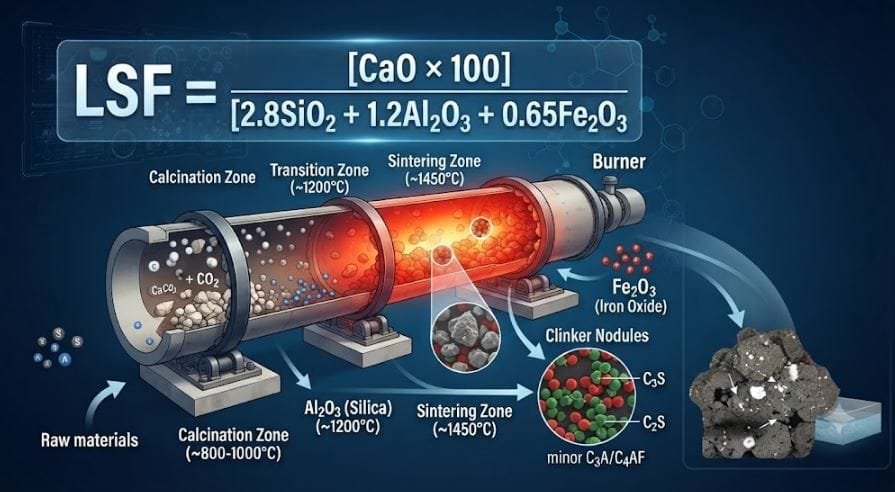
It is the ratio of the available lime (CaO) to the maximum amount of lime required to react with the main acidic oxides in clinker. It is also called the lime standard in some cement plants. In simple terms, it shows whether enough CaO is available to form the main clinker compounds without leaving excess free lime. When limestone is heated, it decomposes into calcium oxide (CaO) and carbon dioxide (CO₂).
CaCO3 → CaO + CO2
This produces CaO that combines with the silica, alumina and iron oxide to form the major clinker phases C2S, C3S, C3A and C4AF. As CaO is a large constituent of the clinker, it is vital to carefully control the chemical balance.
Standard LSF Formula
The most commonly used lime saturation factor formula is:
LSF = [CaO × 100] / [2.8SiO2 + 1.2Al2O3 + 0.65Fe2O3]
Where:
- CaO is calcium oxide, or lime.
- SiO2 is silica.
- Al2O3 is alumina.
- Fe2O3 is iron oxide.
LSF may be expressed either as a decimal, such as 0.96, or as a percentage, such as 96. These describe the same chemical relationship.
How to interpret the formula
The numerator is the CaO present in the raw mix or clinker chemistry. The denominator estimates how much CaO can combine with SiO2, Al2O3, and Fe2O3. A higher LSF usually means more lime is present relative to those oxides. A lower LSF means the lime proportion is lower. This is why LSF must never be evaluated alone. The same CaO level can produce different LSF values when silica, alumina, or iron oxide changes.
Why LSF Matters in Clinker Production
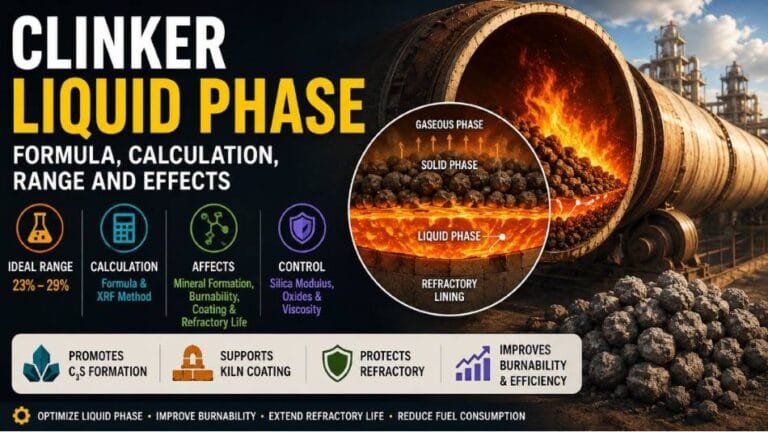
Clinker formation depends on solid-state and liquid-assisted reactions in the kiln. A suitable balance among CaO, silica, alumina, and iron oxide makes these reactions more achievable at normal burning-zone conditions. Alumina and iron oxide help generate a liquid phase that supports diffusion and reaction between particles. Their presence reduces the temperature required for effective clinker formation compared with a system dominated by solid-state reaction alone.
LSF is therefore closely connected to:
- Burnability of the raw mix
- Free lime control in clinker
- Fuel consumption and thermal load
- Kiln coating stability
- Refractory and kiln shell conditions
- C3S and C2S balance
- Cement soundness, setting, and strength

Typical Lime Saturation Factor Range
A commonly used overall LSF range is 0.88 to 1.02, or 88 to 102 when expressed as a percentage. Actual operating targets should be established using plant-specific raw materials, kiln behaviour, clinker quality requirements, free lime results, and the other raw mix control ratios. Many operations aim below unity rather than attempting to run near the upper limit. It is important not to treat the published range as a universal set point. An LSF that is acceptable on paper can still create kiln or quality problems if silica modulus, alumina modulus, fineness, fuel conditions, and raw meal homogeneity are not under control.
What Happens When LSF Is Too High?
A high LSF means CaO is high in relation to the available silica, alumina, and iron oxide. The kiln must then supply more heat and favourable reaction conditions to combine the additional lime.

Operational effects of high LSF
- Harder burning: The raw mix becomes more difficult to combine completely.
- Higher fuel requirement: More thermal input may be needed to achieve adequate clinker formation.
- Higher free lime risk: Excess or insufficiently combined CaO can remain in clinker.
- Higher kiln outlet temperature and shell radiation: Thermal stress on the kiln system can increase.
- Disturbed coating formation: Unstable coating can expose refractory lining to harsher conditions.
- Refractory deterioration: Difficult burning and unstable coating can contribute to lining damage.
Effect on clinker minerals and cement
Increasing LSF tends to increase C3S and reduce C2S when clinker formation is completed successfully. Higher C3S can improve clinker grindability and support higher cement strength. However, this is not an argument for maximizing LSF. If free lime rises too far, cement can become unsound. Unsound cement may show excessive expansion and a greater risk of cracking after use. High LSF can also be associated with slower setting while producing higher strength, especially when the clinker chemistry shifts toward higher alite content. The desired outcome is controlled strength improvement without sacrificing soundness or stable kiln operation.
What Happens When LSF Is Too Low?
Low LSF means the lime content is relatively low compared with silica, alumina, and iron oxide. This generally makes the mix easier to burn because less CaO must be combined.
Benefits and limitations of low LSF
- Easier burning: The reaction is generally easier to complete.
- Lower fuel demand: Less heat may be needed for lime combination.
- Lower free lime tendency: There is less excess CaO available to remain uncombined.
- Potentially easier coating formation: Kiln conditions may become more favourable for coating.
- Lower cement strength risk: If lime is too low, the clinker may not develop the desired strength potential.
Low-grade limestone can reduce the available lime in the mix. If this is not corrected through raw mix design, the final cement may fail to reach the intended strength level. The aim is not simply easy burning. The aim is a chemically balanced clinker that can be burned efficiently and produce consistent cement quality.
LSF and the Main Clinker Phases
LSF is especially useful because it links raw mix chemistry with the expected clinker mineral balance.
- C3S, Alite: Generally increases as LSF rises within a properly burned clinker system. It is associated with strength development and improved clinker grindability.
- C2S, Belite: Tends to decrease as LSF increases.
- Free lime: Can increase if LSF is too high for the available burning conditions, fineness, and chemical balance.
- C3A and C4AF: Depend strongly on alumina and iron oxide, which also influence liquid-phase formation and burnability.
For this reason, an LSF adjustment should be assessed alongside free lime, clinker microscopy or mineral analysis where available, kiln thermal behaviour, and cement test results.
Alternative LSF and Lime Standard Equations
The standard LSF formula is the most widely used basis for raw mix design. However, some plants and technical references use modified equations to account for specific chemical conditions.
Modified lime standard with MgO consideration
One modified approach includes MgO in the numerator and uses a slightly different alumina coefficient:
Improved lime standard = [100(CaO + 0.75MgO)] / [2.8SiO2 + 1.18Al2O3 + 0.65Fe2O3]
This type of adjustment may be used when MgO is relevant to the plant’s chemistry and control practice. Formula selection should follow the plant laboratory standard and the intended interpretation of the result.
Alumina modulus dependent formulas
Some references also use different alumina and iron oxide coefficients according to the alumina modulus, which is calculated as:
Alumina Modulus = Al2O3 / Fe2O3
These variants can be useful in specialised calculations, but they should not be mixed casually with the standard LSF equation. Changing the formula changes the numeric result and may make historical trends incomparable.
How to Use LSF for Raw Mix Control
LSF becomes useful only when it is used as part of a disciplined quality-control routine.
- Use representative samples. Raw material variation can shift CaO and other oxide levels quickly.
- Calculate LSF from consistent chemical analysis. Use the same reporting basis and approved formula for all comparisons.
- Review silica modulus and alumina modulus. These ratios influence liquid phase, coating behaviour, and burnability.
- Track clinker free lime. A high LSF with rising free lime indicates that lime combination is becoming inadequate.
- Check process indicators. Fuel rate, kiln outlet temperature, shell radiation, coating condition, and refractory performance all matter.
- Confirm final cement properties. Assess soundness, setting behaviour, grindability, and compressive strength.
Daily monitoring is important because a stable average LSF does not guarantee stable kiln feed. Variation in limestone chemistry and raw meal composition can create short-term burning problems even when the average result appears acceptable.
LSF, Silica Modulus, and Alumina Modulus Work Together
LSF is not a standalone measure of clinker quality. Two other common chemical control ratios are silica modulus and alumina modulus.
Silica modulus
Silica Modulus, SM = SiO2 / (Al2O3 + Fe2O3)
A typical silica modulus range is 2.1 to 2.7. It provides an indirect indication of the balance between solid constituents and the liquid phase. A lower SM can favour easier burning, more liquid phase, and thicker coating. A higher SM can reduce liquid phase, make coating difficult, and increase thermal load.
Alumina modulus
Alumina Modulus, AM = Al2O3 / Fe2O3
A typical alumina modulus range is 1.0 to 1.7. Alumina and iron oxide influence the liquid phase that helps reactions proceed in the burning zone.
The practical lesson is straightforward: an LSF correction can alter SM and AM. Any raw material adjustment should be evaluated across all relevant chemical modules rather than optimizing one ratio in isolation.
Common LSF Control Mistakes
- Chasing a high LSF for strength alone: Higher potential C3S does not help if free lime and unsoundness increase.
- Ignoring raw material variation: Limestone consistency has a direct effect on CaO control and LSF stability.
- Comparing values calculated with different equations: Standard and modified lime-standard formulas should not be treated as interchangeable.
- Using LSF without free lime data: Free lime is a key confirmation of whether burning is adequate.
- Ignoring kiln conditions: A chemically suitable mix can still burn poorly with inadequate fineness, poor homogenisation, or unstable thermal conditions.
- Adjusting CaO without checking SM and AM: This can create liquid-phase and coating problems elsewhere in the process.
Key Takeaway
Lime Saturation Factor is a central clinker chemistry control parameter because it balances the available CaO against the lime required by silica, alumina, and iron oxide. A controlled LSF supports clinker formation, manageable fuel consumption, stable kiln operation, low free lime, sound cement, and reliable strength. The best operating value is not automatically the highest value in the typical range. It is the value that works with the plant’s limestone quality, silica modulus, alumina modulus, burning conditions, and required cement performance.
Frequently Asked Questions About Lime Saturation Factor
What is the full form of LSF in cement?
LSF stands for Lime Saturation Factor. It is a clinker chemistry ratio used in raw mix design and cement quality control.
What is the standard LSF formula?
The standard formula is LSF = [CaO × 100] / [2.8SiO2 + 1.2Al2O3 + 0.65Fe2O3].
What does an LSF of 0.96 mean?
An LSF of 0.96 is equivalent to 96. It means the effective lime is 96 percent of the calculated maximum lime that can combine with the main acidic oxides under the formula.
Why does high LSF increase free lime?
Higher LSF raises CaO relative to the oxides that combine with it. If kiln conditions are not sufficient for complete reaction, uncombined CaO remains as free lime.
Can LSF be controlled without silica modulus and alumina modulus?
No. LSF should be interpreted with silica modulus and alumina modulus because these ratios affect liquid phase, burnability, clinker formation, and kiln coating behaviour.
Reference
YouTube — Watch the referenced video


2 thoughts on “Lime Saturation Factor in Cement: LSF Formula, Range, and Effects on Clinker”