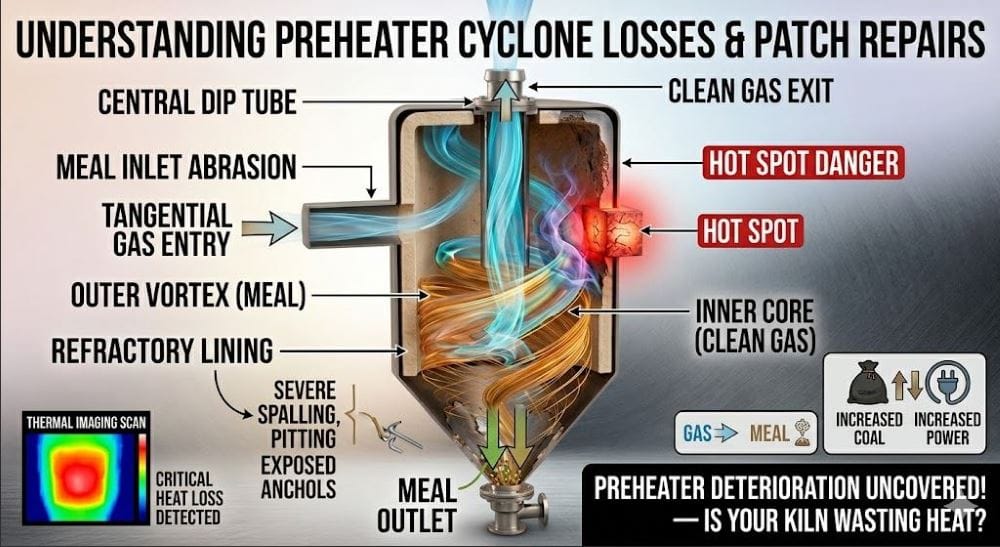
Detailed process explanation of preheater hot spots, cyclone wear, false air, SHC increase and ID fan power rise.
Table of Contents
1. What is a stone box in a cement plant preheater ?
When refractory inside a preheater cyclone or duct starts failing, the steel shell gradually becomes exposed to hot process gases. Under normal conditions, the refractory lining acts as a thermal barrier. Its job is to protect the shell from extreme temperatures and keep heat inside the process where it can be transferred efficiently to the raw meal but once the refractory becomes thin, cracked, detached or completely worn out in certain areas, the shell temperature starts rising rapidly.
This is the stage where plants usually install a “stone box.”
A stone box is basically a steel patch box welded onto the outer surface of the cyclone or duct shell at the hot spot location. The box is then filled with castable or insulating material to provide temporary external thermal protection and reduce the shell temperature. the purpose of a stone box is not to permanently solve the problem. Its main purpose is to avoid an emergency shutdown,prevent shell failure and allow kiln operation to continue until a major shutdown can be planned.
This becomes critical because lower-stage preheater cyclones often operate at gas temperatures of 800–900°C. At these temperatures, an exposed steel shell does not simply become hot, it starts losing mechanical strength. Initially the shell may appear red hot, but over time the steel begins to deform, warp and weaken structurally. If the condition continues, the shell can eventually crack or fail.
That is why hot spots cannot be ignored. however, the real concern is not the stone box itself. the real concern is the internal deterioration that already exists inside the cyclone.
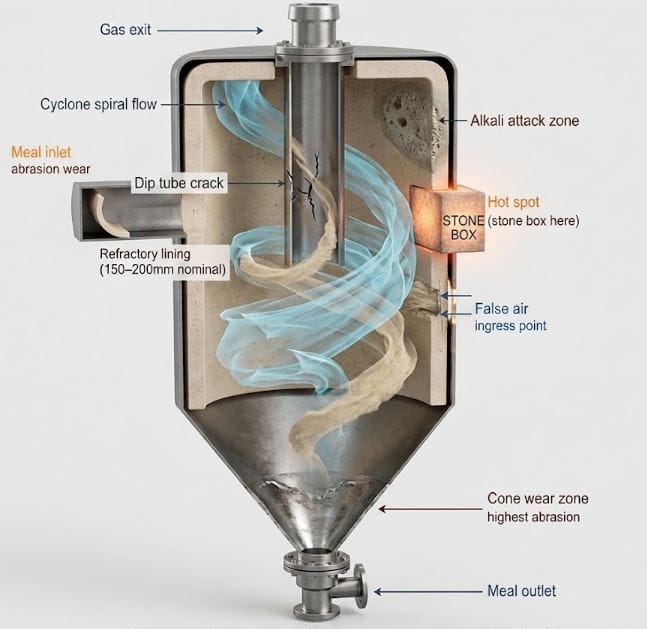
When the same cyclone starts requiring repeated stone box repairs within a short period, it usually indicates that the refractory failure is no longer a localized issue. The internal lining is progressively deteriorating across different areas such as the cyclone cone, Riser Duct, inlet zone, dip tube regionor high-impact gas flow areas. And this is where the hidden process losses begin.
Cyclone performance depends heavily on its internal geometry. Gas and meal inside the cyclone follow a specific flow pattern designed to create stable centrifugal separation. But when refractory becomes uneven, partially collapses or distorts the internal profile, the gas flow pattern is disturbed.
As a result turbulence increases, meal separation efficiency drops, fine particles remain suspended in the gas stream and heat exchange efficiency gradually decreases. This deterioration is usually not immediately visible in the control room. The kiln may still appear to run normally. Production may remain close to target. That is why many plants underestimate the seriousness of repeated hot spots and stone box repairs.
2. What are the main causes of hot spots on a cement kiln preheater cyclone shell?
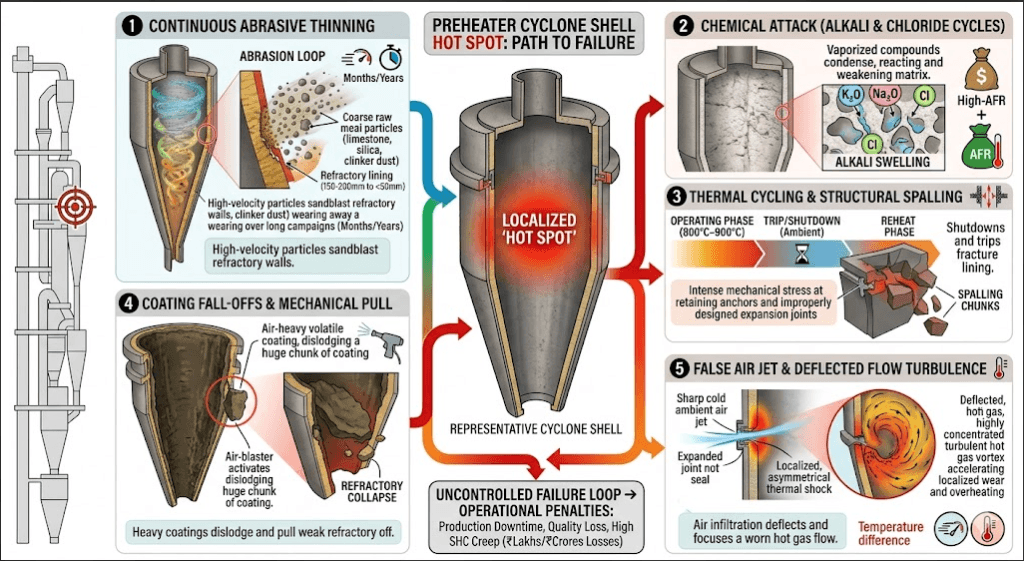
Hot spots in preheater cyclones usually do not develop overnight. In most cases, the shell temperature alarm is only the final visible symptom of a deterioration process that has already been developing internally for weeks or even months. By the time a hot spot becomes visible from outside, the refractory lining inside the cyclone has often already lost a significant portion of its strength, thickness or structural stability.
The important thing to understand is that refractory failure inside a cyclone is rarely caused by a single issue. Normally, several damaging mechanisms work together at the same time, gradually weakening the lining until the shell starts absorbing excessive heat.
Refractory Thinning Due to Abrasion
One of the most common causes of cyclone hot spots is continuous abrasive wear. Inside the preheater, raw meal particles are not moving slowly or gently. The gas stream entering the cyclone carries fine limestone, silica particles, clinker dust and partially calcined material at very high velocity.
In cyclone inlet ducts and vortex regions, gas velocity can reach around 15–25 m/s. At these speeds, the solid particles continuously strike the refractory surface like sandblasting media. This wear becomes especially severe at inlet bends, meal entry points, cone sections and areas where gas direction changes rapidly. Over time, the refractory lining gradually becomes thinner.
For example, a lining originally installed at 150–200 mm thickness may reduce to less than 50 mm in high-abrasion zones after long operation. The dangerous part is that this thinning usually happens internally without obvious external signs. From outside, the shell may still look normal until the remaining refractory suddenly becomes too thin to protect the shell from process heat.
Once that happens, shell temperature starts rising quickly and a hot spot develops.
How does alkali and chloride attack damage the refractory lining of upper-stage cyclones?
Abrasion is not the only problem. Chemical attack also plays a major role, especially in upper-stage cyclones. When the kiln system operates with high-alkali limestone, alternative fuels or elevated chloride circulation, volatile compounds like potassium oxide (K₂O), sodium oxide (Na₂O) and chlorides start circulating inside the preheater gases. As these gases move upward into cooler cyclone stages, the alkalis and chlorides begin condensing onto the refractory surface.
The problem is that these compounds slowly penetrate inside the refractory structure itself. This causes what is commonly known as alkali attack.
Externally, the refractory may still appear hard because the hot face develops a dense crystalline layer. But internally, the structure underneath becomes weak, brittle and friable. In simple terms, the lining may look solid from outside while internally it has already lost much of its strength.
This becomes dangerous during coating fall-offs or kiln upsets. when thick coating suddenly detaches from the cyclone wall due to draft fluctuations or thermal shock, it can pull weakened refractory sections along with it. Large chunks of lining may break away together, exposing the shell almost instantly. That is why some hot spots appear suddenly even though the deterioration process had actually been developing slowly for months.
What causes thermal spalling in cement plant preheater refractory?
Another major cause of refractory failure is repeated thermal cycling. Every kiln shutdown and restart creates thermal stress on the lining. When the cyclone goes from operating temperature to ambient temperature and then back again, the refractory expands and contracts repeatedly. If anchor design is poor, expansion allowance is insufficient or castable curing during installation was improper, the lining cannot absorb this repeated thermal movement properly.
As a result, cracks begin forming inside the refractory. Eventually small surface pieces start breaking away, this process known as spalling. This type of damage is especially common in meal inlet zones, cyclone cone bottoms and transition areas.
These locations already experience heavy mechanical impact from raw meal flow, so thermal stress and mechanical stress combine together, accelerating deterioration. The damage may initially look minor, but once cracks open, hot gases penetrate deeper behind the lining and the failure rate increases rapidly.
Dip Tube Damage
The dip tube is one of the most critical internal components inside a cyclone. Its job is to guide cleaned gas out of the cyclone while maintaining stable separation between gas and meal particles. But the dip tube operates under constant thermal stress, vibration, abrasive wear and gas turbulence.
Over time, refractory on the dip tube may crack, anchors may weaken or the tube itself may distort slightly. Even a relatively small deviation in dip tube position or length sometimes only 30-40 mm can significantly disturb the cyclone’s internal flow pattern.
This happens because cyclone separation depends heavily on stable vortex formation. Once dip tube geometry changes turbulence increases, gas short-circuiting may occur and fine meal particles begin bypassing the normal separation path. As separation efficiency drops, more dust remains suspended in the gas stream instead of being collected properly.
This not only affects cyclone efficiency but also increases dust circulation, pressure instability and thermal inefficiency throughout the preheater system.
How does false air create gas turbulence inside a suspension preheater?
False air is another major contributor to localized hot spots and refractory deterioration. False air commonly enters through leaking expansion joints, worn flanges, damaged sealing plates or improperly sealed inspection doors. The important point is that false air does not enter the system uniformly, it enters as a concentrated cold air jet.
When this cold air suddenly mixes with hot process gas inside the cyclone, localized temperature imbalance develops. Near the entry point, the refractory surface experiences sudden cooling, which increases thermal stress and cracking tendency. At the same time, on the opposite side of the cyclone, the remaining hot gas flow becomes more concentrated. This creates localized overheating in specific shell regions.
That is why many cyclone hot spots appear asymmetrical one side of the cyclone becomes significantly hotter than the other. Over long operation, these localized thermal imbalances gradually weaken the refractory structure and create ideal conditions for hot spot formation.
Why Most Damage Remains Hidden for Months ?
One of the biggest challenges with preheater refractory deterioration is that most of the damage develops internally long before operators can visually detect it from outside. The cyclone may continue operating normally while refractory thickness keeps reducing, alkali penetration increases, dip tube geometry slowly changes and internal turbulence gradually worsens.
Only when shell temperature finally rises beyond safe limits does the issue become externally visible. by that stage, the internal deterioration is usually already advanced. that is why a hot spot should never be treated as an isolated surface issue. In most cases, it is the final visible symptom of a much deeper internal process deterioration already affecting cyclone efficiency, thermal performance, and overall kiln stability.
3. How Stone Box Formation Changes Cyclone Internal Conditions ?
To understand why repeated stone box repairs become a serious process issue, it is important to first understand how a cyclone actually works. A preheater cyclone separates raw meal from hot gas using centrifugal force. The gas-meal mixture enters the cyclone tangentially at high velocity and starts rotating rapidly inside the cyclone body. As this vortex forms heavier meal particles move outward toward the cyclone wall, then spiral downward through the cone and finally exit from the bottom meal outlet. meanwhile, the cleaned gas reverses direction and exits upward through the dip tube.
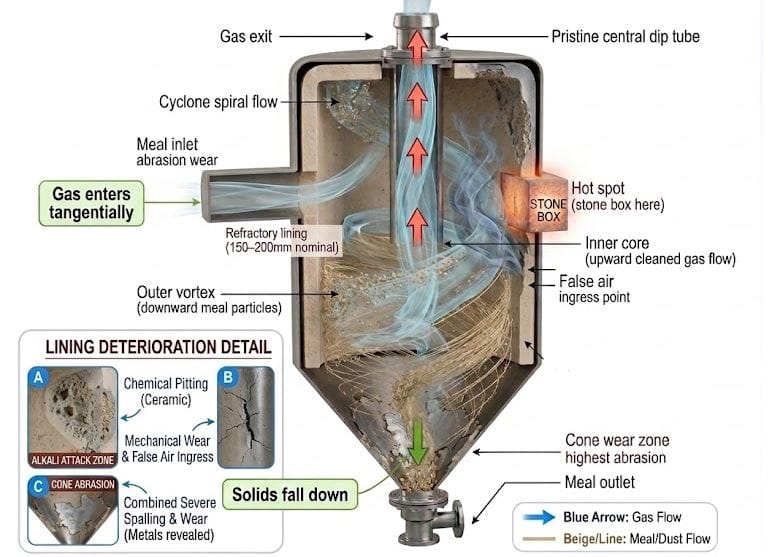
This entire separation process depends heavily on maintaining smooth internal surfaces, stable vortex formation, correct cone geometry and controlled gas flow patterns.
A cyclone is not simply an empty vessel. Its internal dimensions and profiles are carefully designed to maintain stable aerodynamic behavior. That is why refractory deterioration becomes much more than a maintenance issue. Once the internal geometry changes, cyclone efficiency immediately starts deteriorating.
Irregular Internal Surface
When refractory starts failing inside the cyclone, the internal surface no longer remains smooth. Different types of internal irregularities begin developing fallen refractory sections, exposed anchor projections, uneven castable thickness, alkali-swollen refractory and localized wear pockets. These surface defects disturb the smooth rotating gas layer that normally drives efficient separation.
Under healthy conditions, the vortex near the cyclone wall remains relatively stable, allowing meal particles to travel downward in a controlled spiral path. but when the surface becomes rough and uneven turbulence intensity increases, vortex stability weakens and localized eddies begin forming inside the cyclone.
This creates a very important effect – fine meal particles that were supposed to remain near the wall and move downward start getting pulled back into the central gas stream. This process is called re-entrainment.
Instead of separating properly, part of the meal starts travelling upward with the gas through the dip tube. So even though the cyclone may still appear operational externally, its actual separation efficiency is already declining internally.
Changed Cone Geometry
The cyclone cone is one of the most critical parts of the entire separation system. Its shape controls how separated meal particles move downward and exit from the cyclone. In a healthy cyclone, particles spiral smoothly along the cone wall and discharge through the meal outlet without excessive disturbance. but when the cone becomes worn, refractory collapses unevenly, coating develops irregularly or the cone profile distorts, the descending meal flow becomes unstable.
Instead of following a controlled spiral path, some particles begin bouncing back into the upward-moving gas stream. This directly increases meal bypass into the gas outlet and creates one of the most damaging hidden process loops inside the preheater.
The Dust Recirculation Loop
Once cyclone separation efficiency drops, more fine particles remain suspended in the gas stream and travel upward to the next cyclone stage. This increases internal dust circulation throughout the preheater system and higher dust circulation creates several additional problems simultaneously cyclone loading increases, coating tendency increases, pressure drop rises, gas flow resistance increases and heat exchange efficiency declines.
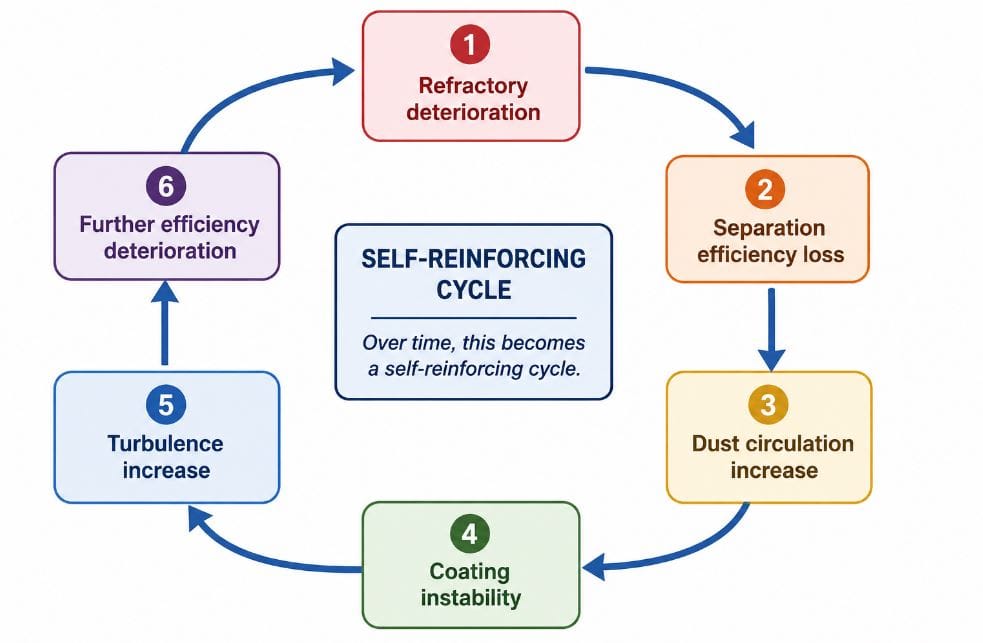
This is one of the main reasons why badly deteriorated preheaters often show simultaneous increases in SHC, SPC, build-up frequency and process instability.
Pressure Drop Instability
A healthy cyclone operating near design condition usually shows a relatively stable pressure drop. Depending on stage and design, this may typically remain around 400–800 Pa with only small fluctuations during stable kiln operation. But when internal geometry starts changing continuously due to coating build-up, coating fall-off, refractory collapse or cone distortion, the effective gas flow path inside the cyclone keeps changing.As a result, the pressure drop across the cyclone becomes unstable.
Operators may notice 600 Pa during one shift, 850–900 Pa during another, even though kiln feed and fan speed remain almost unchanged. This instability is a very important operational indicator because pressure drop in a cyclone is directly related to gas velocity,solids loading and internal flow resistance.
When those conditions become unstable without major process changes, it usually indicates that the cyclone’s internal condition is deteriorating.
What Operators Actually Observe
In many plants, the earliest warning signs are not visible hot spots, they are unstable process trends. Operators may start noticing erratic cyclone pressure fluctuations, increasing build-up frequency, unstable kiln draft, rising fan amps or abnormal exit gas temperature behavior.
One particularly important sign is repeated pressure fluctuation beyond normal variation. If cyclone pressure drop repeatedly swings by more than around ±150 Pa without corresponding changes in kiln feed, fan speed or fuel rate, it often indicates unstable coating behavior, refractory collapse or changing internal cyclone geometry.
At this stage, a thermal scan or detailed shutdown inspection becomes important before the deterioration progresses into a severe hot spot or major process instability.
Why Cyclone Internal Geometry Matters So Much ?
The key point is that cyclone efficiency is not controlled only by temperature or gas volume. It is controlled by stable internal aerodynamics. Even relatively small internal changes such as rough surfaces, cone distortion, dip tube deviation or localized refractory failure can disturb vortex behavior enough to reduce separation efficiency significantly.
And once separation efficiency starts declining, the entire preheater system gradually becomes thermally less efficient, electrically more demanding and operationally more unstable. That is why stone boxes should never be viewed only as external shell repairs. In most cases, they are visible evidence that the cyclone’s internal flow dynamics have already started deteriorating.
4. How does refractory failure inside a preheater cyclone lead to a high Specific Heat Consumption (SHC)?
Specific Heat Consumption (SHC) is one of the most important indicators of kiln thermal efficiency. It tells us how much heat energy is required to produce one kilogram of clinker. In a healthy and well-maintained 6-stage preheater kiln, SHC typically remains around 700–750 kcal/kg clinker depending on kiln design, fuel quality, raw mix properties, AFR usage and operating stability.
But when the preheater starts deteriorating internally, SHC usually does not increase suddenly. That is what makes the problem dangerous. Instead of a sharp jump, the increase happens gradually 5 kcal/kg increase, then another 8 kcal/kg, then slightly higher coal feed, slightly higher calciner firing, slightly higher exit temperature.
Because the kiln continues running, operators often compensate unconsciously by adjusting fuel flow. Over time, the plant slowly accepts a higher SHC as “normal operation,” while the real problem is declining preheater efficiency that keeps worsening internally. The core issue is simple – The preheater is no longer recovering heat from the kiln gases as efficiently as it was designed to.
Recommended Reading: For practical insights into kiln optimization, heat balance calculation, thermal efficiency improvement, and reducing heat losses in cement plants, read this detailed guide on Amazon Kindle.
Heat Loss Through Damaged Shell
The first direct SHC loss comes from heat escaping through damaged refractory and overheated shell surfaces. The primary purpose of refractory inside a cyclone is not only to protect the shell mechanically, but also to keep thermal energy inside the process. Ideally, most of the heat carried by kiln gases should transfer into the raw meal during suspension preheating not escape into the atmosphere through the cyclone shell.
In a healthy preheater shell temperatures usually remain below around 100–120°C, indicating that refractory insulation is functioning properly. But once refractory becomes thin or locally fails, heat transfer to the steel shell increases sharply, shell temperature rises and thermal radiation losses increase significantly.
When a stone box is installed, it may reduce the immediate hot spot severity, but it is still only a temporary external barrier will not a fully restored engineered refractory system. As a result, areas around stone boxes often continue operating at 180–250°C shell temperature or even higher in severe cases.
Why Exit Gas Temperature Starts Increasing
One of the clearest signs of declining preheater thermal efficiency is increasing preheater exit gas temperature. In a typical 6-stage preheater, Stage 1 exit gas temperature generally remains around 250 –300°C under stable operation. If this temperature begins trending upward consistently, it often means the preheater is no longer transferring heat efficiently to the meal. The reason is strongly connected to cyclone separation efficiency.
When cyclone geometry deteriorates, more fine particles bypass separation, more meal remains suspended in the gas stream and less efficient heat exchange takes place inside the cyclone stages. Under normal conditions, meal particles absorb heat from the gas and then separate efficiently from the gas stream. But when separation becomes unstable, hot fine particles continue travelling upward with the gas, excess dust remains suspended and thermal energy leaves the preheater without being properly recovered.
So the exit gas now carries higher temperature, higher dust loading and higher unused thermal energy. This directly increases SHC because the kiln must burn additional fuel to compensate for the unrecovered heat loss.
How Cyclone Deterioration Affects Calcination,?
Lower-stage cyclones, especially Stage 4 and Stage 5, are extremely important for calciner performance. their job is to ensure that the meal entering the calciner is properly preheated, uniformly distributed and already partially calcined. But when lower-stage cyclone efficiency drops due to cone wear, dip tube damage, refractory collapse or unstable gas flow, the meal reaching the calciner becomes cooler than intended. This creates lower calcination efficiency.
In simple terms: the calciner now has to do extra work because the preheater failed to transfer enough heat earlier. To maintain kiln stability and clinker quality, operators usually respond by increasing calciner fuel firing. Initially this may appear to solve the problem but actually it creates another thermal imbalance.
Higher calciner firing means:
- higher calciner outlet temperature,
- hotter riser duct gases,
- higher thermal load on upper cyclones,
- and increased refractory stress throughout the preheater.
So the system enters a self-reinforcing inefficiency loop – deteriorated cyclone efficiency causes higher fuel demand and the higher thermal load further accelerates refractory deterioration.
How does refractory failure inside a preheater cyclone lead to a high Specific Heat Consumption (SHC)?
False air is one of the most underestimated contributors to high SHC. Any false air entering the preheater system through leaking joints, damaged seals, stone box cracks or inspection doors, must still be heated from ambient temperature to process temperature before exiting through the raw mill fan or stack. That heating consumes energy.
The important point is false air contributes nothing useful to clinker production. It only acts as extra thermal load on the kiln system. For example if ambient air at around 35°C enters the upper preheater and leaves at 300°C, the process has spent heat energy simply warming useless infiltrated air.
In severely deteriorated preheaters with multiple hot spots and poor sealing conditions, false air infiltration in upper stages can sometimes reach 15–25% of total gas volume. At those levels, the thermal penalty becomes very significant.
In many cases, false air alone can increase SHC by 20–40 kcal/kg clinker, depending on kiln size and operating conditions. And because false air also increases total gas volume, it simultaneously affects ID fan load, pressure drop and SPC as well.
Why does SHC increase gradually instead of a sudden spike?
One reason plants often miss preheater deterioration is because SHC degradation usually happens slowly. The sequence typically looks like this:
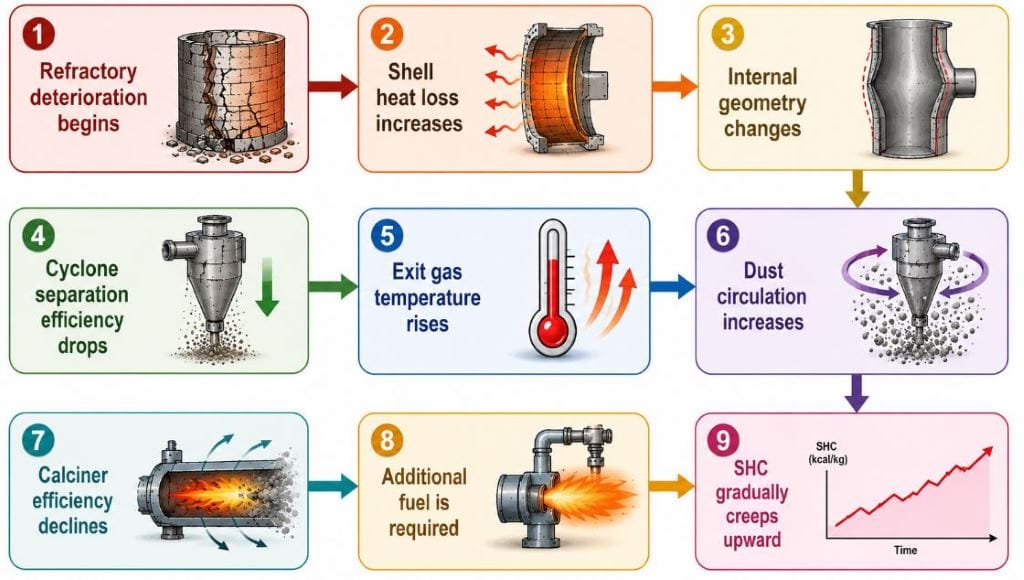
In many cases, each deteriorated cyclone stage may silently add around 5–8 kcal/kg clinker, or even more under severe conditions. Individually these numbers may not appear alarming. But across multiple cyclone stages, the cumulative impact becomes very large. That is why plants with heavily deteriorated preheaters often operate 15–60 kcal/kg above design SHC, even while production still appears relatively normal.
And by the time the issue becomes obvious through severe hot spots or unstable kiln operation, the preheater has usually already been losing thermal efficiency for a long time.
5. Why is my preheater ID fan power consumption (amps) continuously rising without an increase in kiln feed?
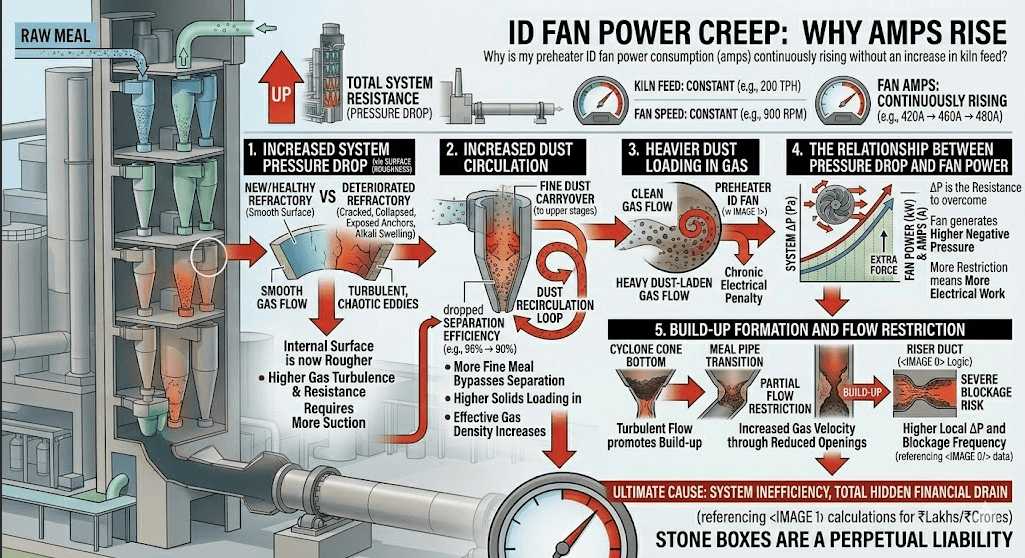
Specific Power Consumption (SPC) represents the amount of electrical energy required to produce one tonne of clinker. In a preheater kiln system, the largest electrical load is usually the preheater fan, commonly called the ID fan. This fan continuously pulls hot process gases through the kiln, calciner, cyclones, ducts, conditioning tower and gas cleaning system.
In simple terms, the ID fan is responsible for overcoming the total resistance of the entire pyroprocess gas circuit. That means the harder it becomes for gas to move through the system, the more electrical power the fan consumes. And this is exactly where deteriorated cyclones and repeated stone box conditions begin affecting SPC.
Increased System Pressure Drop
A healthy preheater system is designed with relatively smooth internal gas flow paths and predictable pressure losses across each cyclone stage. But once refractory deterioration begins, the internal flow conditions start changing. The first problem comes from surface roughness. When refractory have cracks, collapses, becomes uneven or exposes anchors, the internal cyclone surface becomes rougher and more turbulent.
Gas can no longer move smoothly through the cyclone. Flow resistance increases and the fan must generate higher suction to maintain the required kiln draft. But the more serious issue is usually increased dust circulation.
Why Dust Circulation Increases Fan Load ?
When cyclone separation efficiency drops, more fine meal particles remain suspended in the gas stream instead of separating properly. This means the gas flowing through the preheater now carries higher solid loading, more suspended dust and greater internal turbulence.
A gas stream carrying heavy dust loading behaves differently from clean gas flow. The effective density, resistance and flow instability all increase. As a result, the ID fan has to work harder to move the same gas volume through the system. In practical plant operation, this usually appears as slowly increasing fan amperage, rising fan power consumption and higher overall SPC.
For example: an ID fan operating normally at around 420 A may gradually rise to 460 A, 470 A or even 480 A without any major increase in kiln production. This increase often develops slowly over weeks, which is why many plants initially overlook it. But electrically, this becomes a major continuous penalty because the fan operates 24 hours per day, every day, under heavy load. Even a 10–15% increase in fan load creates a very large yearly power cost.
The Relationship Between Pressure Drop and Fan Power ?
The ID fan power requirement is directly linked to gas flow volume, system resistance and total pressure drop. As the preheater deteriorates coating build-up increases, cyclone geometry changes and gas flow paths become more restrictive. This increases total pressure drop across the system.
The fan must then create higher negative pressure to maintain stable kiln draft. In simple terms – more restriction means more electrical work. That is why badly deteriorated preheaters often show rising cyclone ΔP, unstable draft behavior and increasing ID fan current simultaneously.
Build-Up Formation and Flow Restriction
Deteriorated cyclones also create ideal conditions for build-up formation. When separation efficiency drops, dust circulation increases, gas flow becomes turbulent and temperature distribution becomes unstable, fine dust starts sticking more aggressively inside cyclone cones, meal pipes, riser ducts and inlet areas. Over time, thick coating and build-up layers form.
Initially these may only partially restrict gas flow. But as buildup thickness increases gas velocity rises through reduced openings, local pressure drop increases, turbulence worsens and blockage risk becomes much higher.
This creates another vicious cycle: build-up increases pressure drop and higher pressure drop further destabilizes gas flow. Eventually operators may need more frequent air blaster operation, manual poking or emergency clearing actions. All of these increase operational instability and indirectly increase electrical consumption as well.
6. Why is a hot spot or refractory failure in the lower-stage cyclones (Stage 4 & 5) considered critical?
Not all hot spots and stone boxes are equal. Their impact depends heavily on where they occur in the preheater tower.
| Location | Primary Risk | SHC Impact | Severity |
|---|---|---|---|
| Lower stage cyclones (St. 4–5) | Cone wear, meal bypass into calciner | High, meal enters calciner under-preheated | Critical |
| Riser duct (kiln-to-calciner) | Build-up, blockage, refractory collapse | Severe, kiln draft instability | Critical |
| Cyclone cone bottom | Abrasive wear, coating falloff | High, separation efficiency loss | Critical |
| Dip tube region | Geometry change, turbulence increase | Medium-High, bypassed meal in gas | High |
| Tertiary air duct (TAD) | Coating buildup, clinker dust erosion | Medium, affects O₂ to calciner | High |
| Top stage cyclones (St. 1–2) | Alkali condensation, coating | Medium, exit gas temp increase | High |
| Meal inlet area | Abrasion by raw meal particles | Low-Medium, inlet duct geometry change | Medium |
| Gas outlet area | Shell distortion, false air | Low-Medium, false air increase | Medium |
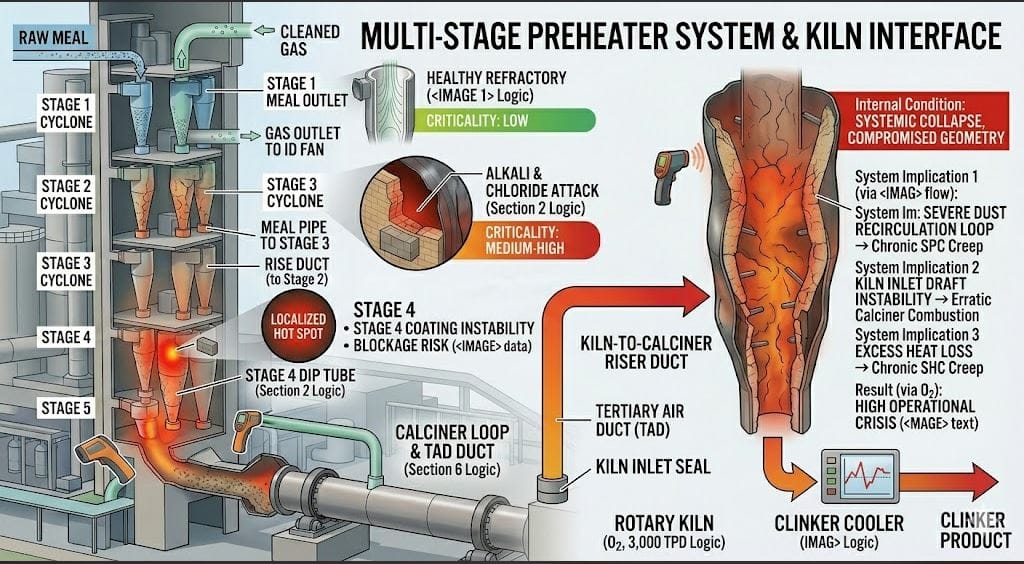
The riser duct deserves special mention. A blockage or partial collapse in the riser duct creates an immediate and severe kiln draft disturbance. the kiln operator sees kiln inlet draught drop sharply, kiln feed backing up and kiln outlet O₂ spiking or crashing. This is not a slow thermal loss like a deteriorated upper stage cyclone, it is an acute operational crisis. Any stone box or repeated hot spot on a riser duct is a warning that must be acted on at the next planned shutdown without fail.
7. What is the hidden financial impact of operating a cement kiln with multiple temporary stone boxes?
This is the stage where preheater deterioration becomes dangerous not because of a single failure, but because the losses slowly become “normal” for the plant. That is why multiple stone boxes often catch management by surprise. From outside, everything may still appear acceptable clinker production is continuing, kiln is still running, major alarms are not active and the line has not stopped. So operationally, the situation feels manageable.
But internally, the system is already operating far below its original efficiency. The plant is now burning more coal, consuming more electrical power, increasing refractory stress, creating more build-up and slowly accumulating maintenance problems that eventually lead to unstable operation or forced shutdowns. The dangerous part is that these losses rarely appear as one dramatic event. Instead, they develop gradually and silently across the entire preheater system.
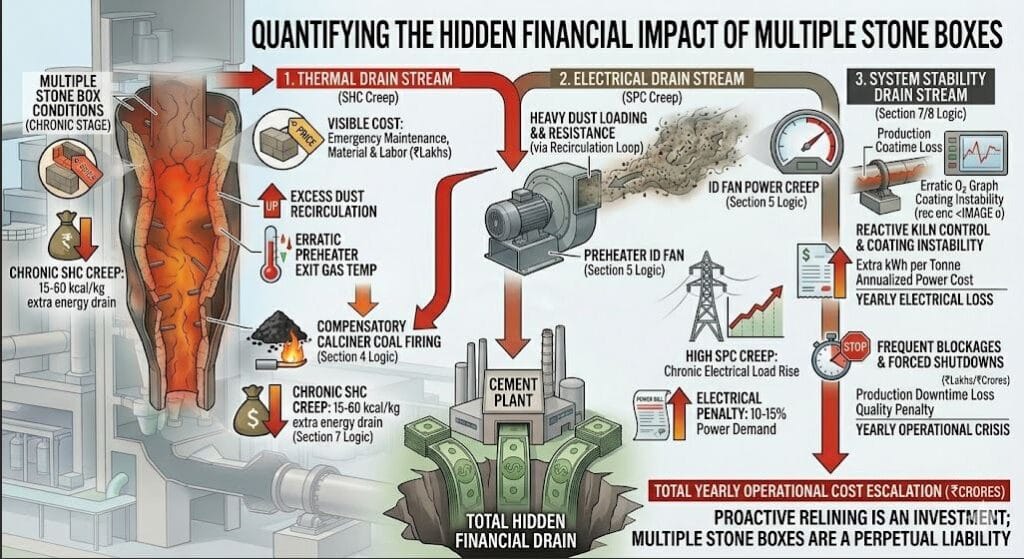
Financial optimization of cement pyroprocesses – balancing shutdown costs vs. chronic SHC losses.
One of the clearest long-term effects of repeated stone box conditions is gradual SHC increase. This usually does not happen suddenly. Instead, the pattern looks like this:
- slightly higher coal feed,
- slightly higher calciner firing,
- slightly higher exit gas temperature,
- slightly higher fan load.
Individually, each parameter change may look small enough to ignore. But together, they indicate that the preheater is slowly losing thermal efficiency. In many plants, each significantly deteriorated cyclone stage may add approximately 3–8 kcal/kg clinker to the total SHC. That means a 6-stage preheater with 2 or 3 badly deteriorated stages can easily operate 20-25 kcal/kg above design SHC without operators identifying one obvious root cause.
And because the increase develops gradually over months, the plant slowly adapts to it operationally. Coal feed adjustments become routine. Higher exit temperature becomes “normal.” Fan load increase becomes accepted as part of daily operation. But thermally, the kiln system is already wasting a large amount of energy continuously.
Why Dust Circulation Keeps Increasing
As cyclone condition deteriorates, separation efficiency starts falling stage by stage. This means more fine particles remain suspended in the gas stream instead of separating properly and exiting through the meal outlet. As a result, internal dust circulation increases and this circulating dust is usually rich in alkalis, chlorides, sulphates and very fine particles. These materials repeatedly cycle through the preheater instead of leaving the system efficiently.
This creates another major problem: coating formation becomes more aggressive.
More circulating dust means:
- higher coating tendency,
- more build-up,
- more gas flow disturbance,
- and more pressure instability.
This creates a self-reinforcing deterioration loop:
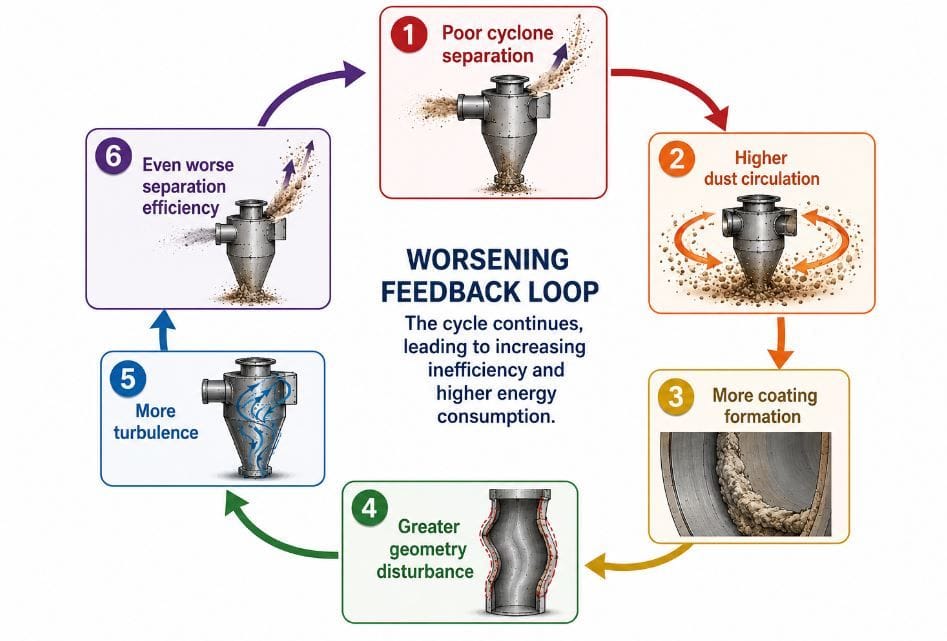
Once this cycle becomes established, the preheater gradually becomes thermally unstable, aerodynamically inefficient and mechanically more stressed.
Why do cement plant managements often underestimate the long-term process losses of a damaged preheater tower?
One uncomfortable reality in cement plants is that production pressure often delays corrective action. As long as the kiln is running, production targets are being met and no major stoppage has occurred, management often prefers temporary repairs over major shutdowns and from a short-term operational perspective, this decision appears logical.
Installing a stone box is faster, cheaper and operationally easier than stopping the kiln for major refractory repair. The problem is that the hidden efficiency loss usually does not appear immediately in a single report.
For example:
- SHC increase may be blamed on raw mix variation,
- fan load increase may be treated as normal aging,
- coating issues may be considered routine process instability.
Meanwhile, very few plants continuously correlate refractory condition, shell temperature trends, cyclone pressure drop, false air levels and fan power consumption as part of a unified deterioration analysis. So the process slowly becomes less efficient while the kiln continues operating.
The Financial Impact Becomes Huge Over Time
The hidden cost becomes obvious only when someone calculates the yearly energy loss. For example:
A kiln producing 3,000 tonnes per day clinker, operating 30 kcal/kg above design SHC is effectively wasting approximately 90,000 Mcal per day.
Depending on coal quality, this can easily translate to roughly 8–10 tonnes of extra coal consumption daily. At around ₹12,000 per tonne coal, the thermal loss alone may exceed ₹1 lakh per day or several crores per year. And this calculation still excludes additional fan power cost, refractory maintenance cost, build-up cleaning cost, production instability and shutdown losses.
That is why repeated stone boxes should never be viewed only as maintenance patches. In many cases, they are visible evidence of a slowly deteriorating preheater system that is continuously draining thermal efficiency, electrical efficiency and operating stability long before a major failure finally occurs.
8. What Plant Operators Actually Observe
Here is the practical picture of what is happening in the control room and on the walkway when a preheater is progressively deteriorating:
PH fan amps rising – not suddenly, but creeping upward over weeks. 5-10% increase without feed or speed change is a red flag.
Exit gas temperature rising – Stage 1 exit temperatures above 350°C consistently suggest cyclone separation loss in upper stages.
Cyclone pressure drop fluctuating – coating build-up and fall-off cycles show as erratic pressure swings on Stage 4 or 5 cyclones.
Unstable kiln draft – operators constantly chasing draft corrections, with the draft not holding steady even when kiln feed is stable.
Recurring build-up in meal pipes – air blasters activating more frequently; meal pipe blockages occurring at the same stage locations each week.
Kiln inlet O₂ instability – O₂ readings at kiln inlet jumping erratically suggest inconsistent false air levels entering through damaged seals.
Abnormal shell temperatures – thermal gun readings on cyclone shells showing hot patches above 200°C that are spreading to adjacent areas.
Calciner temperature instability – calciner operators having to chase temperature swings; calciner fuel increasing to maintain calcination degree.
Increasing coal consumption – specific coal consumption per tonne of clinker trending up with no change in raw mix quality or product specification.
Coating instability in kiln – coating formation and falloff in the kiln inlet zone becoming more erratic, possibly linked to variable calcination degree from preheater issues.
The pattern to look for is clusters of these symptoms appearing together. Any one of them alone could have a simple explanation. Three or more of them trending simultaneously on the same kiln line is a strong indicator that preheater condition is the root cause, not process parameter variation.
9. Conclusion Summary
A stone box on a preheater cyclone must never be mistaken for a permanent maintenance solution; rather, it serves as a critical warning sign that serious internal process degradation is already well underway. Long before a localized hot spot manifests on the steel shell, the internal refractory lining has typically suffered extensive thinning, spalling, or alkali attack, causing a silent drop in cyclone separation efficiency. Because the kiln line often continues to hit production targets, operators unconsciously compensate for this internal geometry distortion by ramping up calciner fuel and running the ID fan harder. Over time, these reactive adjustments are accepted as the new operational “normal,” masking a continuous, costly drain on both thermal and electrical efficiency.
The cumulative impact of a compromised preheater loop simultaneously destroys every key performance indicator (KPI) across the pyroprocess. Specific Heat Consumption ($SHC$) creeps upward as energy escapes through the uninsulated shell and unrecovered heat leaves via bypassed fine dust in the exit gases. Concurrently, Specific Power Consumption ($SPC$) rises because the ID fan must pull heavier, dust-laden gas streams while overcoming severe pressure drop instabilities and increased false air volumes. Ultimately, this structural deterioration robs the kiln of stability, feeding it erratic meal temperatures and fluctuating dust return loads that force the entire system into a highly reactive control loop. The industry’s most efficient plants do not excel at emergency patching; instead, they aggressively monitor shell profiles, trend cyclone pressure drops, and eliminate air infiltration proactively, understanding that the true engineering goal is preventing the system from ever needing a stone box in the first place.