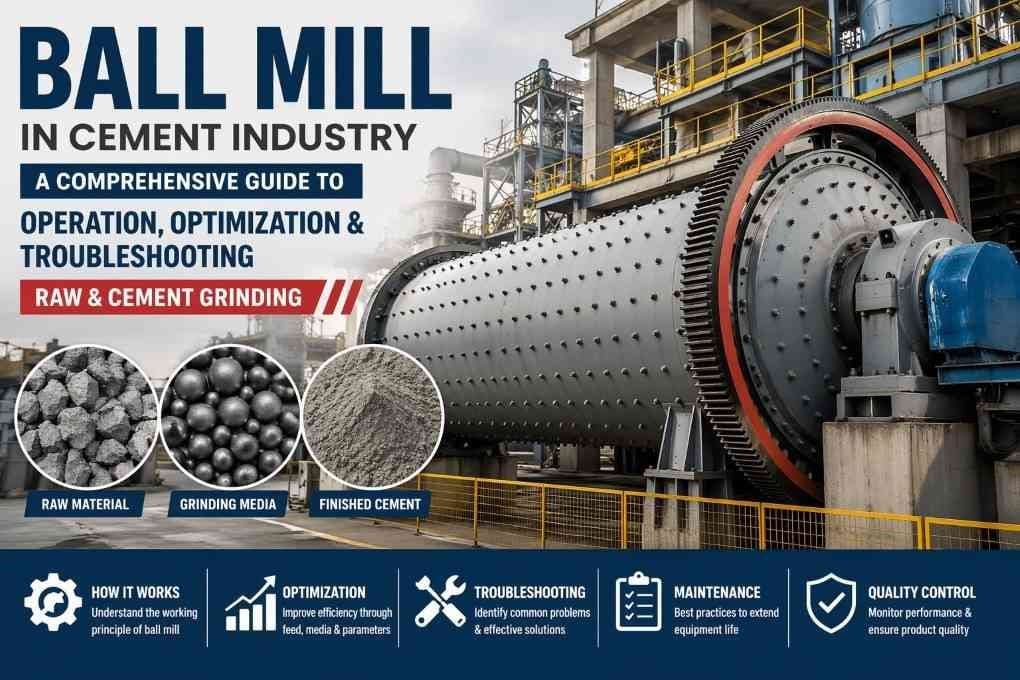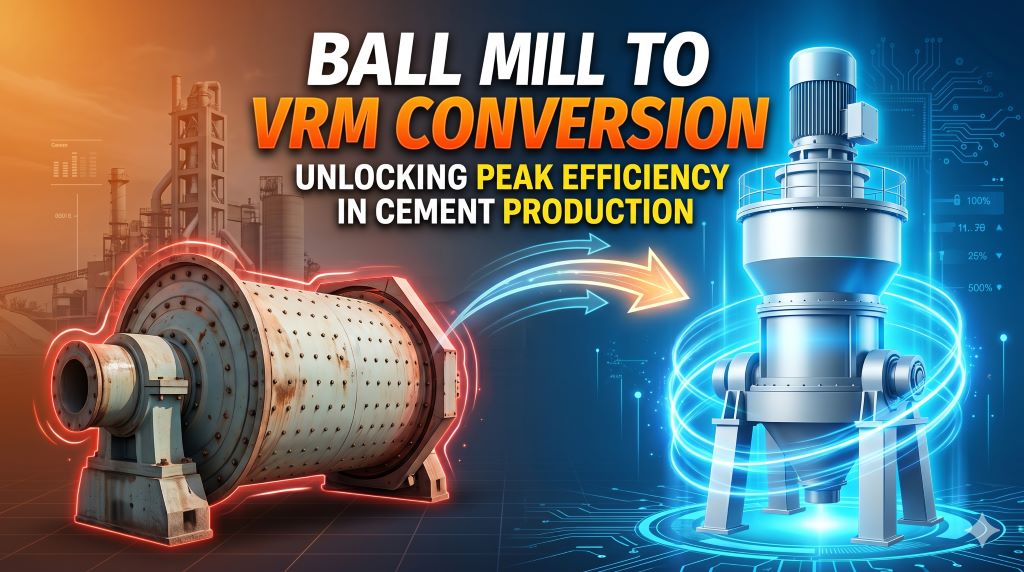
Table of Contents
When a cement mill starts consuming too much power, production is limited, or maintenance cost keeps increasing, the first discussion in many plants is often the same:
“Should we replace the ball mill with a VRM?”
It is a valid question. A Vertical Roller Mill can offer important advantages in the right application. It can combine grinding, drying, separation, and material transport in one process arrangement. It may reduce specific power, improve capacity, and require less layout space than a conventional ball-mill circuit. But a ball mill to VRM conversion is not a simple equipment replacement. It affects the whole grinding circuit: material handling, hot-gas system, fans, separator, filter, civil work, electrical system, automation, maintenance practice, and product quality.
So the correct question is not:
“Is VRM better than a ball mill?”
The correct question is:
“Will a VRM give our plant the required cement quality, output, reliability, and operating cost under our actual plant conditions?”
That answer comes from plant data, not from a standard saving percentage quoted in a presentation.
Why Cement Plants Consider Ball Mill to VRM Conversion
Most conversion discussions begin because the existing ball-mill circuit is facing one or more practical problems. Sometimes power consumption is high. Sometimes the mill cannot meet market demand at the required Blaine or residue. In other cases, grinding-media consumption, liner wear, separator limitations, or limited space for expansion become the main concern.
A VRM can be attractive because it is a compact, integrated grinding system. Grinding takes place between the rollers and the table. Hot gas can dry and transport the material. The separator controls the final product size and returns coarse material for further grinding.
Published reviews and industry comparisons generally show that VRMs can use less specific grinding energy than conventional ball-mill systems in comparable applications. However, the actual result depends on feed moisture, clinker grindability, additives, product fineness, circuit layout, separator efficiency, fan power, and operating practice.[1] [2]
That last point is important. A VRM may look very efficient on paper, but poor feed control, unstable grinding bed, weak gas control, or repeated vibration can quickly reduce the expected benefit.chanics and Advantages
Ball Mill and VRM: The Difference in Simple Terms
A ball mill works mainly by impact and attrition. The shell rotates, grinding media lift and fall, and the material is broken between the media and the mill internals. The system is familiar to most plant teams and is generally forgiving when operating conditions change slightly.
A VRM works differently. Material is fed onto a rotating table and ground under pressure from the rollers. Gas carries fine material to the separator, while coarse material returns to the table. This arrangement gives good control, but it also makes the mill more sensitive to feed condition, gas flow, pressure, separator setting, and grinding-bed stability.
| Item | Ball mill circuit | VRM circuit |
| Main grinding action | Impact and attrition from grinding media | Compression and shear between roller and table |
| Drying | Usually needs a separate drying arrangement or dedicated hot-gas system | Can combine drying with grinding where suitable gas is available |
| Layout | Often needs more horizontal space and more separate equipment | Usually more compact, but needs careful vertical and gas-system layout |
| Product control | Flexible for many products and PSD requirements | Strong separator control, but operating stability is critical |
| Main maintenance areas | Media, liners, diaphragm, bearings, separator | Rollers, table liners, hydraulic system, gearbox, separator, vibration control |
| Sensitivity to feed changes | Often more tolerant | Can be more sensitive to moisture, feed size, grindability, and fines in feed |
Neither system is automatically better in every case. A well-maintained ball mill can still be the right choice for some plants. A poorly selected or poorly operated VRM can become a daily source of vibration, quality variation, and maintenance pressure.
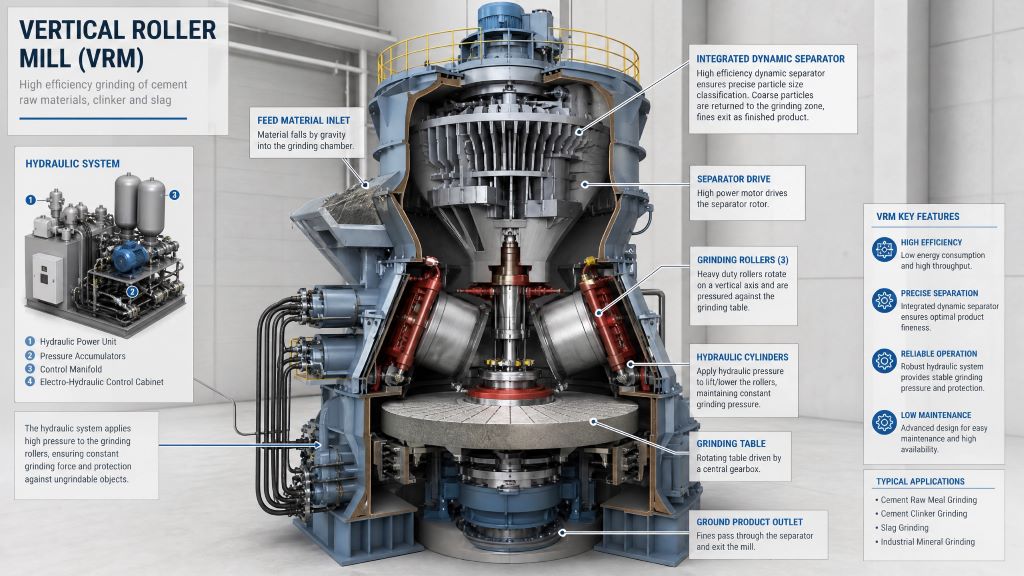
Figure 2: Detailed cutaway view illustrating the internal components and working principle of a Vertical Roller Mill (VRM).
First Check: Is the Ball Mill Really the Problem?
Before planning a conversion, the existing circuit should be checked properly. Many mills are blamed for high power or low output when the real issue is somewhere else.
For example, a worn separator can increase circulating load. Poor mill ventilation can reduce drying and transport. High false air can increase fan load. Incorrect ball charge or worn liners can reduce grinding efficiency. A filter with high differential pressure can affect the whole circuit. Poor clinker quality or high gypsum moisture can make the mill look inefficient even when the mill itself is not the main problem.
A useful first step is to collect data during normal stable operation – not only during the best production day.
| Data to collect | Why it matters |
| Mill output, t/h | Shows the real production level and bottleneck. |
| Complete circuit specific power, kWh/t | Main mill power alone is not enough. Include separator, fan, transport, filter, and auxiliaries where possible. |
| Blaine, residue, PSD, and strength results | Ensures that power is compared at the same cement quality. |
| Clinker, gypsum, and additive moisture | Important for drying requirement and mill performance. |
| Feed grindability and abrasiveness | Affects power, output, roller wear, media use, and equipment selection. |
| Separator condition and circulating load | A poor separator can create an artificial mill-capacity problem. |
| Fan power, gas temperature, and mill ventilation | Helps identify gas-side limitations. |
| Media and liner consumption | Important for operating-cost comparison. |
| Availability, stoppages, and maintenance history | Shows whether the real issue is power, reliability, or maintenance. |
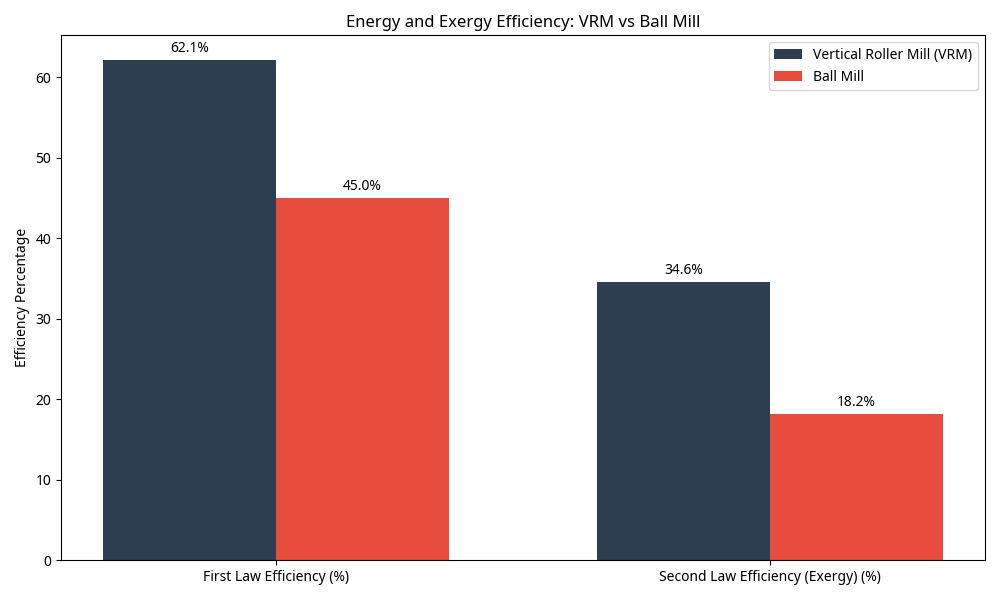
Figure 3: Comparison of First Law (Energy) and Second Law (Exergy) Efficiencies between VRMs and Ball Mills.
When a VRM Can Make Good Sense
A VRM should be studied seriously when the plant has a clear technical reason for it. Common situations include:
- The present circuit cannot meet the required production at acceptable power.
- The plant has a reliable hot-gas source and needs better drying integration.
- Space is limited for expansion of a conventional circuit.
- The existing ball mill is old and major replacement work is already required.
- The plant wants to reduce grinding-media handling and simplify some parts of the process flow.
- The product mix and feed material are suitable for stable VRM operation.
One important advantage of a VRM is that drying, grinding, separation, and transport can be combined. Research and industry reviews also describe lower energy use and a more compact process arrangement as possible advantages. But these advantages are linked to the actual material and process conditions; they should not be treated as universal guarantees.[1] [2]
When a Ball Mill May Still Be the Better Option
There are cases where keeping and improving the ball-mill circuit is more sensible than conversion. If the plant produces many cement types with very different quality requirements, the product flexibility of the existing circuit may be valuable. If the raw materials are highly abrasive, wear cost and spare-parts availability need detailed comparison. If suitable hot gas is not available, the VRM drying concept may become difficult or expensive. If the maintenance team has limited experience with hydraulic systems, VRM gearboxes, roller work, and vibration control, training and support must be part of the project plan.
Product quality is also important. Do not compare only Blaine. Compare residue, PSD, strength development, setting time, water demand, soundness, and customer feedback. A lower kWh/t value is not useful if the cement does not perform as required in the market.
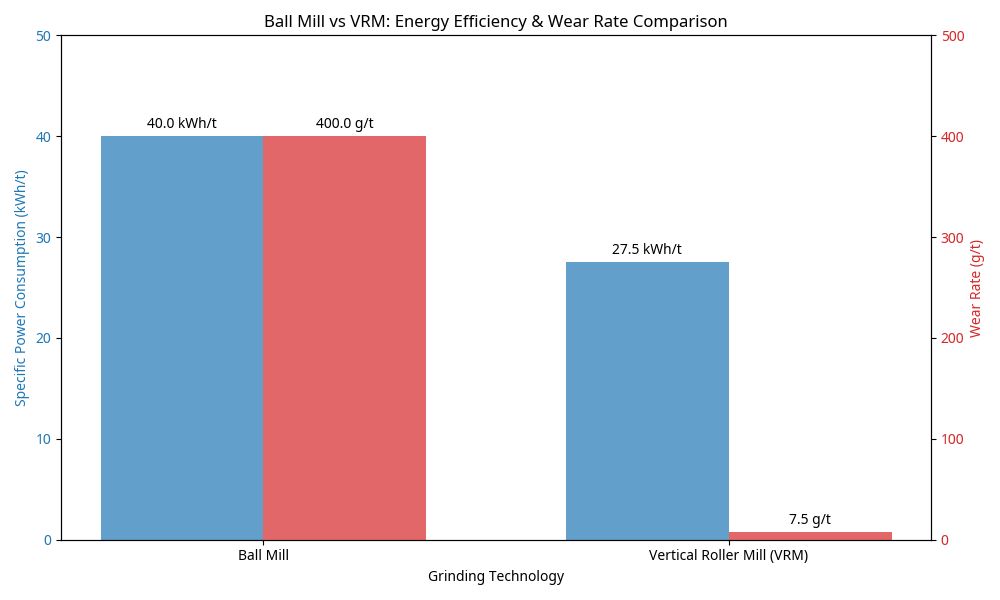
Do Not Compare Only Main-Mill Power
This is one of the most common mistakes in grinding-system studies. A ball mill may appear to use more power at the main drive, while the VRM appears better on a main-motor basis. But the correct comparison must include the full circuit boundary. Compare complete circuit kWh/t, not only mill kW.
The comparison should include the mill, separator, fan, bag filter, conveyors, bucket elevators, air slides, compressed-air load, water system where relevant, and any additional drying or material-handling equipment. Also make sure both systems are compared at the same cement quality and production basis. Comparing one system at low Blaine and another at high Blaine will not give a useful answer.
A Simple Electricity-Saving Calculation
Once a reliable baseline is available, the basic calculation is simple:
Annual electricity reduction = (Current circuit specific power − Verified future circuit specific power) × Annual production
Illustrative example
Assume a plant is presently operating at 38 kWh/t for the full cement grinding circuit. After a detailed engineering study, the project target is 31 kWh/t for the same cement quality and the same comparison boundary.
If annual production is 800,000 tonnes, then:
Annual electricity reduction = (38 − 31) × 800,000
= 5,600,000 kWh/year
This example only explains the calculation method. It is not a promise that every ball mill to VRM conversion will save 7 kWh/t. The future value should come from detailed engineering, testwork, an OEM guarantee, or a genuinely comparable reference plant.
Four Areas That Decide Whether a VRM Will Run Well
1. Feed Material Condition
A VRM needs a reasonably stable feed. Large changes in moisture, feed size, hardness, or fine fraction can disturb the grinding bed. When the bed becomes unstable, vibration increases and output can fall. Before selecting a mill, evaluate clinker hardness, additive hardness, moisture range, feed-size distribution, abrasiveness, and expected variation during normal operation. Do not select the machine only on average material data. The design must also consider difficult operating conditions.
2. Hot Gas and Drying Arrangement
In many VRM applications, hot gas is a major part of the process. The gas must be available at the required quantity and temperature, and the system must remain stable when kiln conditions change. The gas path, mill fan, filter, ducting, dampers, and temperature-control philosophy all need to be reviewed together. If gas temperature becomes too low, drying may suffer. If gas flow is unstable, mill DP and grinding-bed stability can be affected. If the fan is undersized or the ducts have high resistance, the mill may not achieve its expected output.
3. Separator and Product Quality
The separator controls how much coarse material returns to the grinding table. A higher separator speed can improve fineness, but it can also increase circulating load and power. The correct setting is not always the highest speed or the lowest residue. It is the setting that gives the required cement quality with stable operation and reasonable power. For a conversion project, ask the OEM to define the expected performance for each cement type, including Blaine, residue, throughput, power, and any special quality requirement.
4. Maintenance and Operating Discipline
A VRM is not a “fit and forget” machine. Operators need to understand the relationship between feed rate, grinding pressure, mill differential pressure, gas flow, separator speed, vibration, and product quality. Maintenance also needs planning. Roller and table wear, hydraulic performance, lubrication, gearbox condition, separator balance, and vibration monitoring should be built into the maintenance strategy from the beginning. Critical spares and OEM support should be agreed before commissioning, not after the first major issue..
The Conversion Is Much Bigger Than One Mill
A conversion project can require changes in several departments at the same time.
| Area | Practical questions before approval |
| Material handling | Can the existing conveyors, feeders, bins, and transport system provide stable feed? |
| Gas system | Is sufficient hot gas available? Are ducts, fans, dampers, and filters correctly sized? |
| Civil work | Is there space for the mill, separator, fan, filter, access platforms, and maintenance lifting? |
| Electrical system | Can the plant support new drives, transformers, MCCs, instruments, and protection systems? |
| Automation | Are the control loops and interlocks designed for stable operation during disturbances? |
| Product storage | Can the plant handle the expected cement types and production rate after conversion? |
| Maintenance | Are spares, service support, tools, and trained people available? |
| Safety | Have hot-gas, dust, fire, explosion, lifting, and confined-space risks been addressed? |
A strong mill cannot compensate for weak duct design, poor fan selection, unstable feed, or an underperforming separator.
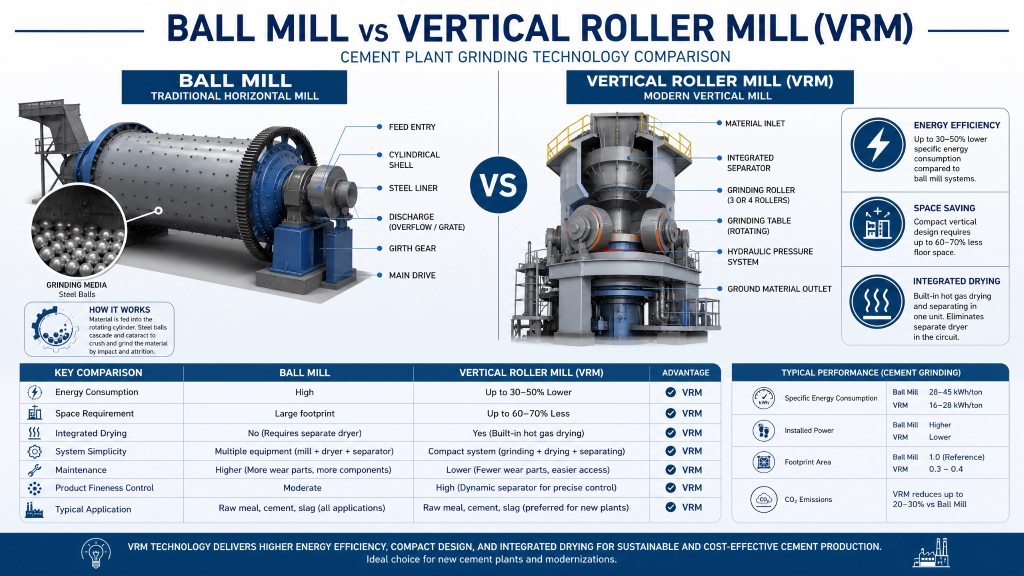
Figure 4: Flowchart illustrating the key phases of a Ball Mill to VRM conversion project.
Common Mistakes in Ball Mill to VRM Projects
Mistake 1: Using a generic savings percentage
A statement such as “VRM saves 30% power” sounds attractive, but it is incomplete. Savings depend on the existing circuit, product, material, and operating boundary. Published figures should be used only as references for possible performance, not as a project guarantee.[1] [2]
Mistake 2: Ignoring product-quality differences
The power comparison is meaningful only if both systems produce comparable cement. Always compare the same cement type, fineness, residue, PSD, and strength requirement.
Mistake 3: Underestimating shutdown and construction work
A conversion may require major civil work, duct modification, electrical changes, process tie-ins, and commissioning time. A good energy case can become financially weak if the shutdown plan is unrealistic.
Mistake 4: Treating the VRM as only a mechanical project
A VRM project is a process project, mechanical project, electrical project, automation project, and maintenance project at the same time. If one part is weak, the mill may not achieve its target.
A Practical Decision Checklist
Before finalising a ball mill to VRM conversion, the plant team should be able to answer these questions clearly:
- What is the current full-circuit kWh/t for each important cement type?
- What output and quality does the plant need for the next five to ten years?
- What is the actual feed moisture, hardness, abrasiveness, and expected variation?
- Is a suitable hot-gas source available during all relevant operating conditions?
- Can the required PSD, strength, and workability be achieved with the proposed VRM circuit?
- What will be the complete project cost, including civil, electrical, automation, fans, filters, ducts, and shutdown loss?
- What performance values are guaranteed, and how will they be measured?
- Does the plant have a practical plan for spares, maintenance, training, and OEM support?
If these questions are answered with plant data, the project discussion becomes much more useful. Instead of debating technology preference, the team can compare real technical and financial options.
Final Takeaway
A ball mill to VRM conversion can be a very good investment for the right plant. It can reduce energy use, improve capacity, simplify the process layout, and support better control. But the project should never be approved only because a VRM is modern or because a generic saving percentage looks attractive. The best conversion studies start with the existing circuit. They measure current performance, define product-quality requirements, understand the feed material, check the gas system, compare complete circuit power, and plan maintenance and commissioning properly.
Choose the grinding system that gives your plant the required cement quality, output, reliability, and total operating cost, not simply the system with the best headline number.
Assumptions and Limitations
This article provides general technical guidance and is not a plant-specific conversion recommendation. Actual performance depends on feed properties, circuit design, product requirements, local energy cost, equipment selection, operating practice, and site constraints. Any investment decision should be checked through detailed engineering, plant data, applicable safety requirements, and qualified technical review.
Sources and Further Reading
1.Pareek, P. and Sankhla, V. S., “Review on vertical roller mill in cement industry & its performance parameters,” Materials Today: Proceedings (2021).https://www.sciencedirect.com/science/article/abs/pii/S2214785320385540
2.“Overview of energy consumption and attributes of grinding technologies in Indian cement industry,” ZKG International (2024 ).https://www.zkg.de/en/artikel/overview-of-energy-consumption-and-attributes-of-grinding-technologies-in-indian-cement-industry-4153616.html
3.Ghalandari, V. et al., “A case study on energy and exergy analyses for an industrial-scale vertical roller mill assisted grinding in cement plant,” Advanced Powder Technology (2020 ). This is a site-specific raw-mill case study; its figures should not be treated as universal cement-finish-grinding targets.https://www.sciencedirect.com/science/article/pii/S0921883120305665