The Hidden Parameter Behind Efficient Baghouse Performance in Cement Plants
Table of Contents
In cement plants, baghouse performance is often judged by parameters such as Differential Pressure (DP), stack emissions, pulse cleaning frequency and fan power consumption. While these parameters indicate the operating condition of the baghouse, they do not always reveal the root cause of performance deterioration. Many baghouse-related problems such as including high DP, excessive fan power consumption, premature filter bag failures, and unstable operation, are often linked to an overlooked parameter – Air Cloth Ratio (ACR).
Air Cloth Ratio defines the relationship between the gas volume passing through the baghouse and the available filtration area of the filter bags. Maintaining the optimum Air Cloth Ratio is essential for achieving stable operation, lower emissions, longer bag life and reduced operating costs. A baghouse is not simply a dust collector; it is an engineered balance between gas flow and filtration area. Even a perfectly functioning pulse cleaning system cannot compensate for an incorrectly designed or overloaded Air Cloth Ratio.
Related Reading: This article is part Baghouse Optimisation Series. If you haven’t already, we recommend reading Part 1, 2 & 3
Part 1: Introduction, Importance, Working Principle & Process Flow
Part 2: Complete Guide to Pulse Jet Baghouse Components, Failure Mechanisms & Maintenance
Part 3: Common Baghouse Problems in Cement Plants and Their Solutions
What is Air Cloth Ratio (ACR)?
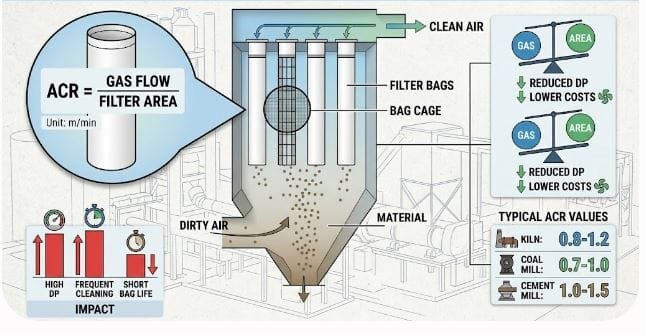
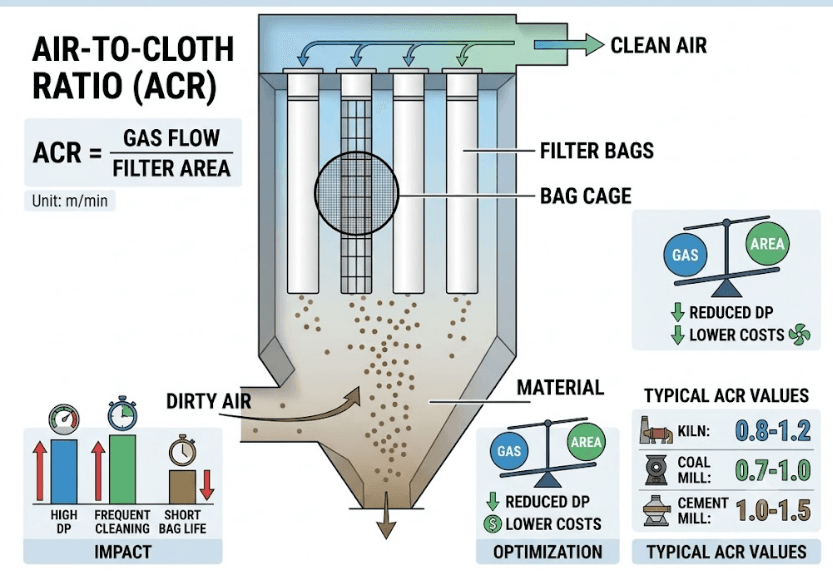
Air Cloth Ratio (ACR) is one of the most important parameters that determines how efficiently a baghouse performs. Simply put, it indicates how much gas each square meter of filter cloth is required to handle every minute. Think of the filter bags as workers inside the baghouse. If too much gas is forced through a limited filtration area, every bag has to work harder, which can lead to higher Differential Pressure (DP), frequent pulse cleaning, increased power consumption and reduced bag life. On the other hand, when the gas flow is properly matched with the available filter area, the baghouse operates more efficiently and reliably.
Formula
ACR = Gas Flow (m³/min) ÷ Total Filter Cloth Area (m²)
Unit = m³/m²/min or simply m/min
Where:
- Gas Flow = Actual volume of gas passing through the baghouse (m³/min).
- Filter Cloth Area = Total effective filtration area of all installed filter bags (m²).
In practical terms:
- Increasing the gas flow increases the Air Cloth Ratio.
- Reducing the available filtration area also increases the Air Cloth Ratio.
- Increasing the filtration area lowers the Air Cloth Ratio.
Maintaining the optimum Air Cloth Ratio is essential because it directly influences pressure drop, dust collection efficiency, filter bag life and overall baghouse performance. A well-designed baghouse is not simply about having more filter bags, it is about maintaining the correct balance between gas volume and filtration area.
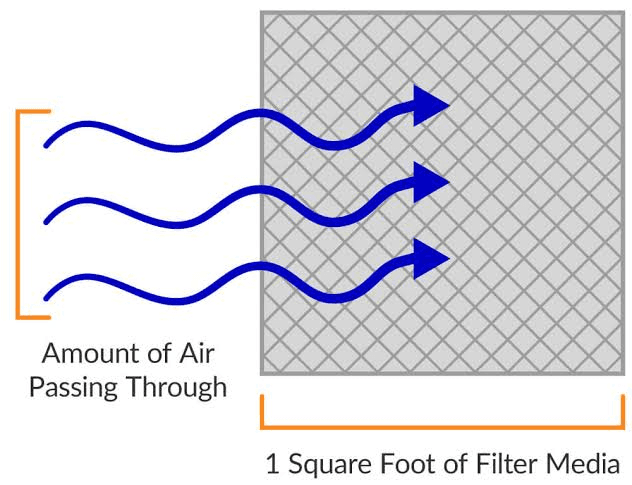
Is Air Cloth Ratio the Same as Face Velocity?
Yes. In the cement industry, Air Cloth Ratio (ACR) is known by several names depending on the baghouse manufacturer, OEM terminology and engineering practices followed at the plant. While the terminology may vary, the underlying concept remains the same, the relationship between the volume of gas being handled and the available filtration area. You may come across the following terms in OEM manuals and technical documents:
- Air-to-Cloth Ratio (A/C Ratio)
- Filtering Velocity
- Filtration Velocity
- Face Velocity
In practical terms, all these terms describe how much gas passes through a given filtration area over a specific period of time. Whether it is referred to as Air Cloth Ratio or Face Velocity, it essentially helps engineers determine whether the baghouse is operating within its designed filtration limits.
Understanding these terms is particularly useful when comparing design specifications from different OEMs, as one manufacturer may specify the filtration parameter as Air-to-Cloth Ratio while another may refer to it as Face Velocity or Filtering Velocity. Regardless of the terminology used, maintaining the optimum relationship between gas flow and filtration area remains critical for achieving stable Differential Pressure (DP), efficient dust collection, and longer filter bag life.
Note: Although these terms are often used interchangeably in industry, their units and methods of representation may differ slightly depending on the OEM’s design philosophy. Therefore, design calculations should always be verified using the specifications provided for the particular baghouse system.
Related Reading: If you would like to learn more about mill stability, read our article on Common Causes of Vibration in Vertical Roller Mills (VRM) and Their Troubleshooting, where the most common process and mechanical-related vibration issues are explained with practical troubleshooting tips.
Understanding Gross ACR and Net ACR
When evaluating baghouse performance, Air Cloth Ratio can be expressed in two different ways – Gross ACR and Net ACR. Understanding the difference between these two calculations is important because they do not always represent the same operating condition.
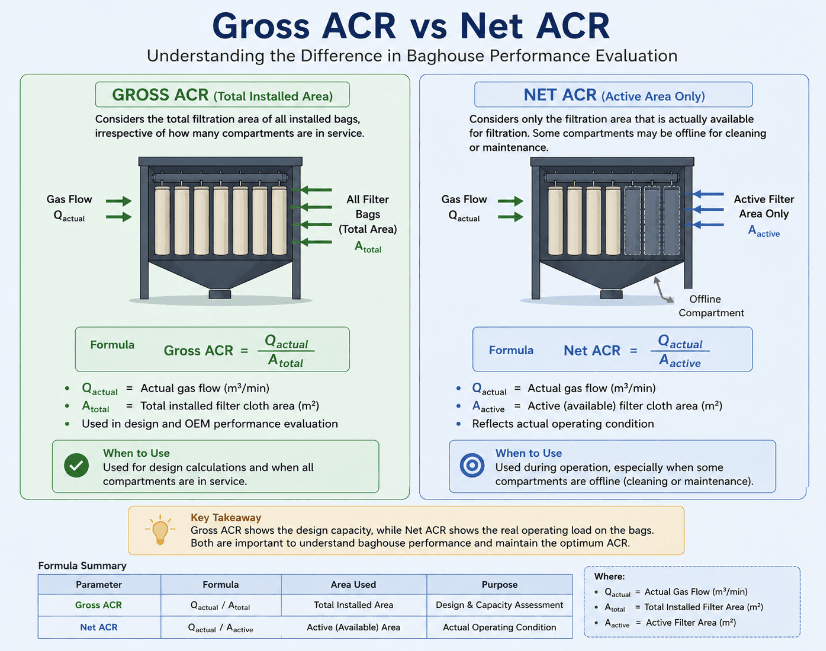
While Gross ACR provides an overall design perspective, Net ACR reflects the actual gas load experienced by the filter bags during operation. In multi-compartment baghouses, the difference between the two can become significant whenever a compartment is isolated for maintenance or taken offline for cleaning.
Gross ACR considers the total installed filtration area of the baghouse, irrespective of whether all compartments are actively available for filtration.
Gross ACR = Total Gas Flow ÷ Total Installed Filter Area
Gross ACR is commonly used during:
- Baghouse design calculations
- OEM performance evaluations
- Capacity assessments
- Filtration area selection during project engineering
Since it assumes that the entire filtration area is available, Gross ACR provides a useful indication of the baghouse’s designed operating conditions. However, it may not always represent the actual load being experienced by the filter bags during plant operation.
For example, if one or more compartments are temporarily unavailable because of offline cleaning or maintenance activities, the remaining bags are required to handle a higher gas load. In such cases, Gross ACR remains unchanged even though the actual operating conditions inside the baghouse have changed significantly. This is why Gross ACR should always be evaluated together with Net ACR when investigating issues such as high Differential Pressure (DP), increased pulse cleaning frequency, or unexpected changes in baghouse performance.n.
Unlike Gross ACR, Net ACR considers only the filtration area that is actually available during operation. It therefore provides a more realistic indication of the gas load being experienced by the filter bags.
Net ACR = Total Gas Flow ÷ Available Filter Area
Net ACR becomes particularly important in:
- Offline cleaning systems
- Multi-compartment baghouses
- Compartment isolation during maintenance
- Damaged or unavailable bag sections
Example
Suppose a baghouse is operating with:
- Gas Flow = 480,000 m³/hr
- Total Filter Area = 8,000 m²
- Total Compartments = 8
- One compartment is offline for cleaning.
Gross ACR
480,000 ÷ 60 = 8,000 m³/min
Gross ACR = 8,000 ÷ 8,000 = 1.0 m/min
Net ACR
Available Filter Area:
8,000 × (7/8) = 7,000 m²
Net ACR = 8,000 ÷ 7,000 = 1.14 m/min
Although the Gross ACR remains unchanged, the remaining filter bags are now required to handle approximately 14% more gas load. This increase in Net ACR may result in higher Differential Pressure (DP), more frequent pulse cleaning, and unstable baghouse performance.
In a Vertical Roller Mill (VRM), harder clinker often requires increased fan airflow to transport the additional internal recirculation and maintain efficient material separation. Understanding and accurately measuring actual fan flow is therefore essential for stable mill operation and energy optimisation. For a detailed explanation, read Fan Flow Measurement in Cement Plants: Methods, Calculations & Optimisation.
Calculation Example
Let us consider a Cement Mill Baghouse operating under the following conditions:
- Gas Flow = 240,000 m³/hr
- Total Filter Area = 6,000 m²
Step 1: Convert Gas Flow
Since Air Cloth Ratio is calculated in m³/min, the gas flow must first be converted from m³/hr to m³/min.
240,000 ÷ 60 = 4,000 m³/min
Step 2: Calculate Air Cloth Ratio
ACR = 4,000 ÷ 6,000
= 0.67 m/min
This means that every square meter of filter cloth is handling 0.67 m³ of gas every minute. In other words, the gas load is distributed across the available filtration area at an Air Cloth Ratio of 0.67 m/min.
The calculated value can then be compared with the baghouse’s design Air Cloth Ratio to determine whether it is operating within its recommended limits. An Air Cloth Ratio that is significantly higher or lower than the design value may adversely affect Differential Pressure (DP), dust collection efficiency, filter bag life, and overall baghouse performance.
Why Air Cloth Ratio Matters
Air Cloth Ratio directly influences almost every aspect of baghouse performance. Maintaining the optimum ACR not only improves filtration efficiency but also helps reduce operating costs and extend filter bag life. When the Air Cloth Ratio moves beyond its recommended operating range, problems such as high Differential Pressure (DP), increased fan power consumption, and premature bag failures often begin to appear.
Lower Differential Pressure
When a baghouse becomes overloaded, the available filtration area is required to handle a higher gas volume, resulting in increased gas velocities through the filter bags. This may lead to:
- Higher Differential Pressure (DP)
- Frequent pulse cleaning cycles
- Increased fan power consumption
- Unstable baghouse operation
Maintaining the optimum Air Cloth Ratio helps minimise unnecessary pressure losses across the filtration system and improves overall operating stability.
Improved Dust Collection Efficiency
Proper gas velocity is essential for effective dust filtration. When the Air Cloth Ratio is maintained within its recommended range, dust is distributed more uniformly across the filter bags, resulting in:
- Better dust collection efficiency
- Uniform dust cake formation
- Lower stack emissions
- Improved environmental compliance
Longer Filter Bag Life
Excessively high Air Cloth Ratio can significantly reduce filter bag life by increasing both mechanical and thermal stresses on the filtration media. This may result in:
- Frequent pulse cleaning
- Increased abrasion and bag wear
- Premature seam failures
- Reduced filter bag life
- Higher maintenance and replacement costs
Maintaining the optimum Air Cloth Ratio not only improves baghouse performance but also contributes to lower maintenance requirements and more reliable long-term operation.
Recommended Reading: Since clinker quality is closely linked to kiln operation, understanding burning conditions, heat balance, and thermal efficiency is essential for improving cement mill performance. For a detailed explanation of these topics, check out this comprehensive guide on Amazon Kindle.
Is Lower ACR Always Better?
Not necessarily.
A common misconception is that a lower Air Cloth Ratio always results in better baghouse performance. In reality, the objective is not to achieve the lowest possible ACR but rather the optimum ACR recommended for the specific application and baghouse design. An excessively high Air Cloth Ratio can overload the filtration system and adversely affect its performance, while an unnecessarily low Air Cloth Ratio may lead to an oversized and economically inefficient design.
Extremely High ACR May Cause:
- High Differential Pressure (DP)
- Increased stack emissions
- Frequent pulse cleaning cycles
- Higher fan power consumption
- Reduced filter bag life
- Unstable baghouse operation
Extremely Low ACR May Cause:
- Oversized baghouse design
- Higher capital costs
- Excessive filtration area requirements
- Poor economic optimisation
- Underutilisation of the installed filtration capacity
Therefore:
The goal is not to achieve the lowest possible Air Cloth Ratio, but to maintain the optimum Air Cloth Ratio for the prevailing process conditions and baghouse design.
A properly selected Air Cloth Ratio ensures an effective balance between filtration efficiency, operating reliability, maintenance requirements, and overall operating costs.
Recommended Reading: Since baghouse performance is closely influenced by raw mill gas flow, temperature, moisture, and process stability, understanding Raw Mill operation and optimisation can help improve overall baghouse efficiency. For a detailed guide on raw mill operation, troubleshooting, and process optimisation, check out this comprehensive book on Amazon Kindle.
Typical Air Cloth Ratio Values in Cement Plants
Although the optimum Air Cloth Ratio varies depending on the baghouse design and process conditions, the following values are commonly encountered in cement plant applications.
| Application | Typical ACR (m/min) |
|---|---|
| Kiln / Raw Mill | 0.8 – 1.2 |
| Coal Mill | 0.7 – 1.0 |
| Cement Mill | 1.0 – 1.5 |
| Cooler Vent | 1.2 – 1.8 |
Note: These ranges represent typical industry practices for pulse-jet baghouses and may vary depending on OEM design criteria and operating conditions.
The optimum Air Cloth Ratio depends upon several factors, including:
- Baghouse type and cleaning system
- Dust loading and dust characteristics
- Gas temperature and moisture content
- Filter bag material
- Pulse cleaning philosophy
- Number of compartments and filtration area
- Process operating conditions and gas flow requirements
- OEM design recommendations
Therefore, the values provided above should be considered as general guidelines rather than fixed operating limits. The actual design and operating Air Cloth Ratio should always be verified using plant design data and the OEM specifications for the particular baghouse system.
Practical Observation in Cement Plants
In many cement plants, baghouse performance is often evaluated based on parameters such as Differential Pressure (DP), stack emissions, filter bag failures, and fan power consumption. When these parameters begin to deteriorate, the immediate assumption is usually that the filter bags or pulse cleaning system are at fault. Common observations include:
- High Differential Pressure (DP)
- Premature filter bag failures
- Increased stack emissions
- Fan overloading or higher power consumption
- Frequent pulse cleaning cycles
The immediate corrective actions are often:
- Increasing pulse pressure
- Increasing pulse cleaning frequency
- Replacing filter bags
- Increasing fan RPM
- Adjusting process operating parameters
While these actions may provide temporary relief, they often address only the symptoms rather than the actual cause of the problem. In many cases, changes in gas flow, false air ingress, capacity enhancement projects, or reduced available filtration area can increase the Air Cloth Ratio beyond its design limits.
Therefore, before implementing corrective measures, engineers should always verify whether the baghouse is operating within its designed Air Cloth Ratio. Identifying an incorrect ACR at an early stage can help avoid unnecessary maintenance costs and improve overall baghouse reliability.is simply an incorrect Air Cloth Ratio.
False Air: A Hidden Contributor to High ACR
False air ingress is one of the most overlooked causes of an increased Air Cloth Ratio. Even when production remains unchanged, additional air entering the system can significantly increase the gas volume handled by the baghouse. Consider the following situation:
Before
- Production = Constant
- Gas Flow = 240,000 m³/hr
- Baghouse operating normally
After False Air Ingress
- Production = Unchanged
- Gas Flow = 320,000 m³/hr
Although production has not increased, the baghouse is now required to handle an additional 80,000 m³/hr of gas. This increase in gas volume results in:
- Higher Air Cloth Ratio (ACR)
- Increased Differential Pressure (DP)
- Higher fan power consumption
- More frequent pulse cleaning cycles
- Increased operating costs
In practice, operators may assume:
“The filter bags are choked.”
However, the actual problem may simply be:
“The baghouse has become overloaded because of increased gas volume caused by false air ingress.”
Unless the source of false air is identified and eliminated, corrective actions such as increasing pulse pressure or replacing filter bags are likely to provide only temporary improvement. Therefore, whenever an unexplained increase in Differential Pressure or fan load is observed, Air Cloth Ratio and false air ingress should be investigated before implementing major maintenance interventions.
Capacity Increase and Debottlenecking Projects
Capacity enhancement and de-bottlenecking projects often focus on increasing production, improving throughput, or reducing process bottlenecks. However, one aspect that is frequently overlooked is the impact of these modifications on the baghouse Air Cloth Ratio. Common examples include:
- Production increases
- Fan upgrades
- Process modifications
- Alternative fuel implementation
- De-bottlenecking projects
In most cases, these changes increase the volume of gas that must be handled by the baghouse. If the filtration area remains unchanged, the Air Cloth Ratio will increase automatically.
As a result, plants may experience:
- Higher Differential Pressure (DP)
- Increased fan power consumption
- More frequent pulse cleaning
- Higher stack emissions
- Reduced filter bag life
- Unstable baghouse operation
It is not uncommon for a baghouse that performed satisfactorily at the original design capacity to become a bottleneck after a production increase. Therefore, before implementing capacity enhancement projects or increasing fan capacity, engineers should evaluate whether the existing baghouse has sufficient filtration area to handle the additional gas load while maintaining the recommended Air Cloth Ratio.
A baghouse assessment should be an integral part of any de-bottlenecking study to ensure that production gains are not achieved at the expense of higher operating costs, increased emissions, or reduced equipment reliability.duction rates, engineers should always verify whether the existing baghouse can accommodate the additional gas load.
Recommended Actions
Whenever abnormal baghouse behaviour is observed, engineers should avoid assuming that the filter bags are the primary cause of the problem. A systematic evaluation of both process and baghouse operating parameters is essential before implementing corrective actions.
Process Parameters
The following process parameters should be verified:
- Actual gas flow
- False air percentage
- Baghouse inlet temperature
- Moisture levels
- Differential Pressure (DP) trends
Baghouse Parameters
Engineers should also assess:
- Total filtration area
- Number of filter bags installed
- Available filtration area
- Pulse cleaning efficiency
- Pulse pressure availability
- Compartment status
Engineering Evaluation
The following calculations and evaluations can help identify the root cause of abnormal baghouse performance:
- Gross ACR
- Net ACR
- Fan operating point
- Production versus gas flow relationship
- Design versus actual operating ACR
If the actual Air Cloth Ratio exceeds the recommended design limits, potential corrective actions may include:
- Controlling false air ingress
- Optimising gas flow conditions
- Increasing the available filtration area
- Improving process stability
- Installing additional baghouse compartments, where feasible
- Upgrading the baghouse during capacity enhancement projects
- Reviewing OEM design recommendations and operating limits
A systematic evaluation of Air Cloth Ratio often helps identify problems that may otherwise be incorrectly attributed to filter bags or pulse cleaning performance. Addressing the root cause not only improves baghouse reliability but also reduces unnecessary maintenance interventions and operating costs.
Key Takeaway
High Differential Pressure (DP) does not always indicate dirty filter bags, and low DP does not necessarily mean that the baghouse is operating efficiently. Many baghouse-related problems are caused not by the filter bags themselves, but by an imbalance between gas volume and the available filtration area. Before increasing pulse pressure, replacing filter bags, or upgrading fans, engineers should always ask one fundamental question:
“Is the baghouse operating within its designed Air Cloth Ratio?”
The objective is not to achieve the lowest possible Air Cloth Ratio, it is to maintain the optimum Air Cloth Ratio recommended for the specific baghouse design and process conditions.
Maintaining the optimum Air Cloth Ratio can provide:
- Stable Differential Pressure (DP)
- Improved dust collection efficiency
- Lower stack emissions
- Reduced fan power consumption
- Longer filter bag life
- Improved baghouse reliability
- Lower operating and maintenance costs
Remember: Air Cloth Ratio is more than just a design calculation, it is a key operating parameter that directly influences baghouse performance. Maintaining the correct balance between gas volume and available filtration area remains one of the simplest and most effective ways to achieve reliable, efficient, and cost-effective baghouse operation in cement plants.