Understanding Their Role from Raw Mill to Cement Mill
Table of Contents
Particle fineness plays a critical role throughout the cement manufacturing process. It influences not only the quality of the final product but also the efficiency and stability of plant operations. From the Raw Mill, where limestone and other raw materials are ground for clinker production, to the Cement Mill, where finished cement is produced, so achieving the right fineness is essential for maintaining consistent performance, optimising energy consumption, and meeting quality requirements. However, fineness is not evaluated the same way in every section of a cement plant. Each grinding process has a different objective, so the parameters used to monitor fineness also differ.
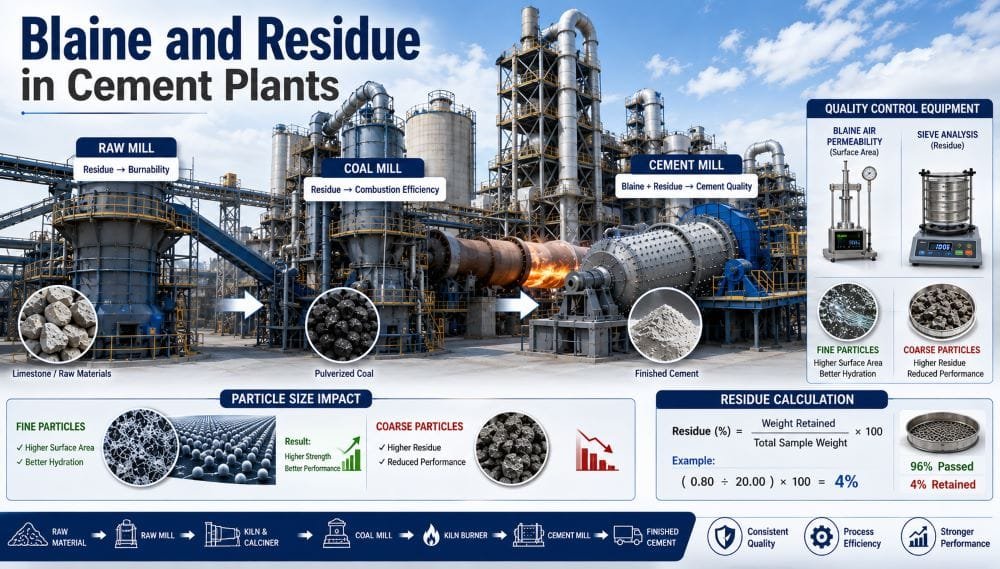
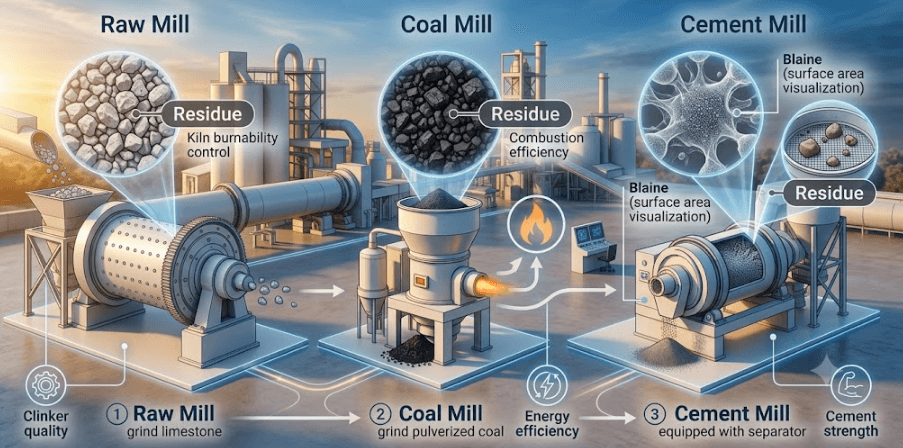
In the Raw Mill, the primary concern is producing a raw meal that burns efficiently in the kiln. Similarly, in the Coal Mill, the objective is to grind coal fine enough to ensure rapid and complete combustion. In both cases, Residue serves as the main control parameter because it indicates the amount of coarse particles that can adversely affect kiln performance and combustion efficiency.
The Cement Mill operates with a different objective. Here, the focus is on achieving the required cement strength and performance. Therefore, quality control relies on both Blaine and Residue. Blaine measures the total surface area available for hydration, while Residue indicates the proportion of coarse particles remaining after grinding. Together, these two parameters provide a more complete picture of cement fineness and particle size distribution.
A clear understanding of where and why these parameters are used enables process engineers to optimise grinding performance, improve kiln stability, reduce energy consumption, and consistently produce high-quality cement.
Understanding Fineness in Cement Manufacturing
In cement manufacturing, fineness refers to the particle size of materials after the grinding process. Although it may seem like a simple quality parameter, fineness has a significant influence on almost every stage of plant operation. The way a material is ground directly affects how it behaves in the next process, making fineness an important factor for both process stability and product quality. The impact of fineness can be seen in several areas, including:
- Grinding efficiency and mill performance
- Material reactivity during subsequent processes
- Heat transfer inside the pre-heater and kiln
- Coal combustion efficiency
- Raw meal burnability and clinker formation
- Cement hydration and strength development
- Overall energy and power consumption
It is important to understand that the optimum fineness is not the same for every grinding system. The purpose of grinding changes from one process to another.
For example, the Raw Mill is designed to produce a raw meal that can react efficiently inside the kiln, so controlling coarse particles is the primary objective. In the Coal Mill, the focus is on producing coal fine enough to achieve rapid and complete combustion. On the other hand, the Cement Mill aims to produce cement with the desired strength and performance, where both the overall surface area and particle size distribution become equally important. For this reason, cement plants do not rely on a single parameter to evaluate fineness. The monitoring method is selected according to the process requirement – Residue is primarily used in the Raw Mill and Coal Mill, while both Blaine and Residue are used in the Cement Mill to ensure consistent product quality and optimum grinding performance.changes.
What is Residue?
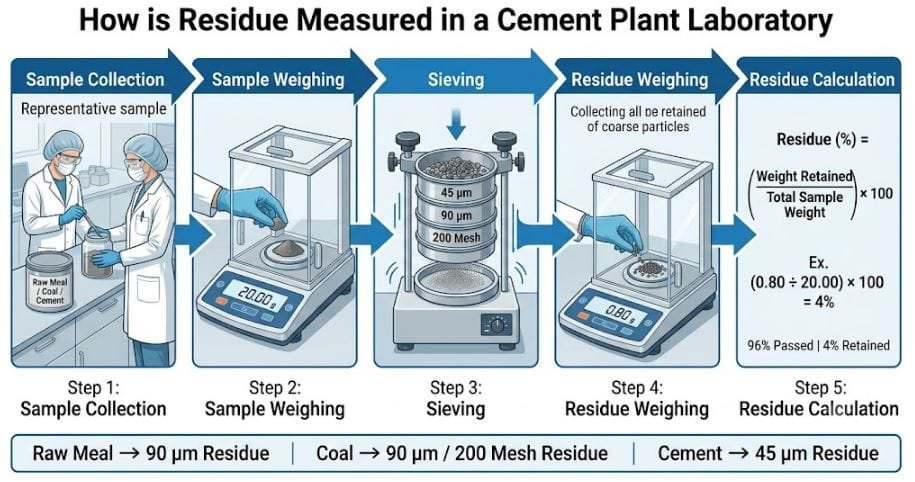
Residue is the percentage of material retained on a standard test sieve after the grinding process. In simple terms, it represents the amount of coarse particles that remain in the material. The higher the residue value, the greater the proportion of coarse particles, indicating that the material has not been ground to the desired fineness.
Residue is one of the most widely monitored quality parameters in cement plants because it provides a quick and reliable indication of grinding performance. However, the sieve size used for residue measurement varies depending on the process and the material being tested.
Typical residue measurements include:
- Raw Meal: Generally measured on a 90 µm sieve (some plants also monitor 212 µm residue based on process requirements).
- Pulverised Coal: Commonly measured on a 90 µm sieve or 200 mesh sieve to evaluate coal fineness for efficient combustion.
- Finished Cement: Usually measured on a 45 µm sieve, while some plants also monitor 90 µm residue depending on product specifications and quality standards.
What is Blaine?
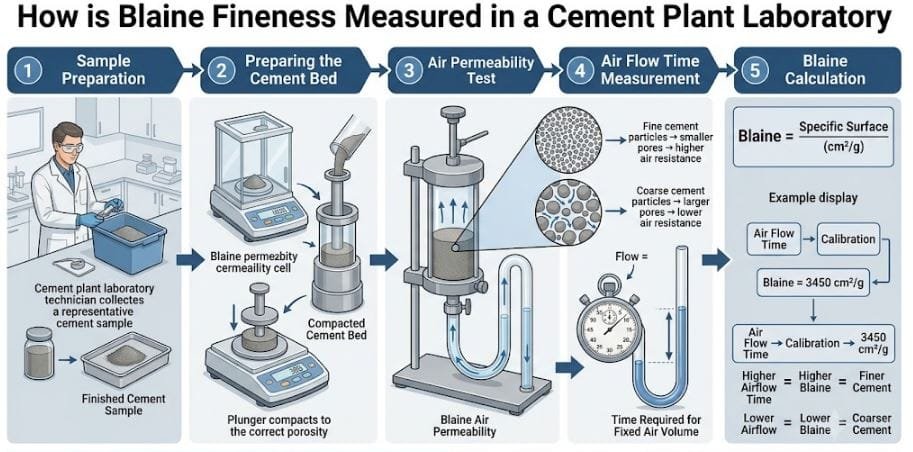
While Residue indicates the amount of coarse particles remaining after grinding, Blaine measures the total specific surface area of cement particles. In other words, it represents the total surface area available for the hydration reaction when cement comes into contact with water. The finer the cement particles, the greater their total surface area. As the surface area increases, more cement particles are exposed to water, allowing hydration to occur more rapidly. This is why Blaine is closely related to cement reactivity and early strength development.
Blaine is expressed as:
- cm²/g (square centimetres per gram) – commonly used in cement plants.
- m²/kg (square metres per kilogram) – SI unit.
Unlike Residue, Blaine is primarily used for finished cement because the performance of cement depends not only on the absence of coarse particles but also on the total surface area available for hydration.
However, it is important to understand that a higher Blaine value does not always mean better cement. Grinding cement excessively to achieve a very high Blaine increases grinding power consumption, reduces mill output, and may increase water demand in concrete. Therefore, every cement type has an optimum Blaine range that provides the desired strength without unnecessary energy consumption.
Why is Raw Meal Residue Important?
The primary objective of the Raw Mill is not simply to grind raw materials, it is to produce a raw meal with the right fineness for efficient clinker formation inside the kiln. This is why Raw Meal Residue is one of the most closely monitored quality parameters in every cement plant. After leaving the Raw Mill, the raw meal passes through the pre-heater, calciner, and rotary kiln, where limestone, clay, silica, iron ore, and other corrective materials undergo a series of physical and chemical reactions. These reactions ultimately form the major clinker minerals such as C₃S (Alite), C₂S (Belite), C₃A, and C₄AF.
For these reactions to occur efficiently, the raw meal particles must be fine enough to provide adequate contact between the different minerals. If the raw meal contains too many coarse particles, especially coarse limestone, complete calcination and clinker formation become more difficult. Some particles may not react fully during their residence time in the kiln, resulting in unstable burning conditions and inconsistent clinker quality.
What Happens When Raw Meal Residue is High?
Excessive Raw Meal Residue can lead to several operational problems, including:
- Poor Burnability: Coarse particles require more heat and longer residence time to complete the clinker-forming reactions.
- Higher Free Lime (f-CaO): Incomplete reactions leave uncombined lime in the clinker, making quality control more difficult.
- Increased Specific Heat Consumption (SHC): More fuel is required to achieve the desired clinker quality.
- Higher Coal Consumption: Additional thermal energy is needed to burn coarse raw meal effectively.
- Difficult Kiln Operation: Kiln control becomes less stable, increasing the likelihood of process fluctuations.
- Inconsistent Clinker Quality: Variations in clinker mineralogy can affect cement strength and overall product performance.
- Reduced Kiln Throughput: In severe cases, coarse raw meal can limit production because the kiln cannot process the material efficiently.
For this reason, experienced process engineers do not treat Raw Meal Residue as merely a laboratory result. It is an early process indicator that directly influences kiln stability, thermal efficiency, clinker quality, and overall plant operating cost. Maintaining residue within the plant’s target range helps ensure smoother kiln operation, lower fuel consumption, and more consistent clinker production.
Why is Coal Fineness Important?
In a cement plant, the Coal Mill is responsible for producing pulverised coal with the required fineness to ensure efficient combustion in the calciner and kiln burner. Unlike raw meal, which participates in chemical reactions, coal serves as the primary heat source for clinker production. Therefore, its particle size has a direct impact on flame stability, heat release, fuel efficiency, and overall kiln performance.
Coal combustion begins at the surface of each particle. The finer the coal particles, the larger the total surface area exposed to oxygen, allowing them to ignite quickly and burn more completely. Coarse coal particles, on the other hand, take longer to heat up and burn, delaying heat release inside the kiln system.
For this reason, Coal Residue is one of the most important quality control parameters monitored in the Coal Mill. It indicates the amount of coarse coal particles that may adversely affect combustion efficiency.
What Happens When Coal Residue is High?
When pulverised coal contains excessive coarse particles, several operational problems can occur:
- Longer Flame: Coarse particles continue burning further inside the kiln, increasing flame length.
- Delayed Combustion: Heat is released later than desired, affecting burning zone stability.
- Higher Unburnt Carbon: Some coarse particles may leave the kiln system before complete combustion.
- Increased CO Generation: Incomplete combustion can lead to higher carbon monoxide levels.
- Higher Specific Heat Consumption (SHC): More fuel is required to achieve the same clinker production.
- Unstable Kiln Operation: Flame fluctuations make it more difficult to maintain stable burning conditions.
- Lower Combustion Efficiency: A portion of the fuel energy is wasted due to incomplete burning.
Conversely, coal that is ground excessively fine is not always beneficial. Very fine coal increases Coal Mill power consumption, drying requirements and explosion risk, while offering limited additional combustion benefits beyond the optimum fineness. The objective is therefore not to produce the finest possible coal, but to maintain the optimum coal residue specified for the plant. Achieving this balance ensures rapid combustion, stable flame characteristics, efficient heat transfer, lower fuel consumption, and reliable kiln operations.
Cement Mill Blaine and Residue
Unlike Raw Meal and Coal grinding, finished cement requires much tighter control of particle size distribution because it directly affects the final product performance. The purpose of cement grinding is not only to achieve a finer product but also to maintain the right balance between strength development, mill productivity and energy consumption. For this reason, cement plants monitor both Blaine and Residue during Cement Mill operation. These two parameters provide different information about cement fineness and together help process engineers optimise grinding performance.
Why is Blaine Important?
Blaine represents the total specific surface area of cement particles available for hydration. When cement comes in contact with water, hydration reactions start from the particle surface. Therefore, a higher surface area generally results in faster reaction and quicker strength development. Higher Blaine generally provides:
- Faster hydration
- Higher early strength development
- Better cement reactivity
- Improved particle interaction during hydration
However, increasing Blaine beyond the required level is not always beneficial. Excessive grinding can reduce overall plant efficiency. Very high Blaine may lead to:
- Higher grinding power consumption
- Lower cement mill output
- Increased grinding media wear
- Higher production cost
- Increased water demand in concrete
Therefore, the objective is not to achieve the maximum possible Blaine but to maintain the optimum Blaine value required for the specific cement grade.
Why is Cement Residue Important?
While Blaine indicates the total surface area, Cement Residue indicates the amount of coarse particles remaining after grinding. It provides information about whether the grinding process and separator operation are producing the required particle size distribution. Higher Cement Residue means more coarse particles are present, which can negatively affect cement performance. High residue may result in:
- Lower early strength
- Slower hydration
- Poor particle size distribution
- Inconsistent cement quality
- Reduced cement reactivity
- Possible customer quality issues
On the other hand, achieving extremely low residue is also not always economical. Excessive grinding to reduce residue can cause:
- Higher specific power consumption
- Reduced mill productivity
- Increased wear rate of grinding components
- Higher manufacturing cost
The ideal condition is to maintain residue within the required range while achieving stable production and energy efficiency.
Blaine vs Residue: Why Both Parameters Are Important
Many engineers assume that Blaine and Residue represent the same measure of fineness. While both parameters are related to particle size, they provide different information about the grinding process. Blaine indicates the total surface area of the particles, whereas Residue indicates the quantity of coarse particles that remain after grinding. Both parameters are required to understand the complete particle size distribution and evaluate grinding performance effectively.
| Blaine | Residue |
|---|---|
| Measures the total surface area of cement particles | Measures the amount of coarse particles remaining after grinding |
| Determined using the air permeability test | Determined using sieve analysis |
| Mainly used for finished cement quality control | Used in Raw Mill, Coal Mill, and Cement Mill |
| Indicates hydration potential and cement reactivity | Indicates grinding efficiency and coarse particle content |
Both parameters complement each other and should always be evaluated together. A cement sample can achieve the required Blaine value but still contain excessive coarse particles, which may negatively affect strength development and overall cement performance.
Practical Example: Why Both Parameters Are Required
Consider two cement samples tested from a Cement Mill:
| Parameter | Cement A | Cement B |
|---|---|---|
| Blaine | 3400 cm²/g | 3400 cm²/g |
| Residue (45 µm) | 4% | 8% |
Both samples have the same Blaine value, meaning their total surface area is similar. However, Cement B contains a higher percentage of coarse particles. This difference in particle size distribution can result in:
- Lower early strength development
- Slower hydration
- Less uniform cement performance
- Variation in customer results
This example shows why relying only on Blaine can sometimes provide an incomplete understanding of cement quality. A complete evaluation requires both Blaine and Residue to ensure optimum grinding performance. In actual cement plant operation, the target is not to achieve the highest possible Blaine or the lowest possible residue. The objective is to maintain the optimum balance between:
- Cement fineness
- Strength requirements
- Mill production rate
- Specific power consumption
- Overall manufacturing cost
Comparison Across the Cement Plant
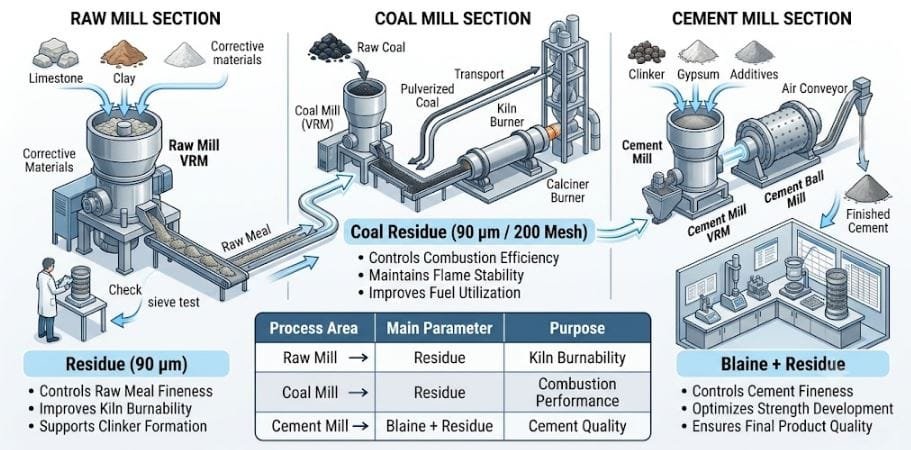
Different sections of the cement plant use different fineness control parameters depending on their process requirements.
| Department | Parameter Used | Why It Is Important |
|---|---|---|
| Raw Mill | Residue | Controls raw meal fineness, kiln burnability and clinker formation |
| Coal Mill | Residue | Controls coal combustion efficiency, flame stability and fuel utilisation |
| Cement Mill | Blaine + Residue | Controls cement fineness, strength development and final product quality |
The same parameter cannot be applied everywhere because each grinding circuit has a different purpose. Raw meal and coal grinding focus mainly on removing coarse particles, while cement grinding requires control of both surface area and particle size distribution.
Conclusion
Blaine and Residue are both important indicators of particle fineness in cement manufacturing, but their role changes depending on the process stage. Understanding the difference between these parameters and applying the right control strategy in each section is essential for efficient plant operation.
In the Raw Mill, Residue is a critical parameter because raw meal fineness directly influences kiln burnability, clinker formation, free lime control, and overall thermal efficiency. Maintaining the correct raw meal residue helps ensure stable kiln operation and consistent clinker quality. In the Coal Mill, Residue plays an important role in controlling coal combustion characteristics. Optimum coal fineness ensures rapid ignition, complete combustion, stable flame conditions, and efficient utilisation of fuel energy inside the kiln and calciner.
In the Cement Mill, the approach is different. Both Blaine and Residue are monitored because finished cement performance depends on multiple factors, including total surface area available for hydration and the amount of coarse particles remaining after grinding. Maintaining the right balance between these parameters helps achieve the required strength, quality consistency, and grinding efficiency. For process engineers, understanding where each parameter is applied and how it affects plant performance is essential for making effective operational decisions. Proper control of Raw Meal Residue, Coal Residue, and Cement Mill Blaine and Residue helps optimise kiln stability, reduce energy consumption, improve mill efficiency, and produce consistent high-quality cement. Ultimately, successful fineness control is not about achieving the highest Blaine or the lowest Residue. It is about finding the optimum balance between process requirements, product quality, production efficiency, and energy consumption.