Coal Saving, Cost Reduction & Profitability Calculations in Cement Plants
Table of Contents
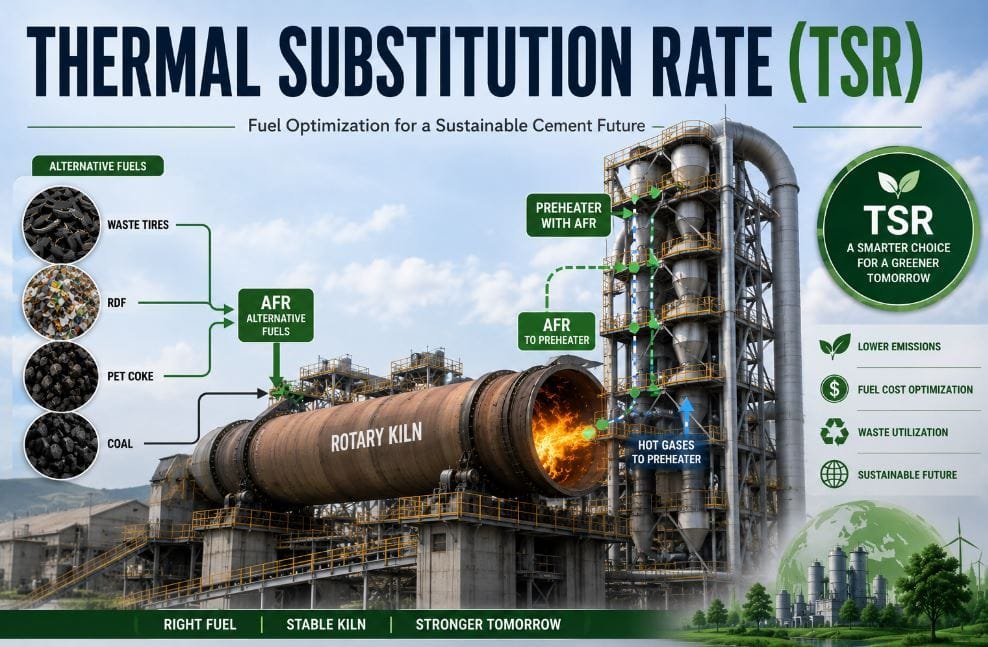
One of the first questions asked after increasing the Thermal Substitution Rate (TSR) is:
“How much coal are we actually saving?”
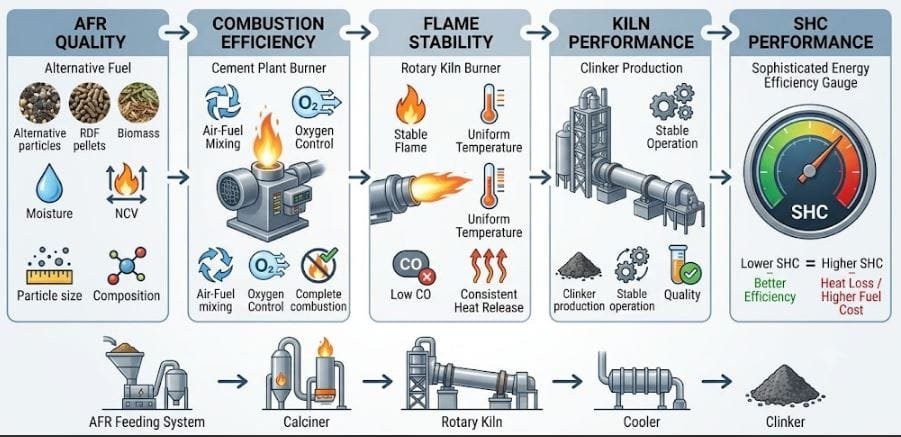
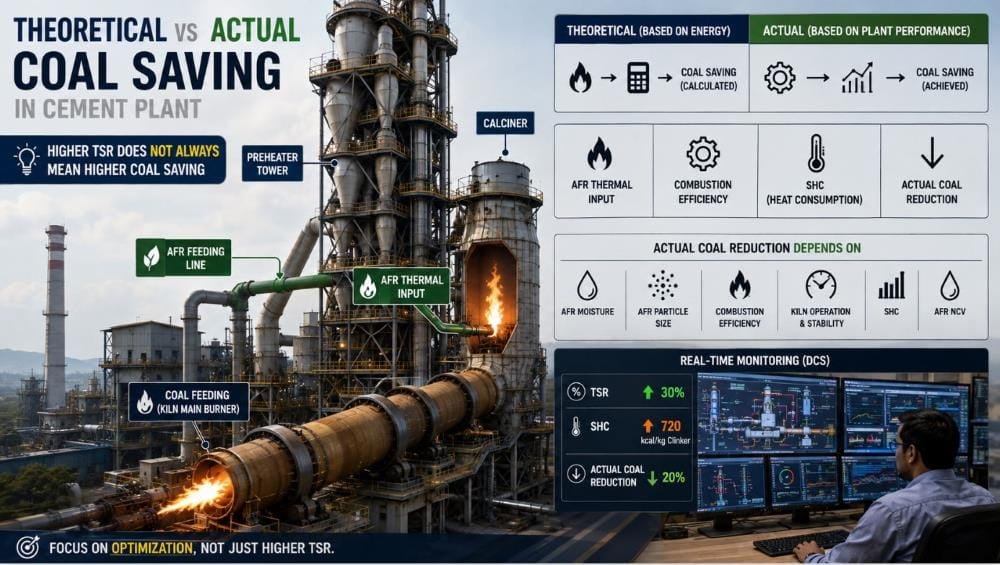
Many people believe that a higher TSR automatically leads to lower coal consumption and higher profitability. In reality, the answer is not that simple. The actual coal saving depends on several operating factors, including AFR quality, moisture content, Net Calorific Value (NCV), combustion efficiency, Specific Heat Consumption (SHC) and overall kiln stability. Even two cement plants operating at the same TSR may achieve completely different coal savings because their process conditions are different. A plant with stable combustion and lower SHC can often save more coal than a plant operating at a higher TSR with unstable kiln conditions.
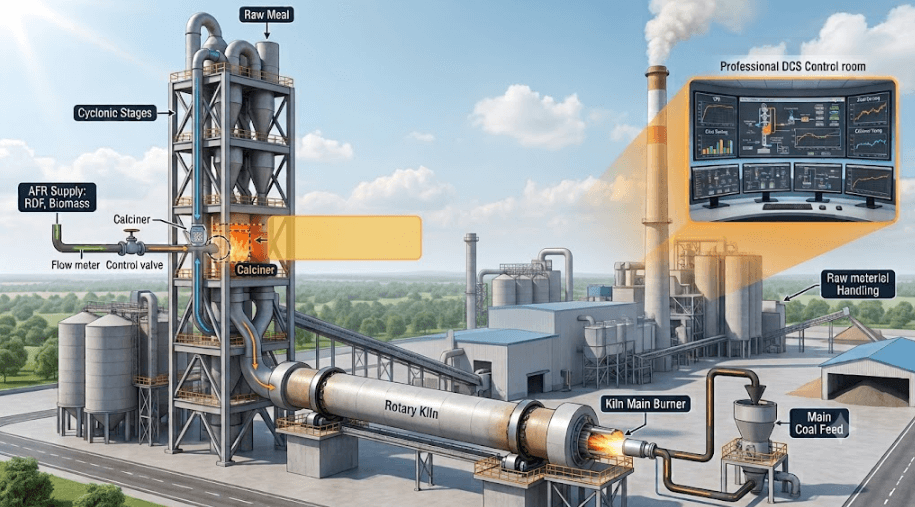
This article explains how coal saving is calculated, the key factors that influence actual coal replacement, and why increasing TSR does not always guarantee higher profitability.
Understanding Coal Saving
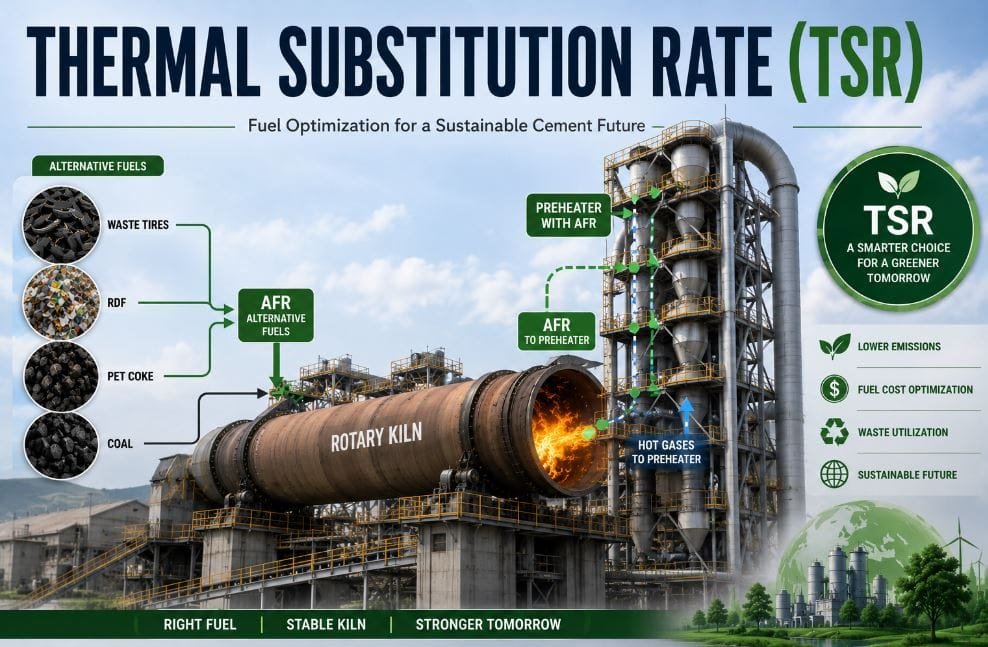
Coal saving refers to the reduction in conventional fossil fuel consumption by replacing a portion of the kiln’s thermal energy requirement with Alternative Fuels and Raw Materials (AFR). The primary objective of increasing TSR is to reduce coal usage while maintaining stable kiln operation and clinker quality. It is important to understand that coal is replaced based on its heat energy contribution, not on the amount of fuel fed into the kiln.
For example, feeding more AFR does not always result in greater coal saving because different fuels have different calorific values and combustion characteristics. The actual amount of coal that can be replaced depends on several operating parameters, including:
- Net Calorific Value (NCV) of the AFR
- AFR moisture content
- AFR material type
- Particle size distribution
- Combustion efficiency
- Production rate
- Specific Heat Consumption (SHC)
- Overall kiln thermal efficiency
For this reason, coal saving should always be evaluated based on the useful thermal energy supplied by AFR rather than the quantity of fuel being fed.
How Does Coal Saving Work?
Coal saving occurs when AFR supply a portion of the kiln’s thermal energy requirement, reducing the amount of coal needed for clinker production. As the heat contribution from AFR increases, the demand for conventional fossil fuels decreases. The basic principle can be summarised as:
Higher TSR → Higher AFR Heat Contribution → Lower Coal Requirement → Reduced Coal Consumption
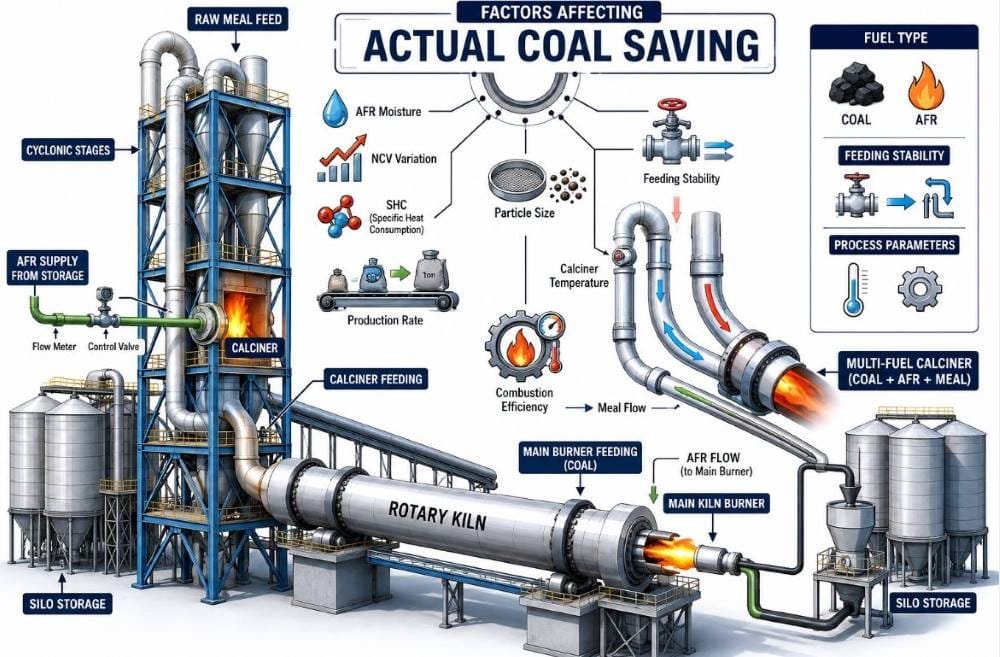
However, this relationship is not always straightforward. The actual amount of coal saved depends on how efficiently the AFR burns inside the calciner and kiln. Factors such as AFR moisture, NCV, particle size, material type, combustion efficiency and feeding stability all influence the effective heat released during combustion. For this reason, higher TSR does not always result in proportional coal saving. Efficient combustion and stable kiln operation are essential to achieve the maximum benefit from alternative fuel utilisation.
Coal Saving Formula
The amount of coal saved can be estimated by comparing the thermal energy supplied by AFR with the energy that would otherwise be provided by coal.
Formula
Coal Saved (kg/hr) = AFR Heat Input (kcal/hr) ÷ Coal NCV (kcal/kg)
Where:
- AFR Heat Input = Total thermal energy supplied by alternative fuels (kcal/hr)
- Coal NCV = Net Calorific Value of coal (kcal/kg)
This formula provides the theoretical coal replacement under stable operating conditions. However, the actual coal saving may vary depending on factors such as AFR moisture, NCV, combustion efficiency, kiln stability and production rate. Therefore, theoretical coal saving should always be verified against actual plant performance
Practical TSR and Coal Saving Calculation
The following example shows how to calculate the Thermal Substitution Rate (TSR) first and then estimate the corresponding coal saving.
Assumed Data
| Fuel | Feed Rate (TPH) | NCV (kcal/kg) | Heat Input (Gcal/hr) |
|---|---|---|---|
| Coal | 12.5 | 6,200 | 77.50 |
| Pet Coke | 3.0 | 8,100 | 24.30 |
| RDF | 4.0 | 3,200 | 12.80 |
| Waste Tyres | 1.5 | 6,800 | 10.20 |
Step 1: Calculate Total Heat Input
Total Heat Input = 77.50 + 24.30 + 12.80 + 10.20
= 124.80 Gcal/hr
Step 2: Calculate AFR Heat Input
AFR Heat Input = RDF + Waste Tyres
= 12.80 + 10.20
= 23.00 Gcal/hr
Step 3: Calculate TSR
TSR (%) = (AFR Heat Input ÷ Total Heat Input) × 100
= (23.00 ÷ 124.80) × 100
= 18.43%
Step 4: Calculate Coal Saving
Convert AFR heat input into kcal/hr:
23.00 Gcal/hr = 23,000,000 kcal/hr
Now calculate the equivalent coal replacement:
Coal Saved (kg/hr) = 23,000,000 ÷ 6,200
= 3,710 kg/hr
Coal Saving = 3.71 TPH
Step 5: Daily, Monthly and Annual Coal Saving
- Daily Coal Saving = 3.71 × 24 = 89.04 Ton/Day
- Monthly Coal Saving = 89.04 × 30 = 2,671 Ton/Month
- Annual Coal Saving = 2,671 × 12 = 32,052 Ton/Year
Note: These values represent the theoretical coal saving based on the thermal energy supplied by AFR. Actual coal saving may be lower depending on AFR moisture, NCV, combustion efficiency, kiln stability, SHC and production rate.
Coal Cost Saving
The financial benefit of coal saving can be estimated by multiplying the amount of coal replaced with the market price of coal. This provides an estimate of the potential fuel cost saving achieved through AFR utilisation.
Assumed Data
| Parameter | Value |
|---|---|
| Coal Saving | 89.04 Ton/Day |
| Coal Price | US$150/Ton |
Step 1: Daily Coal Cost Saving
89.04 × $150 = $13,356/Day
Step 2: Monthly Coal Cost Saving
$13,356 × 30 = $400,680/Month
Step 3: Annual Coal Cost Saving
$400,680 × 12 = $4,808,160/Year
These values represent the potential fuel cost saving based on theoretical coal replacement. However, they should not be considered the actual economic benefit.
The actual profitability of higher TSR depends on several additional factors, including AFR procurement cost, transportation, pre-processing, maintenance, power consumption, SHC and production stability. Therefore, coal cost saving should always be evaluated together with the overall operating cost of the kiln system.
Theoretical vs Actual Coal Saving in AFR Utilisation
Many cement plants estimate coal saving from Alternative Fuel (AFR) based only on the thermal energy supplied by AFR. This calculation gives the theoretical coal replacement potential, assuming that the entire AFR heat input is effectively converted into useful energy inside the kiln system. However, in actual plant operation, the achieved coal saving can be lower than the theoretical value. The reason is that the effective heat contribution of AFR depends on several operational factors such as combustion efficiency, fuel quality, and kiln stability.
Factors Affecting Actual Coal Saving
High AFR Moisture
Moisture present in AFR consumes part of the available heat for evaporation before combustion starts. High moisture fuel reduces the net thermal energy available for clinker production.
Low NCV of AFR
Theoretical calculations are highly dependent on AFR Net Calorific Value (NCV). If the actual NCV is lower than assumed, more AFR quantity is required to achieve the same thermal substitution.
Large or Non-Uniform Particle Size
AFR with inconsistent particle size may not burn completely within the available residence time. Poor fuel preparation can lead to incomplete combustion and reduced heat recovery.
Poor Combustion Efficiency
Stable combustion requires proper fuel distribution, sufficient oxygen availability, and good mixing. Any reduction in combustion efficiency directly impacts the actual coal replacement.
Calciner Temperature Fluctuations
Unstable AFR feeding can create temperature variations in the calciner. To maintain clinker quality and kiln stability, operators may need to increase conventional fuel input, reducing the expected coal saving.
Increased CO Generation
Higher CO levels indicate incomplete combustion and represent a loss of chemical energy. Excess CO also affects kiln operation and emission control.
Production Losses and Higher SHC
If AFR usage results in reduced kiln throughput, operational disturbances, or increased Specific Heat Consumption (SHC), the overall fuel benefit can reduce significantly.
The Importance of Measuring Actual Fuel Saving
AFR success should not be evaluated only by Thermal Substitution Rate (TSR) or theoretical heat replacement. The real benefit comes from achieving a reduction in actual coal consumption while maintaining stable kiln operation and clinker quality. A practical evaluation should compare:
Theoretical Coal Saving = AFR Heat Input Based Calculation
Actual Coal Saving = Theoretical Saving – Process and Operational Losses
A well-optimized AFR system focusses not only on increasing TSR but also on maintaining combustion efficiency, stable calciner operation, and lower overall thermal energy consumption.
Hidden Costs of Higher TSR
Higher Thermal Substitution Rate (TSR) helps reduce fossil fuel consumption, but higher TSR does not always mean higher savings. If the AFR system and process are not properly optimised, additional operating costs can reduce the expected benefit.
Common Hidden Costs
- AFR procurement and transportation cost – Low-cost fuels may require additional sourcing and logistics expenses.
- Pre-processing cost – Shredding, drying, blending and quality control add operational costs.
- Feeding system maintenance – Higher AFR usage can increase wear, blockages and maintenance requirements.
- Higher ID fan power – Increased moisture and gas volume may increase draft requirements.
- Additional burner and equipment maintenance – Fuel impurities can affect combustion stability and build-up formation.
- Higher SHC and production losses – Poor AFR quality or unstable feeding can increase thermal consumption and reduce kiln performance.
Therefore, TSR improvement should always be evaluated based on net operating cost reduction, not only coal replacement percentage.
Real AFR success = Higher TSR + Stable Operation + Lower Total Fuel Cost.
TSR vs Profitability
Higher Thermal Substitution Rate (TSR) does not always guarantee higher profitability. The economic benefit depends on how efficiently the plant converts AFR usage into actual fuel cost savings while maintaining stable operation.
Scenario 1: Optimum TSR
TSR = 20%
- Stable kiln operation
- Controlled Specific Heat Consumption (SHC)
- Lower maintenance requirement
- No impact on production
Result: Higher overall profitability
Scenario 2: Excessive TSR Without Optimisation
TSR = 40%
- Increased SHC
- Production instability
- Higher maintenance cost
- Increased power consumption
Result: Lower profitability despite higher AFR usage
The objective of AFR implementation should not be achieving the maximum possible TSR, but achieving the most economical TSR that provides fuel cost reduction without affecting kiln stability, clinker quality or production performance.
Parameters Affecting Coal Saving
Process engineers should continuously monitor the following parameters to evaluate actual coal saving:
- AFR moisture and NCV
- AFR type and particle size
- Combustion efficiency
- Kiln O₂ level
- Calciner temperature
- CO level
- Kiln draft
- Production rate
- Coal consumption
- Clinker quality
- Power consumption
In real plant conditions, these parameters do not remain constant and continuous optimisation is required. Maintaining stable combustion, controlling SHC and evaluating TSR along with operating cost are key to achieving actual coal saving.
Conclusion
Coal saving is an important benefit of increasing Thermal Substitution Rate (TSR), but in actual plant operation, the result depends on much more than TSR value alone. AFR quality variation, moisture, NCV, particle size, combustion behaviour, SHC, and kiln stability directly influence the actual coal reduction achieved.
A plant achieving very high TSR but facing higher SHC, unstable kiln operation, or production losses may not get the expected economic benefit. On the other hand, a moderate TSR with stable AFR feeding, efficient combustion, and consistent clinker production can deliver better overall savings.
Therefore, the focus should not be only on achieving the highest TSR, but on maintaining an economical TSR that provides real coal saving, stable operation, and sustainable cost reduction for the plant.Baghouse Optimisation in Cement Plants (Part-1)