Table of Contents
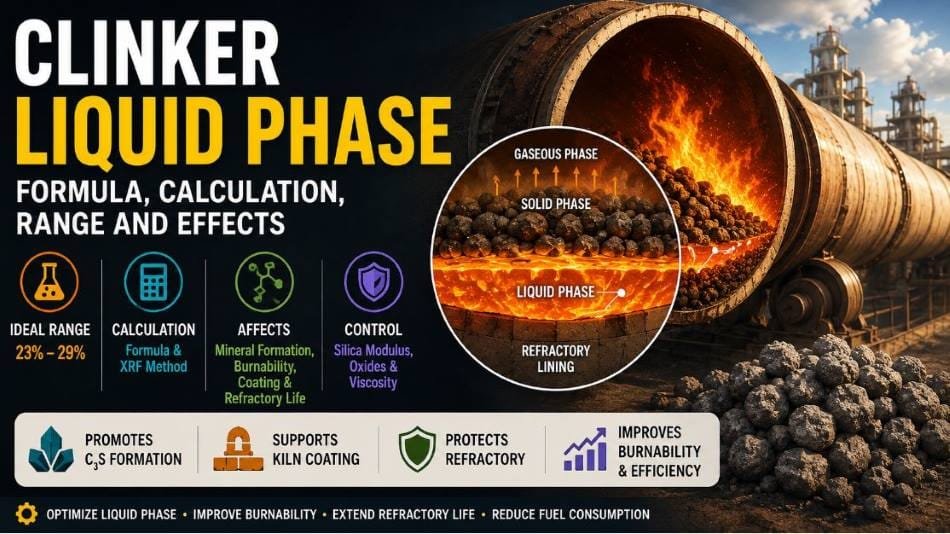
The liquid phase of the cement process, called clinker liquid phase, is one of the important quality control parameters in cement production. It is a description of the percentage of estimate of the liquid in the burning zone during the clinkerisation process. This liquid facilitates the mineral reactions, promotes the formation of nodules of clinker and aids the conversion of belite (C2S) and free lime to alite (C3S). But increasing the amount of liquid is not always better. An improper level of liquid phase may cause hard burning, formation of porous clinker, instability of coating, damage of the refractory lining, and increase in fuel consumption. The real goal is to keep enough liquid to ensure the clinker mineral formation is efficient without harming the lining of the kiln.
- Liquid phase accelerates calcium diffusion and supports C3S formation during clinkerisation.
- Most kiln systems target liquid phase near 23% to 29% for balanced burning and coating.
- Alumina, iron oxide, MgO, alkalis, and SO3 influence calculated liquid phase.
- Both low and excessive liquid phase can harm clinker quality, coating stability, and refractory life.
What Is the Liquid Phase in Cement Clinker?
In the kiln burning zone, raw mix components react at high temperature to form clinker minerals. Some constituents remain solid, while part of the material forms a molten liquid phase. This melt acts as a transport medium for ions, particularly calcium ions, allowing reactions to proceed far more efficiently than they would through solid-to-solid contact alone. Without sufficient liquid phase, diffusion toward C2S is very slow. As a result, the conversion of free lime and C2S into C3S becomes difficult within the kiln residence time.
In practical terms, clinker liquid phase affects:
- Nodulisation and clinker-ball formation
- Burnability of the raw mix
- Formation of C3S and other clinker minerals
- Kiln coating stability
- Refractory life and risk of lining infiltration
- Clinker density, porosity, and grindability
Why Liquid Phase Is Important During Clinkerisation
It speeds up clinker mineral reactions
Solid-state reactions are comparatively slow and need a much higher temperature to progress effectively. The appearance of a liquid phase creates a solid-liquid reaction environment, which improves diffusion and shortens the time required for clinker mineral development. This is especially important for C3S formation. Adequate liquid allows calcium oxide to react more readily with C2S, reducing the likelihood of excessive free lime in finished clinker.
It lowers the temperature required for melting reactions
Fluxing oxides reduce the temperature at which the clinker system begins to form liquid. Alumina, iron oxide, magnesia, and alkalis influence the melting behaviour of the raw mix. A representative progression shows how added components can reduce the liquid-formation temperature:

In this notation, C represents CaO, S represents SiO2, A represents Al2O3, F represents Fe2O3, M represents MgO, and N represents alkali contribution.
It supports stable kiln coating
A controlled liquid phase helps clinker adhere and form a protective coating over the kiln refractory. This coating shields the refractory lining from the burning-zone environment. If liquid becomes excessive or too fluid, it can infiltrate the brick instead of forming a stable coating, increasing the risk of refractory deterioration and spalling.
Typical Clinker Liquid Phase Range
Clinker liquid phase is generally controlled within a narrow operating range. A common working range is approximately 23% to 29%. The exact target must be selected for the kiln, raw materials, fuel, coating condition, and clinker quality requirements. A value that is acceptable in one plant may not deliver the same coating behavior or burnability in another.
How to Calculate Clinker Liquid Phase
Liquid phase is estimated from clinker chemical analysis. The calculation uses oxide percentages, usually from XRF analysis, and applies a formula suited to the relevant temperature and alumina modulus condition.
Alumina modulus, or AM, is calculated as:
AM = Al2O3 / Fe2O3
Before using any liquid-phase formula, confirm that all oxide inputs are reported on a consistent clinker-analysis basis.

Alternative formula based on clinker compounds
A second estimate can be made when clinker compound values are available:
% Liquid = 1.13 C3A + 1.35 C4AF + MgO + Alkalis
This approach highlights the strong influence of C3A, C4AF, magnesia, and alkalis on liquid-phase behaviour. It should be used consistently with the plant’s established calculation method and reporting practice.
How to Calculate Liquid Phase From an XRF Report
- Collect the clinker chemistry: Obtain Al2O3, Fe2O3, MgO, K2O, Na2O, and SO3 percentages from the clinker analysis.
- Calculate the alumina modulus: Divide Al2O3 by Fe2O3.
- Select the appropriate equation: Match the formula to the selected temperature and AM condition.
- Insert oxide percentages: Use the values exactly as percentages, not as fractions.
- Compare with the operating target: Assess the result alongside coating condition, clinker appearance, free lime, burning-zone temperature, and fuel consumption.
- Track the trend: A single result is useful, but repeated variation is more important for process control.
How Major Oxides Affect Clinker Liquid Phase
Alumina, Al2O3 – Alumina acts as a fluxing component and substantially lowers the liquid-formation temperature. It contributes to the liquid phase and affects alumina modulus.
Iron oxide, Fe2O3 – Iron oxide is also a major fluxing oxide. In combination with alumina, it reduces the melting temperature of the clinker system and supports liquid formation.
Magnesia, MgO – MgO is included in liquid-phase estimates, but it must be controlled. MgO itself has a very high melting point and only a limited amount can be incorporated during clinker formation. Excess MgO can contribute to cement unsoundness, so increasing MgO simply to influence liquid phase is not an appropriate control strategy.
Alkalis, K2O and Na2O – Alkalis influence the melting behavior and viscosity of the clinker liquid. They are included in liquid-phase calculations because even comparatively small changes can affect burnability, coating, and refractory exposure.
Sulphur trioxide, SO3 – SO3 is another oxide included in the estimation formulas. Its effect should be considered together with alkalis and the full clinker chemistry rather than in isolation.
Liquid Phase, Viscosity, and Refractory Life
Liquid percentage alone does not fully describe kiln behaviour. The viscosity of the liquid also matters. Alumina, MgO, K2O, and Na2O influence viscosity, which in turn affects ion diffusion, C3S formation, coating behavior, and refractory exposure. A suitable viscosity supports diffusion in the burning zone. But a liquid that is excessively fluid can move into the refractory lining more readily. Higher-than-normal temperatures can improve clinkering, yet they may also increase lining risk when low-viscosity liquid penetrates the refractory and compromises its service life. For this reason, liquid phase should never be managed as an isolated laboratory number. It is a kiln-control indicator that must be interpreted with coating condition and thermal operation.
Effects of High Clinker Liquid Phase
Higher liquid content can make clinker easier to burn because reactions occur more readily. It can also help form denser clinker and may support coating when kept in the correct operating window. When liquid phase rises too high, the risks increase:
- Clinker can become overly dense or hard.
- Grinding can become more difficult.
- Liquid can infiltrate refractory brick and shorten lining life.
- Coating may become unstable rather than protective.
- Excessively fluid clinker can impair proper coating formation.
High liquid phase is therefore not a universal solution for poor burnability. It may solve one operating problem while creating refractory and coating problems elsewhere.
Effects of Low Clinker Liquid Phase
Low liquid phase restricts the solid-liquid reaction mechanism needed for efficient clinkerisation. The kiln may then require a higher thermal load and more fuel to achieve the required mineral formation. Common consequences of insufficient liquid include:
- Hard burning and increased fuel consumption
- Porous clinker
- More difficult C3S formation
- Higher C2S and reduced C3S formation
- Higher free lime and potential cement unsoundness
- Weak or insufficient kiln coating
- Greater shell radiation and refractory deterioration risk
Liquid-phase values in the low twenties or below the plant’s preferred band warrant close attention, especially when free lime, thermal load, clinker texture, or coating condition is also unfavourable.
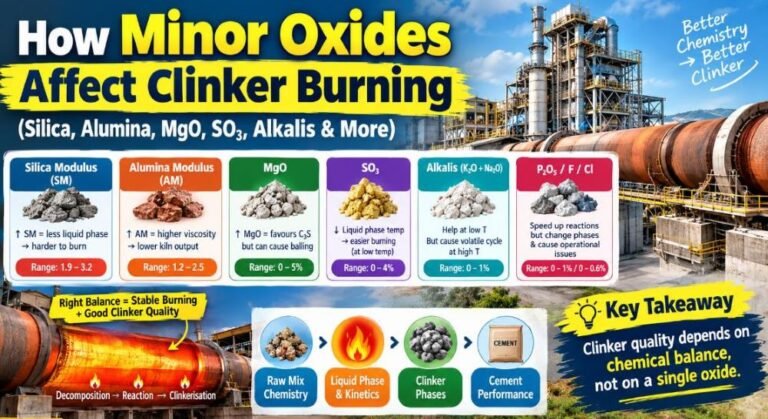
How Silica Modulus Affects Liquid Phase and Burnability
Silica modulus, also called silica ratio, is another important clinker-control relationship:
SM = SiO2 / (Al2O3 + Fe2O3)
A typical silica modulus range is approximately 2.1 to 2.7. It is an indirect guide to the balance between solids and liquid in clinker formation.
Low silica modulus – When SM moves nearer to 2.0, liquid phase tends to increase. This can improve clinker burnability, assist coating formation, reduce dust, and support cooler efficiency. If SM becomes too low, however, clinker balls can become excessively large and liquid-related operating problems may appear.
High silica modulus – When SM approaches 3.0, liquid phase tends to be lower. Burning becomes harder, fuel demand rises, coating formation is more difficult, and radiation from the kiln shell can increase. High SM can also be associated with more C2S, less C3S, higher free lime, and poorer cement-setting and hardening behaviour.
Common Mistakes When Controlling Clinker Liquid Phase
- Using one formula regardless of temperature: Liquid-phase estimates are temperature dependent.
- Ignoring alumina modulus: The AM condition determines which 1338°C calculation is appropriate.
- Focusing only on the percentage: Viscosity, coating condition, refractory condition, and kiln thermal load are equally important.
- Raising fluxing oxides without considering cement quality: MgO, alkalis, and other oxides can introduce quality and operational risks when uncontrolled.
- Judging performance from one result: Monitor the trend in routine quality and production reports.
- Confusing easy burning with safe operation: A liquid-rich kiln can burn efficiently while exposing refractory lining to greater damage.
Practical Checklist for Plant Quality Control
- Review clinker Al2O3, Fe2O3, MgO, K2O, Na2O, and SO3 results regularly.
- Calculate alumina modulus before selecting a liquid-phase formula.
- Use a consistent calculation temperature for trend comparison.
- Track liquid phase with free lime, C3S, C2S, fuel use, clinker size, and clinker hardness.
- Inspect kiln coating and refractory condition when liquid phase deviates from target.
- Review silica modulus when changes in burnability or coating are observed.
- Avoid corrective changes based on one parameter alone.
Key Takeaway
The clinker liquid phase is the chemical and operational bridge between raw mix composition and kiln performance. A controlled amount of liquid improves diffusion, mineral development, nodulisation, and burnability. Too little liquid creates hard burning and porous clinker. Too much liquid can destabilise coating and damage refractory lining. The most effective control approach is to calculate liquid phase from clinker chemistry, monitor trends continuously, and interpret the result with kiln coating, viscosity, mineralogy, free lime, and thermal performance.
Frequently Asked Questions
What is the ideal liquid phase in clinker?
A commonly used operating range is about 23% to 29%. Some references identify 22% to 30% as a limiting range and 25% to 29% as a preferred range. The practical target depends on the kiln and raw mix.
Why is liquid phase needed for C3S formation?
The liquid phase improves ion diffusion between reactants. This allows calcium oxide to react more efficiently with C2S and form C3S within kiln operating time.
Which oxides increase clinker liquid phase?
Al2O3, Fe2O3, MgO, K2O, Na2O, and SO3 are included in the liquid-phase estimation formulas and influence liquid formation or viscosity.
What happens if clinker liquid phase is too low?
Low liquid phase can cause hard burning, higher fuel use, porous clinker, weak coating, higher free lime, and difficulty forming sufficient C3S.
Does more liquid phase always improve clinker burnability?
No. While higher liquid content can make burning easier, excessive or low-viscosity liquid can damage refractory lining and prevent stable protective coating from forming.
Reference: Clinker liquid phase importance & how to calculate


One thought on “Clinker Liquid Phase: Importance, Calculation Formulas and Effects on Kiln Operation”